The de Ecouis Family of Middleton Mount: Norman Conquest, the Scales Dynasty, and the Lost Castles of Norfolk
– 16 min read


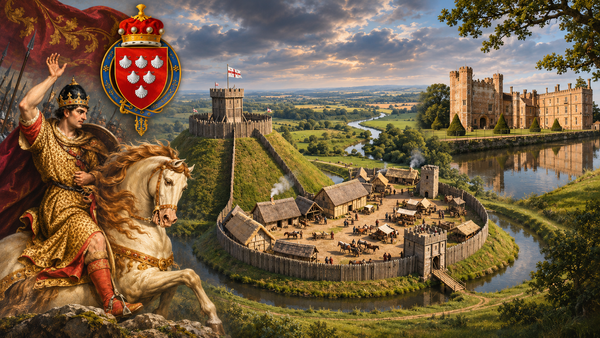
Rising above the Norfolk countryside near King's Lynn stands one of the most remarkable surviving earthworks of the Norman Conquest. Known as Middleton Mount, this imposing mound is all that remains above ground of a medieval motte-and-bailey castle, a fortress that once symbolised the authority of England's new Norman ruling class.
Today the site is peaceful, its steep grassy slopes and surrounding earthworks offering little immediate indication of the political upheaval that brought it into existence. Yet beneath the mound lie traces of an earlier Anglo-Saxon settlement, while its medieval history connects the village of Middleton with powerful landowning families, the Norman Conquest, the rise of the Scales dynasty, and the turbulent struggles of the Wars of the Roses.
At the centre of this story stands William de Ecouis, sometimes rendered as William d'Acouis, a Norman landholder whose estates were recorded in the Domesday Book of 1086. His ownership of land at Middleton links him directly to the remarkable redistribution of English property that followed William the Conqueror's victory at the Battle of Hastings.
The story would eventually extend far beyond William de Ecouis himself. Over the following centuries, different Middleton manors became associated with the de Clare, de Montfort, de Lisewis and de Scales families. Through marriage, inheritance and political fortune, these estates later passed into the world of the Woodvilles, Howards and de Veres, connecting an apparently modest Norfolk village with some of the most influential families in medieval England.
Middleton Mount represents an extraordinary point of contact between these histories. Its surviving earthworks reveal the military and administrative world of the early Norman aristocracy, while the later Middleton Castle, also known as Middleton Towers, preserves the ambitions of a different generation of noblemen almost four centuries later.
The story begins in 1066, when William, Duke of Normandy, invaded England and defeated King Harold Godwinson at the Battle of Hastings. The conquest transformed the kingdom's political structure, replacing much of the Anglo-Saxon landowning elite with followers of the new Norman king.
William's victory was followed by a vast redistribution of estates. Lands formerly associated with English nobles, church institutions and local landholders were reorganised under a network of tenants-in-chief who held property directly from the Crown.
These men formed the foundations of the Anglo-Norman aristocracy. Some received enormous collections of estates scattered across several counties, while others exercised authority through smaller manors and dependent holdings. Their responsibilities included collecting revenue, maintaining order, supplying military service and supporting the king's administration.
Among the men who benefited from this transformation was William de Ecouis, whose name suggests a connection with the Norman locality of Écouis. His precise ancestry and activities before the conquest are not securely documented, but his position in the Domesday survey demonstrates that he became a significant landholder in the new kingdom.
By 1086, William de Ecouis possessed extensive holdings across England. The Domesday Book associates him with estates in Norfolk, Suffolk, Herefordshire and Dorset, among other regions. His possessions included agricultural manors, woodland, mills and resources that generated income for their lord.
Like many Norman tenants-in-chief, his wealth was measured not in coins stored within a treasury but in rights over land, agricultural production, labour and the obligations of dependent tenants.
One of William's recorded holdings lay at Middleton in Norfolk, where he appears as both tenant-in-chief and lord of estates formerly associated with Anglo-Saxon landholders.
The Domesday survey preserves an unusually detailed glimpse of these properties. One Middleton holding under William included four villagers, six smallholders and four enslaved people, together with ploughland, thirty acres of meadow, a mill, a fishery and eight salt-houses.
The manor was valued at seven pounds annually in 1086, compared with five pounds in 1066. Such figures provide evidence of the estate's economic importance, although medieval land valuations cannot be directly converted into modern monetary values.
The salt-houses are particularly revealing. Medieval Norfolk was a landscape of marshes, waterways and coastal inlets, and salt production formed an important part of the regional economy. Salt was essential for preserving food, supporting livestock and supplying markets, making control of salt-producing land a valuable source of income.
Middleton's location near the lower-lying landscapes west of the village placed it within a network of agricultural estates and waterways that had already supported communities for centuries.
The Domesday Book also records other landholding interests at Middleton, including estates associated with Count Alan of Brittany, the abbey of Bury St Edmunds and Hugh de Montfort. The village was therefore not the exclusive possession of a single Norman family. Instead, it was divided among different manors, each with its own history of lordship and inheritance.
This distinction is particularly important when tracing the later castles and noble families of Middleton. The history of one manor cannot automatically be treated as the history of every estate within the parish.
Explore the House of de Montfort
It was within this complex landscape of early Norman lordship that Middleton Mount emerged.
The castle followed the motte-and-bailey design that became one of the defining features of the Norman Conquest. Such fortifications could be constructed relatively quickly and provided a powerful means of establishing military control over newly acquired territory.
The motte consisted of a substantial artificial mound, usually formed from earth excavated from the surrounding ditch. Its summit supported a timber tower or fortified residence, often protected by a wooden palisade.
Beside the motte stood the bailey, an enclosed area that might contain stables, workshops, stores, living quarters and administrative buildings. Together, these elements provided accommodation for the lord's household and retainers while creating a defensible centre from which the surrounding estates could be governed.
At Middleton, the surviving motte is particularly impressive. Historic England records a mound approximately forty-five metres in diameter and ten metres above the present surrounding ground level, encircled by a ditch approximately eight metres wide.
The surrounding earthworks and the depth of the original defences would once have made the fortification appear even more imposing. Today, visitors can still appreciate the extraordinary labour required to create such a structure using medieval tools and manual labour.
At the summit is a comparatively small platform, approximately nine metres across, where a timber tower would once have stood. From this elevated position, the occupants could survey the lower ground extending to the west, north and southwest.
To the east lay the bailey, a defended enclosure whose buried boundaries have been identified through excavation and archaeological survey. Its internal area measured approximately fifty-eight by thirty-six metres, providing space for the domestic and practical activities of a medieval fortified residence.
Although the surviving earthworks suggest a classic Norman castle, the precise date of construction remains uncertain.
The fortress may have been built soon after the conquest, during the period when newly established Norman lords were consolidating their possessions. Its association with the manor held by William de Ecouis makes his period of lordship an important part of the site's historical context.
However, there is no surviving charter or contemporary account definitively identifying William as the individual who ordered the castle's construction.
Archaeological evidence also allows for a somewhat later date. Pottery recovered from the site indicates occupation during the first half of the twelfth century, and Historic England notes that the castle might have been constructed during the civil war between King Stephen and the Empress Matilda.
This conflict, commonly known as the Anarchy, began in 1139 and continued until 1153. Rival claims to the English throne disrupted royal authority and encouraged powerful nobles to construct or strengthen private fortifications.
Across England, the period saw the creation of numerous castles as rival factions attempted to control territories, roads and local populations.
Middleton Mount therefore belongs to an important but not completely resolved chapter of Norman military history. Its origins may lie in the immediate aftermath of 1066, or it may reflect the instability of the following century.
Archaeological discoveries at Middleton have added another remarkable dimension to the site's history.
Excavations in 1987 revealed evidence of occupation beneath the medieval bailey. Archaeologists identified traces of an earlier substantial timber building, together with material associated with the Late Anglo-Saxon period.
These discoveries show that the Normans did not establish a fortress in an empty landscape. The hill had already formed part of a settled and organised community before the conquest.
The buried remains may represent an important Anglo-Saxon estate centre, suggesting that the Normans deliberately chose a location already associated with local authority and economic activity.
Such continuity was common in early medieval England. New rulers frequently occupied or reorganised existing centres of administration, taking advantage of established settlements, agricultural resources and networks of communication.
At Middleton, the construction of the motte may have transformed an earlier centre of local power into a visibly Norman stronghold.
Further archaeological investigations, including aerial photography and earthwork surveys, have identified ditches, enclosures and possible settlement features around the castle. Some belong to medieval activity, while others may preserve evidence of occupation predating the Norman period.
A medieval seal and fragments of pottery have also been recovered from the site, offering small but valuable clues about the people who once lived and worked within the castle's defences.
The surrounding landscape was not simply a military outpost. It was part of a living community whose inhabitants cultivated fields, managed livestock, maintained buildings and participated in the local economy.
The Norman Conquest changed the identities and political loyalties of those who controlled such estates, but daily agricultural life continued through generations of tenants, servants and dependent families.
Read more about the Howard Family
The later history of the estate associated with William de Ecouis is less clearly documented than its appearance in Domesday.
The castle is thought to have been associated with the manor subsequently known as Castlehall. Historic England records that this holding passed by marriage into the hands of the Earls of Clare, one of the most influential aristocratic dynasties of medieval England.
The de Clare family possessed major estates across England and Wales, and its members played important roles in royal government, military campaigns and the political struggles of the twelfth and thirteenth centuries.
The family's influence stretched through the reigns of the Norman and Plantagenet kings, and its marriage alliances connected it with numerous other noble houses.
The passing of a Middleton manor into the wider de Clare inheritance demonstrates how Norman estates could become absorbed into increasingly complex networks of aristocratic property.
Unlike the modern concept of a family estate descending continuously through one surname, medieval lordships could be divided, exchanged, inherited through daughters or transferred by marriage.
The later history of Middleton illustrates this process particularly clearly.
Another important family associated with the village was the de Scales dynasty, whose name appears in the medieval records of England under several spellings, including Scales, Scalers and de Scalariis.
The family's early history reaches back to the generations surrounding the Norman Conquest.
Hardwin de Scales, also known as Hardwin de Scalers, appears among the landholders recorded in the Domesday Book. His holdings included property in Cambridgeshire and Hertfordshire, placing him among those who had acquired an established position within the Anglo-Norman landholding system by 1086.
Later genealogical traditions connect the Scales family with the Norman invasion and sometimes associate Hardwin with the Battle of Hastings. However, the surviving evidence does not securely establish his personal participation in that battle, and the precise relationships between the earliest recorded bearers of the family name require caution.
What is clear is that the Scales family developed important landed interests during the twelfth century.
At Middleton, the relevant Scales manor had a different documented history from the estate associated with William de Ecouis.
It had originally belonged to the fief of the de Montfort family and was held by the de Lisewis household. During the reign of Henry II, it passed to Roger de Scales, probably through his marriage to Muriel, traditionally identified as a daughter and co-heiress of Geoffrey de Lisewis.
This marriage illustrates one of the principal mechanisms through which medieval aristocratic families increased their influence.
Marriage was not simply a personal union. It could transfer estates, introduce new claims to lordship, establish political alliances and secure the inheritance of future generations.
For the Scales family, the acquisition of the Middleton manor helped establish a lasting association with the Norfolk countryside.
Roger de Scales and Muriel were also connected with the foundation of Blackborough Priory, near Middleton, around the middle of the twelfth century.
Initially established as a religious community with connections to both monks and nuns, Blackborough later became a Benedictine nunnery. The foundation illustrates how aristocratic patronage extended beyond military and residential buildings to include religious institutions intended to provide spiritual benefits and commemorate noble families.
The priory remained an important religious establishment until the Dissolution of the Monasteries under Henry VIII in 1538.
Over the following centuries, the de Scales household consolidated its position within the Norfolk aristocracy.
The family acquired additional estates, participated in royal military service and eventually held the hereditary title Baron Scales. Its members belonged to the political world of the Plantagenet kings, where military service and noble patronage could bring considerable influence.
The barony became particularly significant during the conflicts of the late medieval period.
By the fifteenth century, the family was represented by Thomas Scales, seventh Baron Scales, an experienced soldier who served the English Crown during the later phases of the Hundred Years' War.
Thomas's military career included service in France, where English forces struggled to maintain territories acquired during earlier campaigns. His experience placed him among the professional military aristocracy of the reigns of Henry V and Henry VI.
As England's political divisions deepened, Thomas remained a committed supporter of the Lancastrian cause.
The Wars of the Roses brought rival branches of the Plantagenet dynasty into conflict over the English throne, dividing noble families between supporters of Lancaster and York.
These struggles were not confined to distant battlefields. They affected the fortunes, marriages and properties of aristocratic households across England, including the great landowners of Norfolk.
Around 1455, Thomas Scales began an ambitious new building project at Middleton.
Rather than reconstructing the ancient motte-and-bailey fortress, the family developed a separate moated residence approximately a mile to the northwest.
This new residence became known as Middleton Castle or Middleton Towers, and its architecture belonged to a very different age from the original Norman earthwork.
The new complex was planned as a substantial brick-built courtyard house surrounded by a broad moat. Its surviving gatehouse incorporated polygonal corner turrets, battlements and elaborate architectural details intended to convey both aristocratic prestige and defensive strength.
By the fifteenth century, buildings of this type often functioned as statements of wealth and status as much as practical military fortifications.
The use of brick was particularly significant. Brick construction had become fashionable among wealthy English patrons, allowing the creation of elaborate towers, gatehouses and residential buildings associated with the highest levels of society.
The design of Middleton Towers reflects the same architectural culture that produced other great late medieval residences in East Anglia, including Oxburgh Hall.
The building project was interrupted by the political violence of the Wars of the Roses.
In 1460, following the Lancastrian defeat at the Battle of Northampton, Thomas Scales found himself defending the Tower of London against Yorkist forces.
His position became increasingly desperate as the political situation turned against the Lancastrian regime. When he attempted to escape from the Tower, he was captured and killed by men associated with the Yorkist cause.
His death brought an abrupt end to the career of one of the most prominent Lancastrian noblemen of his generation.
Thomas Scales left no surviving son to inherit the family's title and estates. His daughter Elizabeth became his principal heir, carrying the family's inheritance into a new network of aristocratic marriage alliances.
Elizabeth Scales was already connected to the powerful Bourchier family through her first marriage to Henry Bourchier, a younger son of the Earl of Essex.
She subsequently married Anthony Woodville, a member of a family whose fortunes were transformed through its connections to the Yorkist monarchy.
Anthony was the brother of Elizabeth Woodville, who married King Edward IV in 1464 and became Queen of England.
The Woodville family's sudden rise generated intense resentment among older aristocratic houses, many of whom regarded the new royal relatives as ambitious newcomers.
Nevertheless, Anthony Woodville developed a considerable reputation as a soldier, courtier and patron of literature.
He became second Earl Rivers and held the title Lord Scales through his marriage to Elizabeth, whose inherited estates strengthened his position within the English nobility.
Anthony and Elizabeth are associated with the continuation of the Middleton Castle building project after Thomas Scales's death.
The surviving gatehouse preserves the architectural ambitions of this period, while later alterations and restoration demonstrate the building's continued importance long after the Wars of the Roses.
Elizabeth Scales died in 1473 without surviving children, ending the direct inheritance of the Scales estates through her own descendants.
Anthony Woodville, however, remained an important figure in the political world of Edward IV's court.
Following the king's death in 1483, the Woodville family's influence became a central issue in the struggle over the succession.
The young Edward V, son of Edward IV and Elizabeth Woodville, was expected to inherit the throne, but his uncle Richard, Duke of Gloucester, moved to take control of the royal government.
Anthony Woodville was arrested during this crisis and executed at Pontefract in June 1483, shortly before Richard became King Richard III.
His death was another dramatic reversal in the fortunes of the families associated with Middleton.
Within a generation, the Scales and Woodville households had experienced military defeat, inheritance through marriage, royal favour and political destruction.
The question of who should inherit the remaining estates became increasingly complicated.
The Scales inheritance subsequently became connected with John Howard, Duke of Norfolk, another powerful figure whose political career was closely associated with Richard III.
John Howard belonged to one of England's most influential noble families, and his rise under Richard III placed him at the centre of the final phase of the Wars of the Roses.
Yet his fortunes were also determined by the outcome of a single battle.
In August 1485, John Howard fought for Richard III at the Battle of Bosworth Field, where both men were killed during Henry Tudor's victory.
The battle brought Henry VII to the English throne and inaugurated the Tudor dynasty, once again transforming the political landscape and the ownership of aristocratic estates.
Middleton's later history became associated with the de Vere family, Earls of Oxford, through Elizabeth Howard, daughter of John Howard and wife of John de Vere, thirteenth Earl of Oxford.
John de Vere had been a prominent supporter of Henry Tudor and played a significant military role at Bosworth.
The changing fortunes of Middleton therefore mirror the wider political history of England. Its estates passed through the world of Norman lordship, Plantagenet aristocracy, Lancastrian and Yorkist conflict, and ultimately the settlement established by the Tudor monarchy.
Other genealogical connections involving the Scales inheritance have been traced to the Tyndale family, illustrating how the family's landed interests became distributed among collateral lines after the failure of the immediate succession.
Such relationships demonstrate why aristocratic genealogy can rarely be reduced to a simple sequence of fathers and sons.
Medieval inheritance was shaped by daughters, widows, second marriages, royal intervention and the changing consequences of civil war.
For those researching the de Ecouis, de Clare, de Scales, Woodville, Howard, de Vere or Tyndale families, Middleton offers an exceptionally rich example of these processes.
Yet the two surviving castle sites must be distinguished.
Middleton Mount represents the earlier medieval military landscape, associated with Norman lordship and the transformation of England after 1066.
Middleton Castle, or Middleton Towers, belongs primarily to the fifteenth century and the ambitions of the Scales family during the Wars of the Roses.
The first was a timber stronghold raised upon a great earthwork. The second was an elaborate brick-built moated residence designed to express the wealth and standing of a late medieval noble household.
Together, they preserve almost four centuries of changing aristocratic architecture.
The later Middleton Castle survived in a very different form from the original Norman fortress.
By the eighteenth century, much of the medieval residence had fallen into ruin, leaving the gatehouse as its principal surviving architectural feature.
In the nineteenth century, the property was acquired by Sir Lewis Whincop Jarvis, who undertook a substantial programme of restoration and rebuilding.
The surviving gatehouse was repaired and incorporated into a renewed country residence, with additional wings constructed during the Victorian period.
These alterations preserved the medieval structure while adapting it to the tastes and domestic requirements of a later age.
Today, Middleton Castle remains a distinctive historic property, its moat and brick gatehouse recalling the aspirations of Thomas Scales and his successors.
Middleton Mount, meanwhile, survives as a protected archaeological monument.
Although the timber tower and buildings of its bailey have long disappeared, the great mound remains a striking reminder of the early Norman presence in Norfolk.
The surviving earthworks also preserve information beneath the ground that may help future archaeologists better understand the castle's construction and occupation.
In an on-location film at Middleton Mount, Simon Howard explores the remarkable Norman earthwork and recounts the history of William de Ecouis, the Scales family and the later noble houses connected with Middleton.
Standing beside the mound, the enormous scale of the original fortification becomes apparent. Thousands of tonnes of earth were moved to create a defensive structure that once dominated the surrounding countryside.
Watch Simon Howard's on-location account of Middleton Mount
The landscape visible today is far removed from the world of timber palisades, mounted retainers and Norman estate administration. Yet the surviving mound offers a direct physical connection to the period when William the Conqueror and his followers were establishing a new political order across England.
The site is also a reminder of the ordinary people whose labour supported the great aristocratic estates. Domesday records preserve not only the names of powerful landholders but also the presence of villagers, smallholders and enslaved workers whose agricultural production sustained the medieval economy.
These individuals rarely appear in surviving family genealogies, yet their lives formed the foundation of the communities from which later generations descended.
From the perspective of ancient DNA and population history, this distinction is particularly important.
The Norman Conquest introduced new political and aristocratic networks connecting England with Normandy, Brittany and other regions of continental Europe. These networks included military households, administrators, religious figures and families whose origins crossed the English Channel.
Yet the Norman Conquest was not a complete replacement of England's existing population. The majority of people continued to inhabit established communities, and their descendants became part of the increasingly interconnected society of medieval England.
Archaeological DNA research has revealed patterns of ancestry and migration associated with Anglo-Saxon settlement, Viking Age interaction and other population movements that shaped Britain before and during the medieval period. Such studies allow researchers to investigate the broader ancestry of communities that lived under Norman and later aristocratic rule.
For those with ancestral connections to Norfolk, the Anglo-Norman aristocracy or the medieval families of eastern England, this scientific perspective can complement the evidence preserved in charters, estate records, wills and genealogical research.
The story of Middleton Mount is ultimately a history of transformation.
An Anglo-Saxon estate centre became associated with the new Norman landholding system, and a fortified mound rose above the countryside to express the military authority of the conquerors.
Different manors passed through the hands of powerful families, and the Scales dynasty eventually established a grander residence that reflected the changing ambitions of the later medieval nobility.
The Wars of the Roses brought violence, political reversal and the redistribution of estates, connecting Middleton with some of the most dramatic events in English history.
Today the remains of these two castles offer different windows into the past. At Middleton Mount, the grassy slopes conceal the vanished timber buildings of an early medieval stronghold. At Middleton Castle, the surviving brick gatehouse and moat recall the wealth and ambition of the fifteenth-century aristocracy.
Between them lies the story of centuries of conquest, inheritance, religious patronage, political conflict and changing family fortunes.
Through historical research, archaeology and ancient DNA, we can explore the wider human world in which these events unfolded.
Explore the Noble House of De Vere
For visitors researching their own ancestral connections to medieval Britain, MyTrueAncestry offers the opportunity to upload existing raw DNA data and compare it with ancient archaeological samples, including samples connected to the wider populations and historical worlds behind families such as de Ecouis, de Scales, Woodville, Howard and de Vere.
The families of de Ecouis, de Scales, Woodville, Howard and de Vere may have governed the estates and shaped the political destiny of Middleton, but the site's enduring significance belongs to the many generations who lived and worked within its landscape.
More than nine centuries after the Norman Conquest, Middleton Mount remains a powerful reminder that even when castles disappear and noble dynasties fade, the traces of their world can survive beneath our feet.

Comments