The Gladiator from the Near East
– 5 min read


The man often called the Headless Gladiator from the Near East was buried in Roman York, ancient Eboracum, around the middle of the 3rd century AD. He is known to researchers as sample 3DRIF-26, and he matters because his bones and his DNA together illuminate something the Roman Empire was very good at producing: movement, violence, and surprising human mixtures at the far edge of the world. Here was a man with strong genetic ties to the Near East or eastern Mediterranean, buried not in Antioch, Alexandria, or Ephesus, but in rainy northern Britain.
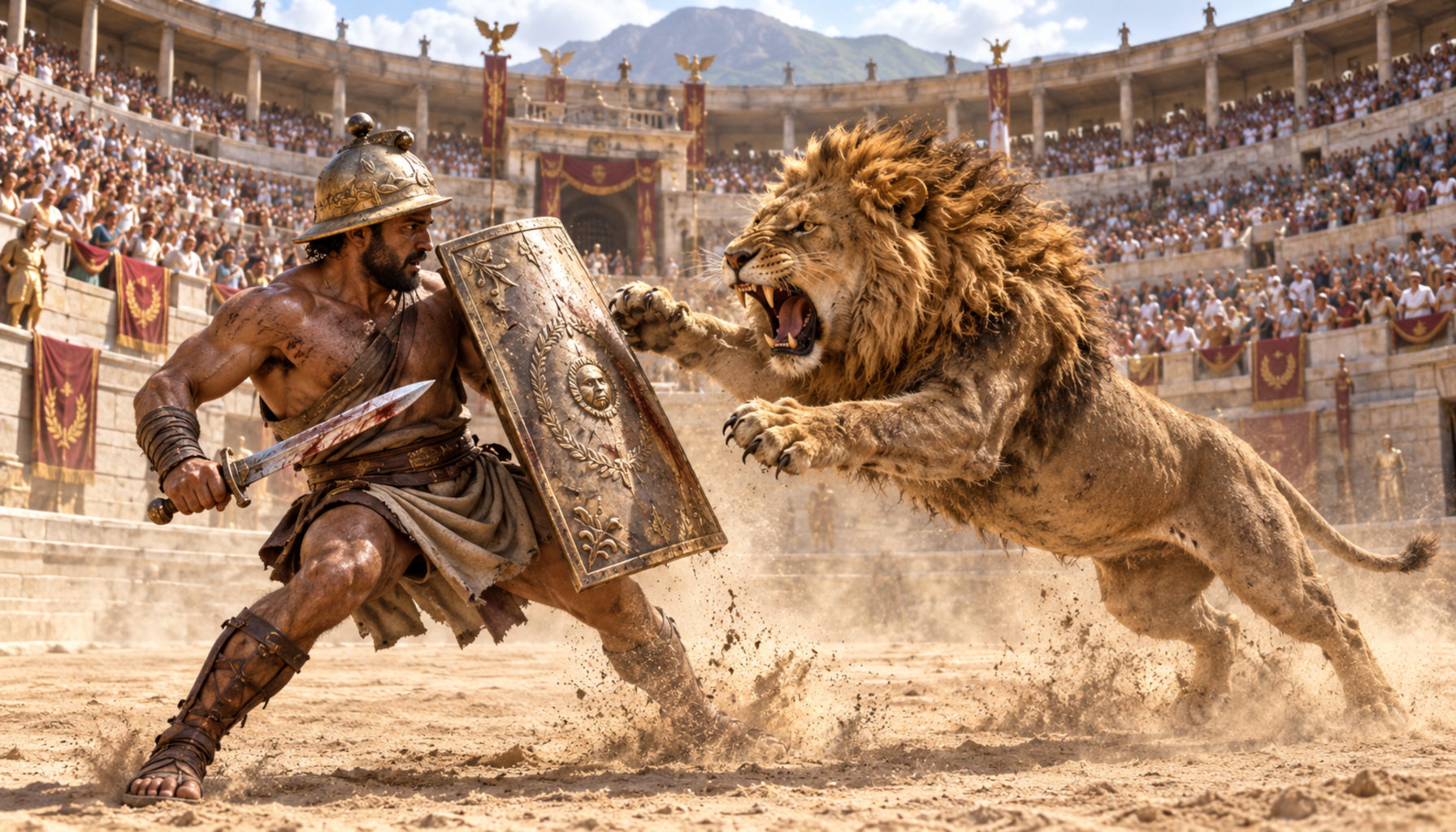
His grave belonged to the remarkable cemetery at Driffield Terrace in York, a burial ground that has fascinated archaeologists because so many of its dead were powerfully built young men marked by trauma and decapitation. Some had injuries consistent with repeated combat. One individual from the same cemetery even preserved unhealed bites from a large carnivore, likely an arena beast, which gives unusual weight to the idea that at least some of these men were gladiators or other professional fighters. In that setting, 3DRIF-26 stands out not only for violence endured in life, but for the enormous geographical journey implied by his ancestry.
It is worth pausing over the sheer scale of his story. York in the 3rd century was no provincial backwater. It was a legionary centre, an imperial city, and at moments a place where emperors themselves lived and died. Septimius Severus had campaigned from York in the early 200s, and the city remained tied into military, administrative, and commercial networks stretching across the empire. The man buried as 3DRIF-26 belonged to that imperial world of roads, shipping lanes, army recruitment, slavery, entertainment, and forced or voluntary migration.
His skeleton preserved injuries to the shoulder, ribs, and wrists, suggesting a hard and dangerous life. Whether he was a gladiator in the strict sense, a soldier, a condemned fighter, or another sort of trained combatant is still a matter of interpretation rather than certainty. The cemetery strongly invites the gladiator hypothesis, but the evidence does not permit us to pin a name, profession, or biography on him with perfect confidence. What we can say is that he was part of a violent male burial group in Roman York, and that genetically he differed sharply from the other men studied there. That contrast is precisely what makes him historically so interesting.
The biological sample associated with this individual is described as Egyptian/Near East Gladiator York, dated approximately to 250 AD. The remains came from the Driffield Terrace cemetery at York. The identification here is best described as a probable contextual identification, not a securely named historical person. In other words, researchers are not claiming to know his personal name. Rather, they are associating the DNA sample with a particular excavated skeleton, 3DRIF-26, from a cemetery that has been interpreted as containing gladiators or similar combat specialists.
The broader interpretation rests on archaeology and osteology: the unusual concentration of young, robust males; repeated signs of violent injury; the pattern of decapitation; and the famous evidence for large animal bites at the site. The genome study published in Nature Communications added a further twist. According to that research, 3DRIF-26 showed ancestry affinities unlike the others sampled from the cemetery and most consistent with origins in the Near East or eastern Mediterranean. That does not tell us his language, legal status, religion, or exact hometown, but it strongly suggests that either he himself, or very recent ancestors, had moved across great distances before ending up in York.
The reported Y-DNA haplogroup for this man is J2. Y-DNA traces the direct paternal line: father to son to son across many generations. His mtDNA haplogroup is H5. Mitochondrial DNA traces the direct maternal line: mother to child, passed on through the maternal line. These are lineages, not ethnic labels, and they should not be mistaken for a complete identity card.
Haplogroup J2 is historically widespread across the eastern Mediterranean, Anatolia, the Caucasus, the Balkans, and parts of the Near East, and it appears in many ancient contexts linked to the long, tangled history of farming expansions, Bronze Age interaction, classical mobility, and later imperial worlds. In that broad sense, J2 fits comfortably with the genomic observation that 3DRIF-26 had strong Near Eastern or eastern Mediterranean affinities. But the haplogroup alone does not prove he was “Syrian,” “Egyptian,” “Greek,” or any other single identity. It simply places his direct paternal line inside a lineage long present in regions connected to the eastern Roman world.
Short ancient-DNA comparisons help show just how broad that J2 story can be. Related J2-linked ancient samples appear in places as varied as Neolithic northwest Anatolia at Barcin (I1580), the Minoan world of Hagios Charalambos Cave on Crete (HGC033), Iron Age Adriatic Italy among the Piceni at Novilara (PN162 and PN28), Roman-era Apollonia in Anatolia (I16583 and I16585), Imperial Roman Viminacium in Serbia (I15534), and even later medieval contexts such as Cambridge St John’s Hospital in England (ATP_PSN_306) and Kilis in southeast Anatolia (I14787). That is exactly the point: J2 is not the badge of one people, but a paternal lineage found again and again in populations moving through the Mediterranean and adjacent regions over millennia.
His maternal lineage, H5, belongs to the larger mtDNA haplogroup H, one of the most common maternal lineages in western Eurasia. H5 has appeared in ancient European and Mediterranean contexts as well, which again reminds us that maternal ancestry in the Roman world could be layered, old, and geographically wide-ranging. In this case, H5 does not contradict the broader genome signal, but neither does it narrow him neatly to one city or province. The maternal line tells us about one thread of ancestry; the genome as a whole is far more informative about his broader population affinities.
The great value of this man’s DNA is not that it solves his life in a tidy sentence, but that it sharpens the historical picture of Roman York. It shows that the city and its institutions could draw in people from very far away, whether through military service, enslavement, trade, entertainment, or other imperial mechanisms. His genome supports the idea that northern Britain was connected to the same vast human traffic that linked the Nile, the Levant, Anatolia, Italy, and the western provinces.
At the same time, DNA does not tell us whether he entered the arena willingly, whether he was freeborn or enslaved, what name he answered to, or what gods he prayed to before combat. Those are exactly the questions that make Roman archaeology so compelling. Bones and genomes can give us movement, injury, ancestry, and kinship; they cannot by themselves recover a full inner life. Yet even within those limits, 3DRIF-26 is unforgettable: a man of eastern ancestry, scarred by violence, buried among decapitated fighters in one of Roman Britain’s most haunting cemeteries.
Read Eastern Mediterranean DNA
With MyTrueAncestry, you can compare your DNA with ancient populations and archaeological samples from worlds like Roman Britain, the eastern Mediterranean, and the wider Roman Empire. It is a way to explore deep genetic connections to the past without pretending that a shared lineage alone proves direct descent from any one ancient person.
Comments