Elite Viking Warrior of Bodzia
– 5 min read


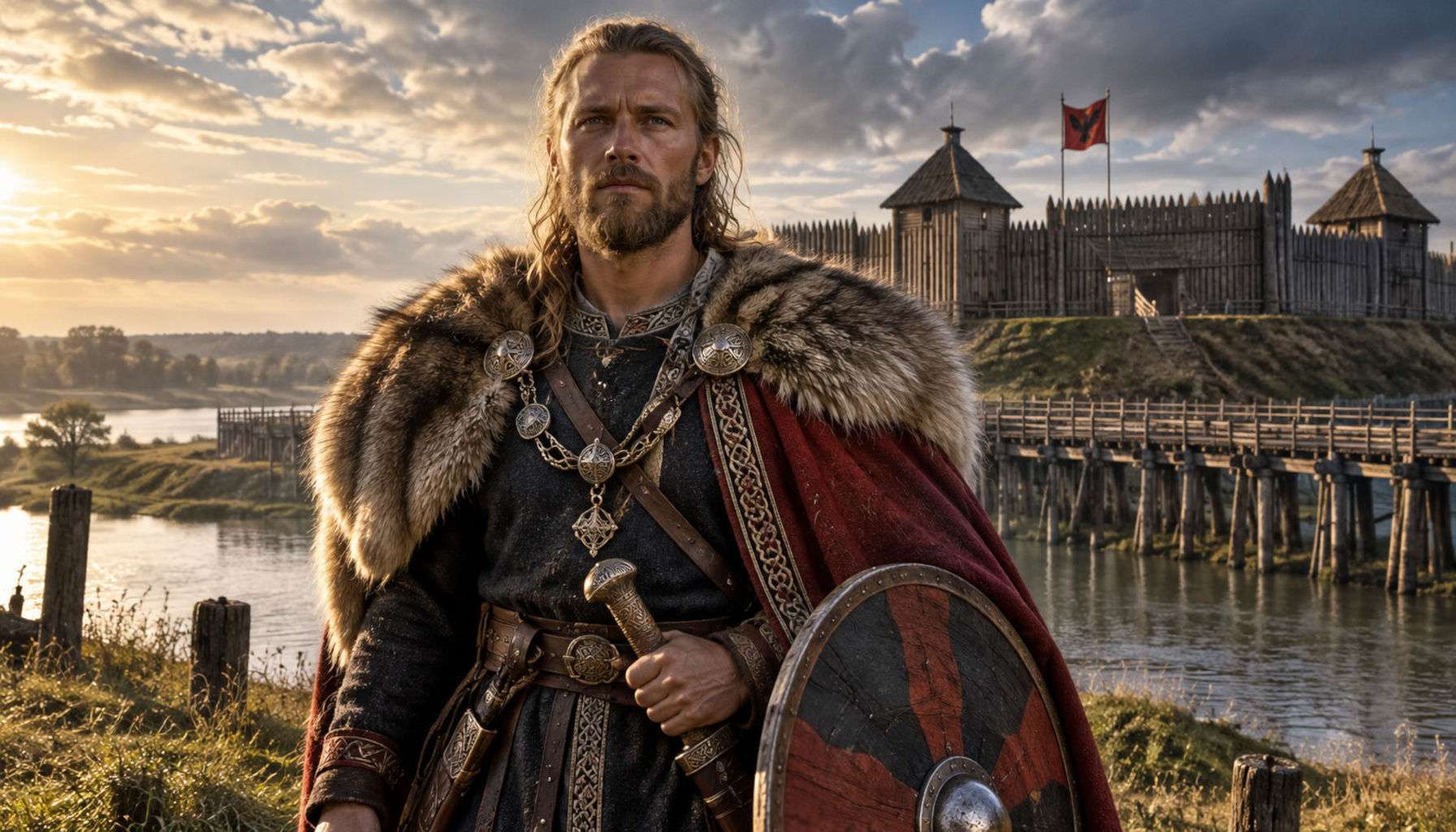
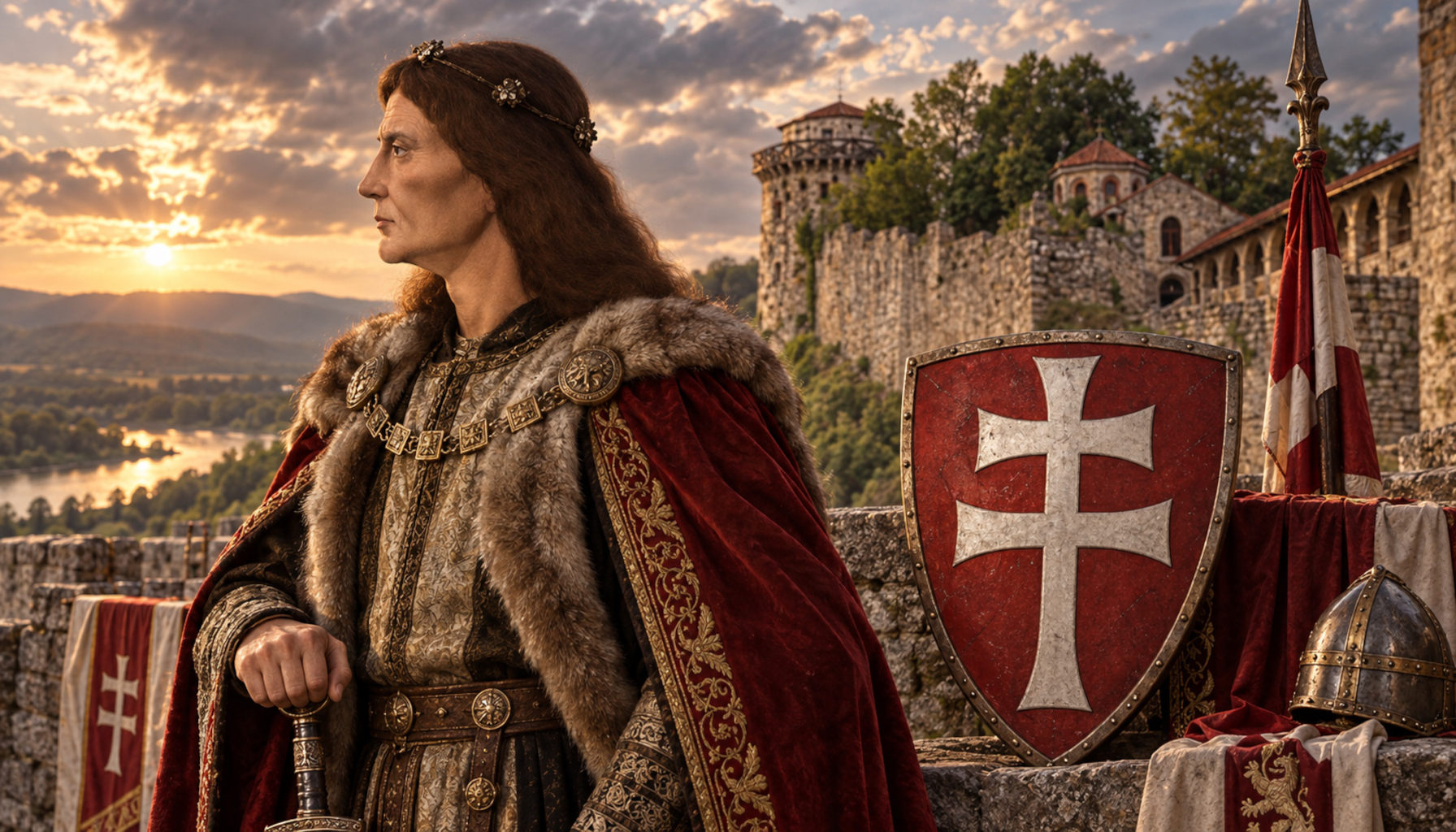
The man known from sample VK157, the Elite Viking Warrior of Bodzia, was buried in Poland around 1015-1020 AD in one of the most extraordinary cemeteries of the Viking Age. Bodzia was no ordinary burial ground. Its chamber graves, timber enclosures, imported goods and armed burials speak of people who moved in the hard, glittering world of high-status warriors, traders and political retainers who linked Scandinavia, the Baltic, the Kievan Rus and Byzantium.
That matters because Bodzia sits at a historical crossroads. In the early 11th century, power in eastern Europe was being fought over with swords as much as with dynastic claims. Princes, mercenaries, exiles and warbands moved between courts from the Piast realm in Poland to the lands of the Rus. In that setting, grave E864/I stands out above all the others: the richest burial in the cemetery, and the resting place of a man whose equipment suggests rank, mobility and a life spent close to the business of war.
The Bodzia cemetery contained around 58 graves, several of them richly furnished. Other armed men were buried there too, including VK156 with a battle-knife and related equipment, and his son VK153 with a battle axe. Yet VK157 eclipses them. He was interred with an exceptional Petersen Type Z sword about a metre long, with a five-lobed pommel and a silver-encrusted hilt decorated in Scandinavian Mammen style. Even the leather-and-wood scabbard points toward late 10th-century Scandinavia. Alongside it were an antler-handled knife, archery equipment and an elaborate bronze belt. These are not the things of a peasant pressed into service. They belong to a man of means, and probably of command.
Most tantalising of all was a belt fitting engraved with a two-pronged symbol topped by a cross, associated with Sviatopolk the Accursed of the Rurikid dynasty. Sviatopolk, son of Vladimir the Great, was one of the most embattled princes of the Kievan Rus, locked in violent struggles for power and dead by about 1019 after retreat toward Poland. The chronology fits. The geography fits. The wealth of the grave fits. So too do the sharp-force injuries to the skull and jaw, which suggest a violent end. For that reason, scholars have proposed that VK157 may have been a high-ranking member of Sviatopolk’s military entourage, or in the boldest version of the hypothesis, possibly Sviatopolk himself. That last identification remains speculative, and it should be treated as such. But even without turning him into a named prince, this was plainly a man very near the top of his social world.
The relevant ancient DNA sample is described as Viking Age Elite Warrior Bodzia Poland, dated approximately to 1015 AD. It comes from the man buried in grave E864/I at Bodzia, identified in the research dataset as VK157. Archaeologically, this is a very strong association between the biological sample and the burial itself. What is not secure is the leap from burial occupant to a specific named historical person. In other words, the remains certainly belong to the elite warrior buried in that grave; the suggestion that he was Sviatopolk, or one of Sviatopolk’s closest men, is a historical interpretation built from context rather than a proven personal identification.
The wider archaeological setting strengthens the importance of the find. Bodzia combines local Polish setting with burial customs and artefacts tied to the Viking Age elite sphere. This is precisely the kind of cemetery one would expect for a mobile retinue operating between political worlds. The preprint at https://www.biorxiv.org/content/10.1101/703405v1 helped place Bodzia within an ancient DNA framework, adding biological evidence to what archaeology had already made clear: these were not isolated villagers, but people connected to broader networks of movement and status.
VK157 carried Y-DNA haplogroup I1a3a1 and mtDNA haplogroup H1c. These two results trace different parts of his ancestry. Y-DNA follows the direct paternal line, passed from father to son. mtDNA follows the direct maternal line, passed from mother to child. They do not describe all of a person’s ancestry, only two very narrow genetic lines among many thousands of ancestors.
The Y-DNA lineage I1a3a1 is especially interesting in this case because broader I1 lineages are well documented in Scandinavia and appear repeatedly in medieval and earlier northern European contexts. That does not prove that VK157 was “ethnically Scandinavian,” still less that his culture or allegiance can be read straight off a haplogroup. But it does sit comfortably with the Scandinavian-style elements of his burial and with the long-distance networks implied by Bodzia itself.
A short ancient-DNA comparison makes the point neatly. I1a3a1-linked individuals appear across a striking range of times and places, from Viking Age Scandinavia and Bodzia itself to medieval Sweden, Poland, Belgium, England, Hungary and Sicily, and even further back into Bronze Age and Roman-period contexts in parts of Europe. Samples such as Viking Age Fjalkinge Sweden (fjk533), Viking Age Skara Varnhem Sweden (VK308), Viking Hesselbjergmarken Jutland Denmark (VK340), Medieval Sigtuna Sweden (mbs081), Medieval Poland Early Kingdom of Poland (PCA0167) and Medieval Piast Dynasty Poland Plonsk Masovia (PCA0319) show that this paternal lineage belonged to a broad and long-lived European network rather than to one neat political label. In that sense, VK157’s Y-line fits the very world his grave suggests: one of mobility, service, and overlapping Scandinavian, Slavic and Rus connections.
His mtDNA haplogroup H1c traces his direct maternal line. Here the supplied comparative list is much shorter, and the key securely relevant example is VK157 himself. That limitation is worth stating plainly. The maternal result is useful as part of his full genetic profile, but on its own it cannot identify his family, rank or homeland. Like the Y-line, it marks a lineage, not an ethnicity and not a biography.
Read about Viking Age genetics
The value of VK157’s DNA lies in how it complements the archaeology. The grave already told us this was a non-local elite warrior embedded in far-reaching networks at a moment of political crisis in eastern Europe. The genetic evidence supports the picture of a man whose ancestry was bound into the wider northern and central European world, rather than contradicting it. But DNA does not by itself prove he was Sviatopolk, nor can a haplogroup assign him cleanly to “Viking,” “Rus,” “Polish” or any other identity. Those were political and cultural categories, lived on the ground and contested in life, not boxes written in the chromosomes.
What remains so compelling about the Bodzia warrior is precisely that convergence of clues: the chamber grave, the sword, the belt fitting, the trauma, the date, the location and the genetic profile. Put together, they give us not a solved mystery, but a sharply drawn historical possibility. And sometimes that is the more interesting thing: not certainty, but a grave that still keeps part of its secret.
With MyTrueAncestry, you can compare your DNA with ancient populations and archaeological samples from the Viking Age, medieval Poland, the Kievan Rus world and beyond. It is a way to explore broad genetic connections to the peoples and lineages that shaped this frontier age, without claiming that a shared match proves direct descent from VK157 himself.


Comments