Duke Béla of Macsó
– 4 min read


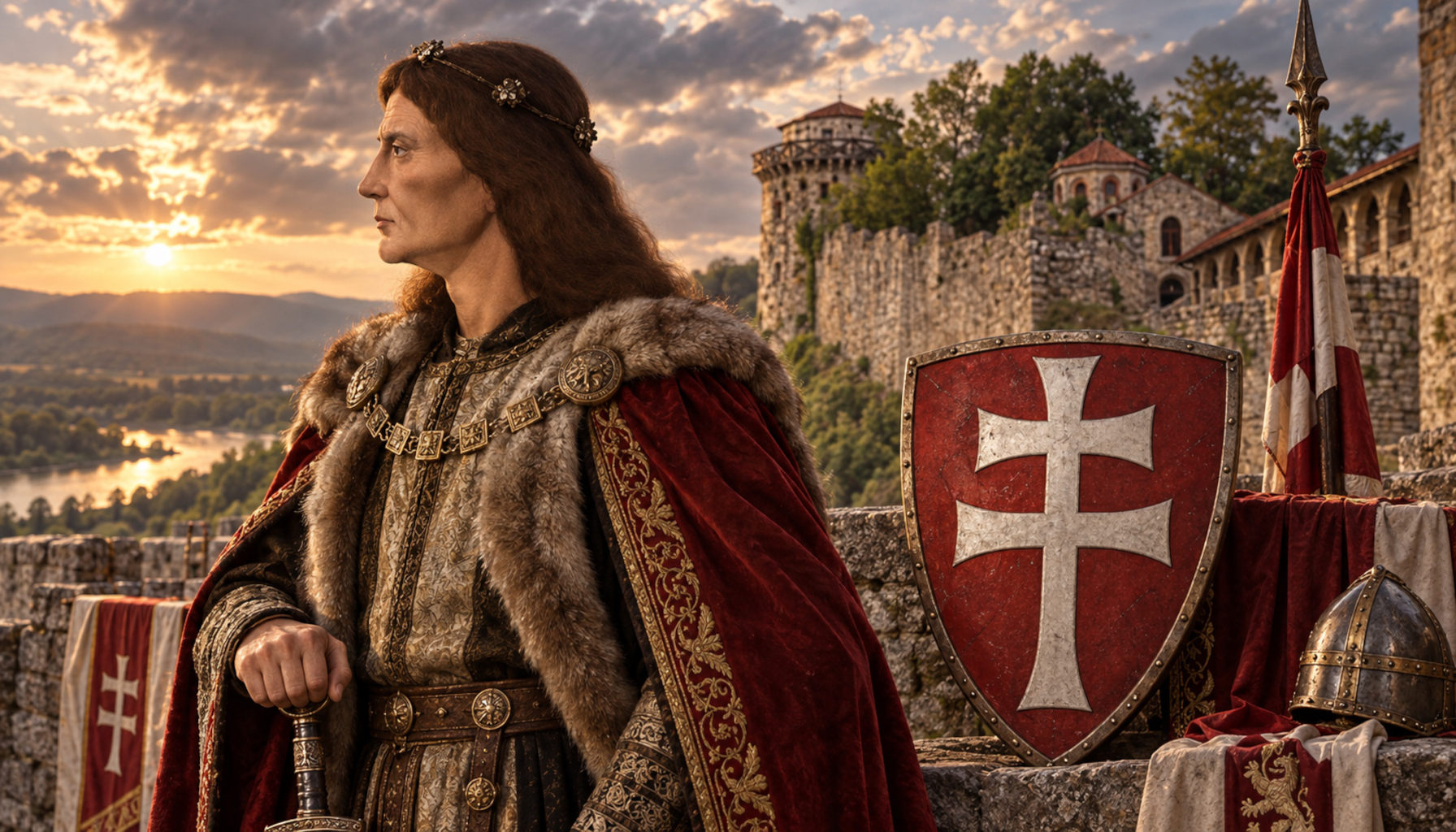
Duke Béla of Macsó was one of those medieval princes who seem to stand at the hinge of several worlds at once. Living in the 13th century and dying in 1272, he was the son of Rostislav Mikhailovich, a Rurikid prince descended from the rulers of Chernigov, and Anna of Hungary, daughter of King Béla IV of the Árpád dynasty. That made him not merely a nobleman with a good pedigree, but a dynastic link between the Hungarian kingdom, the Rus principalities, and the contested lands of the Balkans.
His importance lies in more than genealogy. Béla inherited the Duchy of Macsó after his father’s death, ruling a strategically vital frontier zone around Belgrade and the lower Danube. In a kingdom where borders were porous and aristocratic loyalties could shift with alarming speed, Macsó mattered. It was a military buffer, a political prize, and a reminder that medieval Hungary was deeply entangled with southeastern Europe. Béla’s violent death in a factional clash in 1272 tells us quite a lot about the atmosphere of the age: power was real, but so was danger.
Béla’s family background is what makes him especially compelling to historians. On his mother’s side stood the Árpáds, the ruling house that had shaped the Hungarian kingdom for centuries. On his father’s side stood the Rurikids, one of the great dynastic networks of the medieval Rus lands. These were not abstract bloodlines on a chart. They were active political inheritances, carrying alliances, claims, prestige, and suspicion. Béla belonged to that broad corridor of medieval politics stretching from the Carpathian Basin to the forests and river routes of the east, and southward toward the Danube frontier.
The world he inhabited had been transformed by upheaval. His grandfather Béla IV had ruled during and after the Mongol invasion of Hungary in 1241–1242, an event that devastated the kingdom and forced major military and administrative changes. Frontier lordships like Macsó became even more important in the rebuilding of royal authority and defense. Yet the later 13th century was also an age of magnate rivalry, and powerful young princes could become targets as much as assets. Béla’s murder in 1272, during a violent confrontation among aristocratic factions, is a grim reminder that dynastic eminence did not protect a man from court politics. If anything, it may have made him more vulnerable.
The biological sample associated with him is listed as Duke Bela of Macso Arpad Rurik Dynasty, dated approximately to 1272 AD. Recent forensic and genetic research has linked an elite medieval skeleton to Béla, making this a strongly supported identification rather than a casually assumed one. The significance of that link is obvious: here is a man expected from written history to sit between the Árpád and Rurikid dynasties, and the genetic evidence reportedly supports biological relationships to both lineages.
It is worth being careful here, because archaeology is full of overconfident identifications. In this case, the broad claim is not simply that an impressive skeleton was found and given a famous name. Rather, the interest of the research, including the study referenced at https://pubmed.ncbi.nlm.nih.gov/41197516/, is that forensic examination and ancient DNA were used together to test whether the remains fit the historical expectations. Without inventing details that are not supplied here about grave context or excavation history, the safest summary is that the remains are presented as an elite medieval individual whose identification with Duke Béla is strongly supported by biological kinship evidence.
The reported Y-DNA haplogroup for this sample is N1a1a1a1a1a1a7a3a, while the mtDNA haplogroup is U3b3. These two markers tell different stories. Y-DNA traces the direct paternal line, passed from father to son. mtDNA traces the direct maternal line, passed from mother to child. Neither one describes the whole ancestry of Béla, and neither one by itself defines his identity, culture, or dynasty. But together they provide useful lineage markers that can be compared with other ancient and historical samples.
For Béla, the Y-DNA result is especially interesting because his father was Rostislav Mikhailovich, a Rurikid prince. That means the paternal line is directly relevant to the historical question of dynastic connection. The mtDNA result, U3b3, reflects only one narrow maternal line among many ancestors, but it remains valuable for identifying maternal lineage continuity and for distinguishing this individual biologically from others in the same cemetery or family network.
A short ancient-DNA comparison helps place the paternal lineage in a wider frame. Samples linked to the same Y-lineage label or closely associated reporting set include Duke Bela of Macso Arpad Rurik Dynasty (BPDOM01), and in broader ancient datasets the lineage has parallels noted in places as varied as Iron Age Urartian Armenia Karashamb Cemetery (I16220), Early Bronze Age Southeast Anatolia Tatika (I4617, I4619), Late Bronze Age Armenia Urartian Harjis (I18161), Iron Age Iran Hasanlu Period (I4356), Iron Age Iran Hasanlu Period Dinkha Tepe (I4238), Vendel Age Saaremaa Salme II-XXV (VK489), Vendel Age Saaremaa Salme II XXVII (VK512), Bronze Age Baqah Jordan (I6564), Middle Bronze Age Ebla Syria (ETM006), and Byzantine Empire Troy (ByzantineNod1, ByzantineNod2), where available in comparative databases. That does not mean these people belonged to the same ethnicity or close family. It means only that very broad paternal-line connections can stretch across long spans of time and geography.
The maternal side is narrower in the current comparison. For U3b3, the directly relevant linked sample named here is Duke Bela of Macso Arpad Rurik Dynasty (BPDOM01). That limited comparison is a useful reminder of the unevenness of ancient DNA evidence: some lineages are richly sampled, others remain sparse, and absence of matches in a list is not evidence of historical absence.
What makes Béla’s DNA so interesting is not simply that we have haplogroups for a medieval nobleman. It is that the genetics fit a man who occupied a very precise place in history: a prince born from the meeting of Árpád and Rurikid dynastic lines, active in a frontier duchy at a politically explosive moment, and killed in the factional violence of 1272. Ancient DNA cannot tell us what language he spoke at court on a given day, what he thought of his rivals, or whether he felt more Hungarian or more Rus in identity. Medieval identity does not reduce neatly to a chromosome. But genetics can help test whether remains belong within the expected family web, and in Béla’s case that creates an unusually vivid bridge between documentary history and the body in the grave.
MyTrueAncestry lets you compare your DNA with ancient populations and archaeological samples from the medieval and ancient worlds. You may discover genetic connections to the peoples, regions, and lineages that shaped the world of Duke Béla of Macsó, from the Carpathian Basin to the wider networks of eastern Europe and beyond.

Comments