Khnum-Nakht Egyptian Priest
– 4 min read


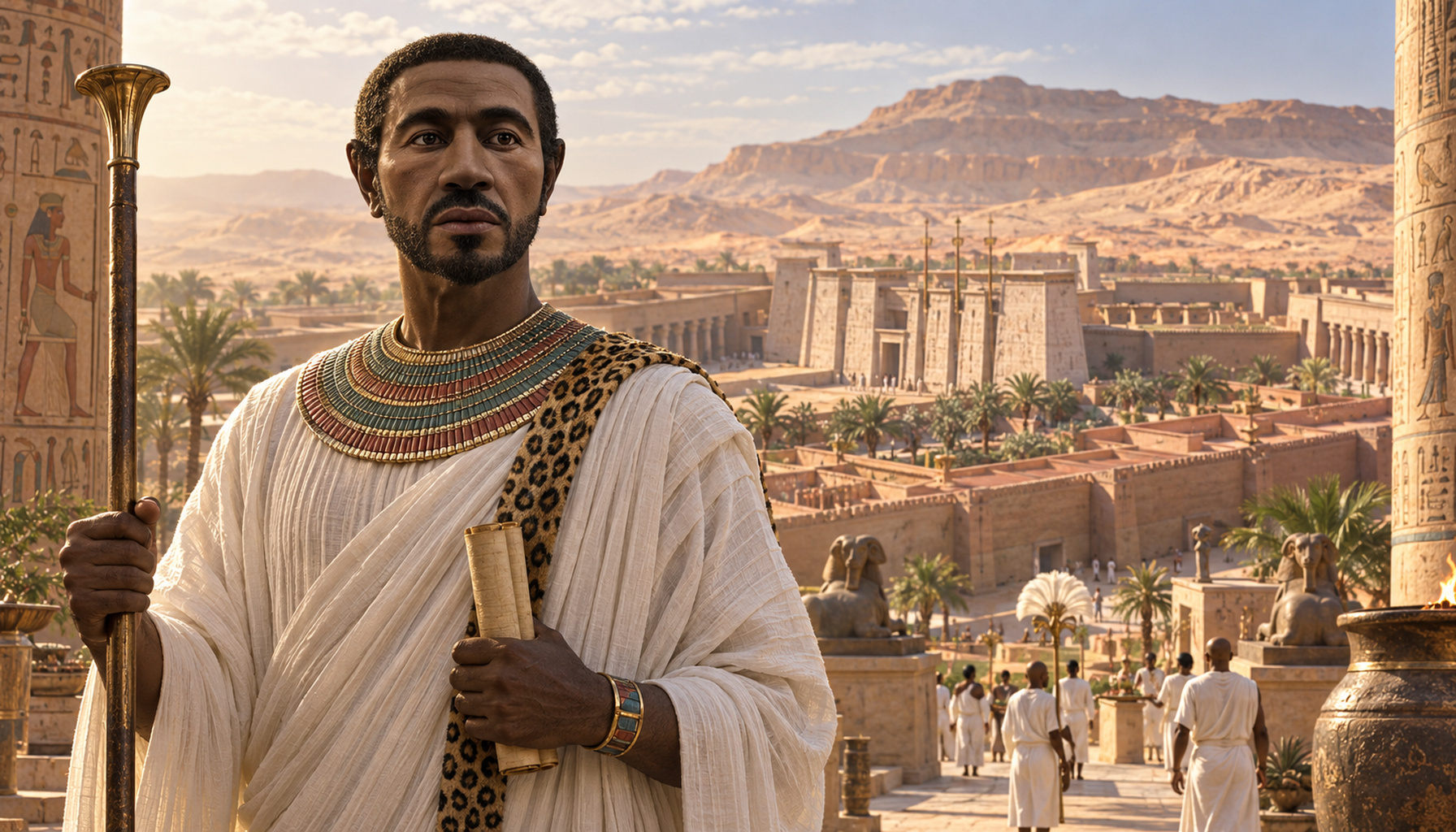
Khnum-Nakht was a high-status Egyptian priest of the Middle Kingdom, living around 1800 BC in Middle Egypt, a world of provincial elites, temple offices, careful funerary preparation, and deeply local religious identities. His inscriptions connect him to the cult of Khnum, the ram-headed creator god, and to ancient Shashotep, while his burial at nearby Rifeh placed him among the better-known named individuals of Egyptian archaeology.
He matters today not because he was a conquering pharaoh or a famous lawgiver, but because his tomb preserves something rarer: a human-scale story. Found with Nekht-Ankh in the celebrated "Two Brothers" burial, Khnum-Nakht sits at the meeting point of text, object, body, and now DNA. Few ancient Egyptians have given us so intimate a combination of funerary art, biography, physical remains, and genetic evidence.
The Egypt of Khnum-Nakht was not static or simple. Around his lifetime, the Middle Kingdom had built a powerful state, but that power was expressed not only through kingship. It also lived in towns, estates, temple institutions, and regional families whose status can still be read in their tomb equipment. Khnum-Nakht's own funerary record places him in this provincial elite: a man important enough to be commemorated with fine coffins, statues, and burial goods, and pious enough for his identity to be framed through divine service.
His link to Khnum is especially telling. Khnum was an ancient and important deity associated with creation, fertility, and the fashioning of human life. To bear a name invoking Khnum and to be identified through that cult was to stand inside a religious landscape that joined local temple worship to wider Egyptian ideas about order, rebirth, and the afterlife. Khnum-Nakht therefore represents the sort of person who kept Egyptian religion working on the ground: not a distant monarch, but a local sacred official whose status, family ties, and mortuary provisions reveal how belief and society were intertwined.
Explore another ancient Egyptian burial landscape
The biological sample associated with him is listed simply as Khnum-Nakht Ancient Egypt, dated to about 1800 BC. The remains come from the famous Rifeh tomb discovered in 1907, where Khnum-Nakht and Nekht-Ankh were buried together in a richly furnished funerary assemblage. Their painted coffins, statues, and other grave goods made the burial one of the most recognizable Egyptian discoveries later housed in the Manchester Museum. The Manchester Museum's long-running presentation of the "Two Brothers," reflected in its reference material at The Two Brothers, helped turn what might have been a specialist find into one of the public faces of Middle Kingdom Egypt.
In this case, the identification is comparatively strong because the mummies were associated with inscribed coffins and funerary equipment naming Khnum-Nakht and Nekht-Ankh. That does not magically remove every archaeological question, but it does mean we are not dealing with an anonymous skeleton loosely attributed to a period. We are dealing with remains tied by burial context and inscription to named individuals, which is exactly why later genetic work became so historically valuable.
For decades, the relationship between the two men was debated. Their physical differences encouraged speculation: were they really brothers, as the modern nickname suggested, or had archaeology and appearance misled everyone? This is where ancient DNA performed its most useful service. It did not reconstruct every branch of their family tree, and it did not tell us everything about their ancestry, but it answered one sharp question with unusual clarity.
Khnum-Nakht's reported mtDNA haplogroup is M1a1. Mitochondrial DNA traces the direct maternal line, passed from mother to child. His Y-DNA haplogroup is unknown from the supplied data, so the direct paternal-line haplogroup should be treated as undetermined rather than guessed.
The key historical result is kinship. Ancient DNA showed that Khnum-Nakht and Nekht-Ankh shared the same maternal lineage but had different fathers. In plain terms, they were maternal half-brothers. That is a splendid example of what genetics can do when used properly: not sweeping claims about identity, but a precise answer to a question raised by archaeology, anatomy, and inscription.
The mtDNA lineage M1a1 is a maternal genetic branch with a history that has been documented in parts of North Africa, Northeast Africa, and the broader Mediterranean-connected world. That does not make it an "ethnic marker," and it certainly does not define Khnum-Nakht's cultural identity, which is already clear from his Egyptian name, cultic role, and burial context. What it does provide is one thread of biological ancestry, specifically along his mother's mother's line.
A short ancient-DNA note is worthwhile here. Other ancient individuals carrying M1a1 or related M1-linked maternal lineages appear across a remarkably wide chronological and geographic range, including samples such as Elite Celtic Burial Germany Magdalenenberg Villingen-Schweningen (MBG012), Late Medieval Uzbekistan Tell Garden Lungi Tepa (TGA007), and Post Imperial Roman Italy Pesaro Adriatic (PF9). That broad spread does not mean these people were closely related to Khnum-Nakht in any recent genealogical sense. Rather, it reminds us that a maternal lineage can persist and travel across very long spans of time and space, while the cultures, languages, and identities of the people carrying it differ enormously.
Read about North Africa's genetic history
Khnum-Nakht's DNA is historically interesting because it sharpens, rather than replaces, the archaeological picture. We already knew he was a real Middle Kingdom elite associated with Shashotep and the cult of Khnum. Genetics adds a family fact of great intimacy: the man buried beside him shared their mother's line, but not their father. Suddenly the tomb is not just beautiful; it is familial in a more exact and rather moving way. It shows how ancient DNA can illuminate the domestic realities behind formal funerary display.
Just as importantly, the DNA has limits. Khnum-Nakht's mtDNA haplogroup does not tell us his language, profession, beliefs, or social rank; archaeology and inscription do that far better. And because the Y-line is unknown in the supplied data, we cannot responsibly say anything about his direct paternal haplogroup. Good archaeogenetics is often less about grand declarations than about respecting exactly what the evidence can bear.
Discover how ancient DNA changed archaeology
With MyTrueAncestry, you can compare your DNA with ancient populations and archaeological samples from worlds like that of Middle Kingdom Egypt, exploring broad genetic connections to the deep human past without confusing them with proven descent from a named individual such as Khnum-Nakht.

Comments