Golden Man of Issyk
– 4 min read


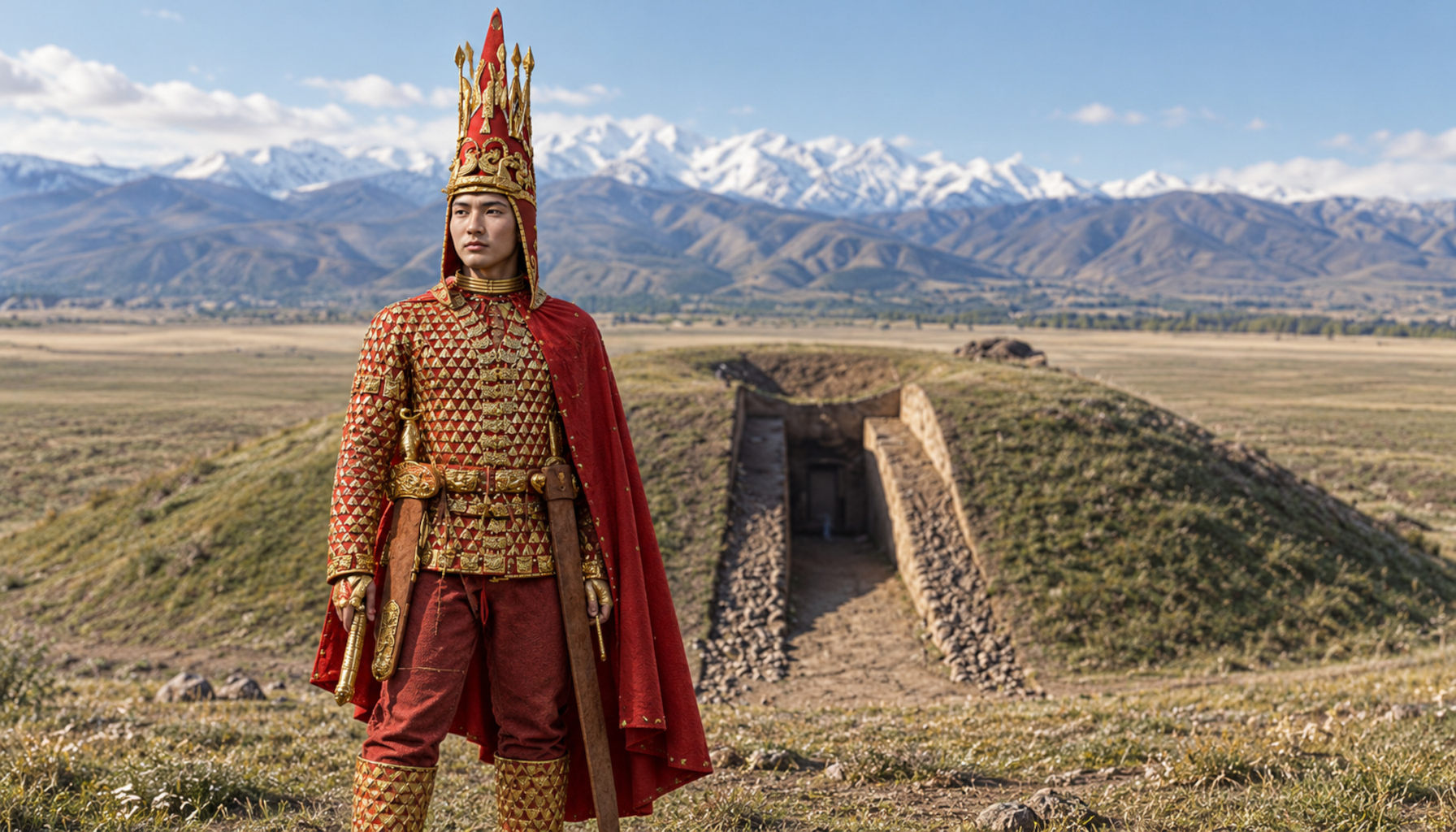
The Golden Man of Issyk is one of those archaeological finds that has all but walked off with the public imagination. Buried around 296 BC in the Tian Shan region of what is now Kazakhstan, this Saka elite was laid to rest inside the Issyk kurgan near modern Almaty in a blaze of gold. Thousands of ornaments covered the ceremonial costume: animals in the famous steppe animal style, geometric designs, weapons, and symbols of rank. Add the tall pointed headdress, the weapons, vessels, and jewellery, and the message is hard to miss: this was someone of very high status.
Historically, the burial matters because it opens a window onto the Saka world, part of the broader Scythian cultural sphere that stretched across much of Central Asia and the Eurasian steppe. These were not isolated nomads drifting at the edge of civilisation, as older clichés sometimes imply. They were mounted pastoralists, warriors, traders, and patrons of a striking visual culture, operating across enormous distances and connected to networks that linked the steppe to Iran, China, and beyond. The Golden Man became, in modern Kazakhstan, an emblem of that deep past.
We do not know this person’s personal name, nor can we reconstruct a biography in the way we might for a king preserved in written sources. But archaeology tells us a good deal about their world. The Saka communities of Iron Age Central Asia lived in a landscape shaped by mobility, horse culture, seasonal movement, and political hierarchy. Rich kurgan burials such as Issyk were not ordinary graves; they were statements. They advertised status, martial authority, and belonging to an aristocratic steppe tradition whose artistic language was instantly recognisable from the Black Sea to the Altai. The Issyk burial therefore matters not because it gives us a named ruler, but because it captures, in unusually vivid form, the ceremonial and political culture of a steppe elite at the height of the Iron Age.
The ancient DNA sample associated with this famous individual is GOM001, described as Elite Scythian Golden Man Tian Shan Saka Iron Age Issyk Kazakhstan. The approximate date attached to the sample is 296 BC. In this case, the identification is strong at the archaeological level: the sample comes from the remains attributed to the celebrated Issyk “Golden Man” burial. What we can say securely is that GOM001 represents the individual buried in this elite Saka grave. What we cannot do, because the supplied evidence does not allow it, is assign a personal name, title, or precise political office.
That distinction matters. The Golden Man is a real excavated person from a real high-status burial, not a legend. But this is not the same as having an inscription reading “here lies so-and-so.” The power of the find comes from the convergence of archaeological context, grave goods, and now biomolecular evidence, rather than from written self-identification.
A short note on broader ancient-DNA comparison is worthwhile here. GOM001 sits most naturally alongside other steppe and Iron Age Central Eurasian samples rather than as an isolated curiosity. Related comparisons can include individuals such as Elite Scythian Grave Tasmola Iron Age Bakybulak Central Kazakhstan (BKB001), Scythian Grave Tasmola Iron Age Serekty Central Kazakhstan (SRK004), Scythian Grave Tasmola Iron Age Serekty Central Kazakhstan (SRK005), and Iron Age Ken-Su Kyrgyzstan (KEN001) or KEN003, which help place the Issyk burial within a wider web of steppe populations. For the maternal line specifically, GOM001 belongs to mtDNA haplogroup R0, and R0-linked ancient individuals appear across a broad span of time and geography, reminding us that a maternal lineage can travel very widely without mapping neatly onto a single culture or people.
The reported Y-DNA haplogroup for the Golden Man of Issyk is unknown or not determined from the supplied information. That means the direct paternal line cannot currently be discussed with confidence here, and it would be quite wrong to guess. In ancient DNA, absence of a Y-haplogroup result may reflect preservation limits, coverage, or reporting choices rather than anything historically meaningful in itself.
The mtDNA haplogroup is R0. Mitochondrial DNA traces the direct maternal line: mother, mother’s mother, and so on. Haplogroup R0 is a broad maternal lineage with a deep history in western and central parts of Eurasia. That does not make the Golden Man “western” or “eastern” in any simplistic sense, nor does it define Saka identity. It simply places this individual within one branch of the much larger human maternal family tree.
This is exactly where ancient DNA is most useful when handled carefully. A haplogroup is a lineage marker, not an ethnic badge. It cannot prove that someone was Saka, Scythian, royal, or nomadic. The archaeology already tells us this was an elite burial in the Saka world. The DNA adds a biological dimension: one small but valuable piece of evidence about ancestry and population history, to be interpreted alongside the grave, the art, and the wider steppe context.
The importance of GOM001 lies less in producing a dramatic one-line answer than in anchoring a famous burial within the emerging genomic history of Iron Age Central Asia. Studies such as the reference research in Science Advances have helped show that steppe societies were often biologically mixed, mobile, and connected across long distances, much as archaeology has long suggested. For the Golden Man, the mtDNA result contributes to that larger picture. It reminds us that this glittering figure from Issyk was not merely an icon of art history, but a real person embedded in the human networks of the Eurasian steppe.
At the same time, the limits are just as important. The DNA does not tell us the individual’s language, personal identity, rank within a court, or exact relationship to other Saka elites. It cannot by itself settle debates about whether the buried person was male or female, nor can one maternal haplogroup define an entire people. What it does do is bring the Golden Man one step closer to the realm of recoverable human history.
Read about Scythian Genetic Origins
With MyTrueAncestry, you can compare your DNA to ancient populations and archaeological samples from the worlds that shaped Eurasian history, including steppe cultures like the Saka and Scythians. It is a way to explore broad genetic connections to ancient peoples and lineages, not a claim of direct descent from the Golden Man of Issyk.
Comments