Ancient DNA and Dynastic Rule among Iron Age Scythian Elites
– 5 min read


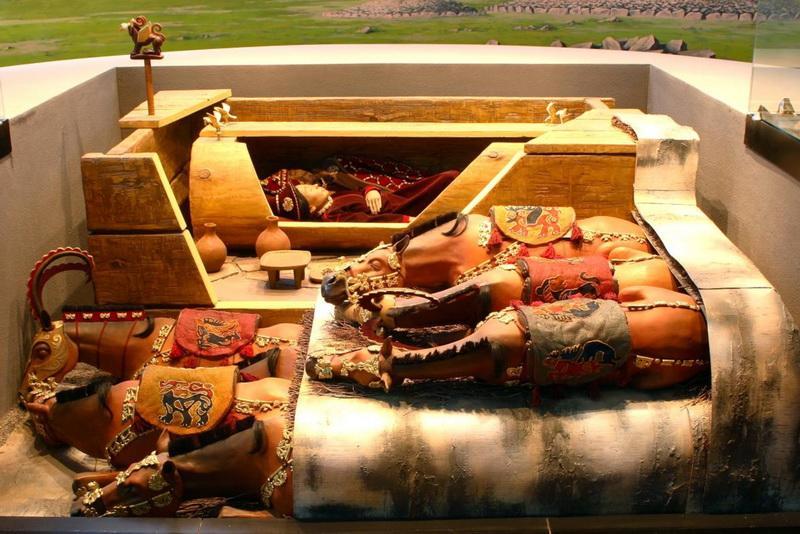
Across Eurasia's vast grasslands in the first millennium BC, a remarkable world stretched from the Altai Mountains to the Black Sea. Horse-riding communities moved with herds across this immense belt of steppe, yet it was no empty wilderness. It was crowded with memory, ritual, and power — written most visibly into the earth through burial mounds, great kurgans rising from the plains like artificial hills, visible for miles.
These communities, broadly labelled Scythian or Saka, are famous for animal-style art, weapons, horse gear, and glittering gold. But the deeper fascination lies in the social drama those objects reveal. Some people were buried modestly with simple pottery or a knife. Others were laid in gigantic constructions of turf, stone, and timber, with underground chambers and side spaces for animals or attendants. Even in death, the difference in rank could hardly have been louder.
Elite kurgans were genuine building projects. Labour had to be gathered, wood hauled, chambers prepared, horses selected, and the mound raised layer by layer. Such monuments announce command — proof that someone could mobilise people, time, and wealth on a grand scale. Timber-lined chambers created interior spaces part tomb, part stage set. Gold ornaments, weapons, mirrors, and decorated clothing turned the dead into dazzling public figures. Certain elite bodies also show postmortem trepanation, skull openings made after death, likely for preservation during extended burial ritual — a practice appearing only in the highest-status graves.
The cemeteries lie across Kazakhstan at sites including Issyk, Shilikty, Berel, Eleke Sazy, Akbeit, and Urdzhar. Each is rooted in its local landscape, yet together they form a broad cultural world linked by recurring symbols: deer, griffins, felines, and mountain goats rendered in vivid curling forms. This animal-style art bound far-flung elites into a recognisable visual language of authority. The kurgans themselves demolish the lazy image of nomads drifting lightly across the land. These communities moved, yes — but they also planted the dead in enduring architecture. A burial mound was not simply a grave. It was a claim, a memory anchor, and a statement to rivals.
The elite cemeteries of the Eurasian steppe were places of enormous visual power. Rising above the plain, the mounds dominated the horizon — monuments designed to transform individuals into lasting figures of prestige. Below the surface lay timber burial chambers, sometimes reached through a dromos entrance passage, with side chambers containing animals or additional human remains. This was impressive architecture for the dead.
The Issyk burial is among the most famous examples. One major mound, roughly six metres high and sixty metres across, contained the individual celebrated as the "Golden Man" — one of the great archaeological discoveries of Central Eurasia. Buried in a fir-wood chamber, he was accompanied by more than four thousand gold ornaments, an iron sword, a bronze mirror, pottery, and vessels of wood, silver, and bronze. Four thousand gold ornaments are not decoration. They are a statement in precious metal. The weapons hint at martial identity; the vessels gesture toward ritual and feasting. Then there is the silver bowl carrying an undeciphered inscription — an object that seems almost to speak, but stops just short of explanation. His sword was decorated with griffin heads, a motif appearing across other elite sites, linking separate cemeteries through a shared symbolic language.
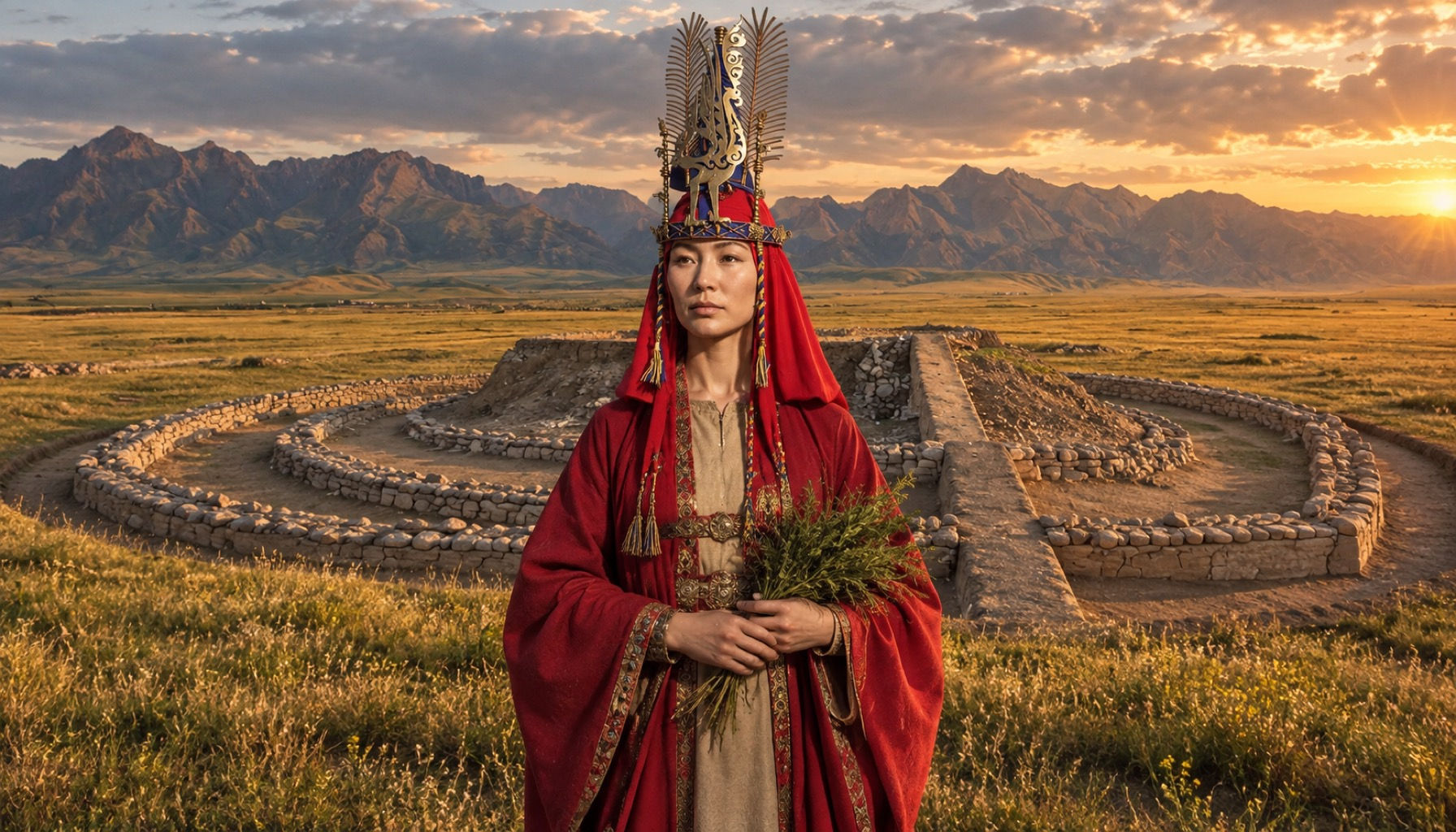
The "Princess of Urdzhar," found in eastern Kazakhstan, offers another striking portrait. Aged around thirty to thirty-five and dating to the fifth or fourth century BC, she wore a magnificent gold headdress decorated with zoomorphic ornaments in the Scythian style. Her burial also contained a stone altar and medicinal plants, suggesting ritual authority and encouraging interpretation of her as a priestly or shamanic figure.
Children, too, could be buried in elite fashion — one of the clearest signs that rank was inherited. At Akbeit, a child of four or five received postmortem treatment and burial in a large mound. At Karashoky, a one-year-old lay in an elite kurgan with a dromos. No one becomes a military hero at one year old. If a baby is buried like royalty, royalty must be a family matter. What emerges from these mounds is a world where burial was a political act — the ceremonial backbone of a society organised by hierarchy and lineage, and among the most dramatic archaeological landscapes of the ancient world.
Were the great steppe burials for leaders who rose by personal achievement, or for members of ruling houses whose status was inherited? The evidence points strongly toward the second option. Family links appear among elite individuals buried at different cemeteries, sometimes across generations, and the mounds begin to look very much like dynastic landscapes.
A particularly revealing family group connects Akbeit, Nurken, and Karashoky. AKB001, an elite older man from Akbeit buried with gold objects and postmortem trepanation, was the brother of NUR002 from Nurken — another elite man with a large mound and dromos. More strikingly, AKB001 appears to have been the grandfather of two elite individuals at Karashoky: KSH001, the one-year-old buried with a dromos, and KSH003, an adult elite male in another large mound. A grandfather, his brother, and grandchildren all receiving elite burial across distances of fifty to one hundred and forty kilometres — that is not random clustering. It is dynastic continuity made visible in the ground.
Elite women were embedded in the same network. Elite individuals were also far more likely to be related to each other than to non-elites, suggesting the upper rank formed a tighter social and biological circle. Some elite individuals appear to have been born from unions between close relatives, consistent with patterns seen in other ancient societies where close-kin marriage helped preserve status and legitimacy. The ruling stratum was a narrower, more self-conscious circle, reproducing itself over time while the wider population remained more mixed and open.
The kurgans are therefore family archives as well as tombs — preserving brothers, grandparents, grandchildren, and children born into privilege they barely had time to live. Through them appears a world where authority was carried in bloodline, announced through burial, and reinforced through repeated ceremonial display. Dynastic rule was not confined to palace states. It rode on horseback and left its signature in the grasslands.
The Iron Age steppe populations were not biologically uniform. People with roots in western steppe pastoralist groups, eastern steppe communities, and southern Central Asian populations all contributed to the human landscape. The steppe was a meeting ground that gathered people from different directions and turned them into new societies.
Crucially, elite and non-elite individuals did not divide into separate ancestry groups. The ruling class was not a foreign people imposing itself on locals — both belonged to the same broad, varied world. Yet the elite clustered more tightly than the non-elite, suggesting the upper stratum acted as a stable core, preserving continuity through controlled marriage and inherited status during a period of wider mixture and movement.
Women with strong eastern steppe ancestry were often non-elite, raising the possibility that marriage alliances brought women across regional frontiers, knitting the steppe into a wider web of connection. This is consistent with ancient accounts of political alliances formed through marriage. Elite female burials like the Princess of Urdzhar show simultaneously that women could hold prestigious roles in their own right. Marriage, mobility, and politics were deeply entangled.
What emerges is state-like behaviour without formal states. There are no stone palaces or royal inscriptions on the steppe — only mounds, bodies, ornaments, horses, timber chambers, and long-distance family links. Yet these reveal the same underlying processes found in any ancient political system: concentration of wealth, control of labour, ceremonial display, inherited privilege, and the maintenance of a ruling circle. A heterogeneous population produced a strongly ranked society held together by shared symbols, rituals, and family strategy. Diversity at the population level coexisted with narrowing at the top.
The old habit of treating nomadic worlds as politically thin cannot survive contact with this evidence. The burial grounds show planning, symbolism, and social memory on a grand scale. Across the grasslands, communities of varied origin created a shared cultural language and used it to distinguish rulers from others with startling clarity. The great mounds remain on the land as proof that the making of inequality, family power, and political identity also happened beneath open skies — where horses grazed, gold flashed, and the dead were raised into monuments.
Comments