Sakhtysh: Forest Hunter-Gatherers and Europe’s Deep Genetic Past
– 4 min read


In the deep woodland and wetland country near the Upper Volga, Sakhtysh opens a window onto a prehistoric landscape that was anything but empty. Rivers wound through the land like roads. Lakes and bogs offered fish, birds, and reeds. Forest tracks linked camps, hearths, and burial places. These were not people drifting aimlessly through the forest. They had routes, rhythms, and places that mattered.
For ancient hunter-gatherers and fishers, this environment was rich. Water meant food. Forest meant game, wood, and shelter. Seasonal movement made perfect sense. The archaeology suggests adaptation of great subtlety: a practiced, intimate knowledge of how to live with a difficult but generous landscape.
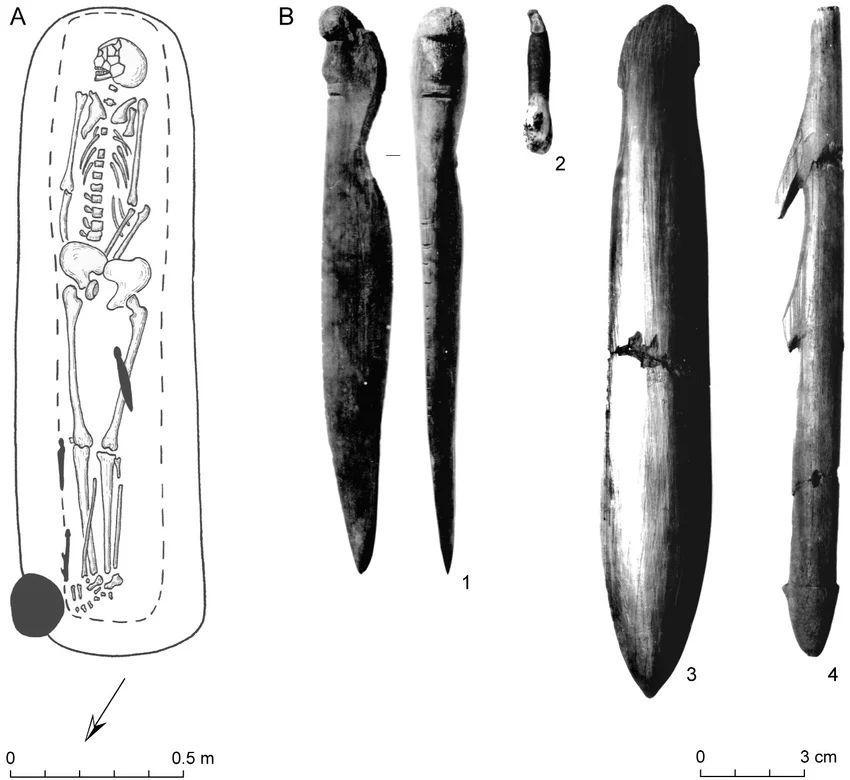
Sakhtysh is especially striking because it preserves burial grounds woven into daily life. The dead lay in the same remembered world as camps and fishing grounds. Returning to a familiar place meant returning to ancestors as well as resources. The past was present in the soil. Sakhtysh overturns the idea of prehistoric forest people as shadowy figures on the edge of civilization. Here are communities with enduring traditions, careful burial customs, and strong attachment to place.
The graves at Sakhtysh bring ancient individuals out of prehistory's blur and place them before us as people who were mourned, adorned, and carefully laid to rest. Among the most striking finds are ornaments made from bear teeth and marmot incisors. A bear tooth is not just decoration. Bears carry symbolic weight in many northern traditions, associated with strength, danger, and spirit power. Such ornaments may have marked personal identity, social role, or spiritual protection.
The burial landscape suggests continuity across generations. Mourners knew they were burying their dead where others already lay, creating layers of remembrance. Ancestors were not abstract figures. They were present in the ground itself. The graves at Sakhtysh matter because they restore depth to ancient hunter-gatherer lives. These people hunted, fished, and endured hard seasons, but they also decorated themselves and attached meaning to the creatures around them. The bear tooth and marmot incisor become clues to a vanished language of identity, spoken in bone and tooth, still faintly audible beneath the forest soil.
Each burial once held a person who walked forest paths, handled fishing gear, smelled woodsmoke, and knew local waters by experience. Bones tell of repeated labor and activity patterns. Teeth carry traces of diet. The body is a record of lived experience. Childhood would have been full of close observation: how to read tracks, where to find dry ground, when fish were running. Such knowledge was the very substance of survival.
The people of Sakhtysh appear to represent a long-lasting northern tradition with deep roots in the region. Their bodies preserve evidence of that continuity. There is something profoundly moving in the fact that these individuals lived during wider change they may never have fully seen. Elsewhere, farming villages expanded and new social worlds developed. Yet in the Sakhtysh forests, people continued a way of life rooted in fish, game, and seasonal movement. From their own point of view, they were simply present, practical, and adapted.
The people buried at Sakhtysh carried a strong Eastern Hunter-Gatherer ancestry that remained strikingly stable across centuries. In plain terms, these forest communities preserved an older population heritage long after much of Europe was being transformed by incoming farmers and later migrations. The forest zone was not a blank margin waiting to be absorbed into broader trends. It was a place of persistence.
Stable ancestry means grandparents, parents, and children likely shared not just genes but also ways of moving through the land, making ornaments, and burying the dead. That is the human meaning of population continuity. Remarkably, this older ancestry did not vanish. Later steppe populations carried Eastern Hunter-Gatherer ancestry across Europe, meaning threads from this forest world traveled into later peoples. Sakhtysh is both a stronghold of ancient continuity and a source of ancestry that would echo far beyond its wetlands.
Among the most intriguing discoveries is the story written in immune genes. The evidence suggests low diversity in some of these genes, typical of small, closely connected communities, yet certain variants appeared at strikingly high levels. The people of Sakhtysh lived in wetlands full of parasites, insects, and infections. Over generations, certain immune traits likely helped people survive the specific challenges of this environment.
History is written not only in weapons and ornaments but in the body's hidden defenses. The dead at Sakhtysh were vulnerable human beings negotiating hunger, infection, and seasonal hardship. Yet their story extends into legacy. Some immune-related lineages from this forest world may still survive in modern Europeans, transformed by thousands of years of mixing but real nonetheless. Traits shaped beside rivers and bogs could travel into entirely different environments and historical settings.
Sakhtysh links graves, ornaments, landscape, ancestry, and immune history into a single picture of survival. Beneath the reeds and forest floor, archaeology found not only ancient bones but evidence of adaptation, endurance, and inheritance that still echoes in the biology of people living today.
 EMBL-EBI



Comments