Clan ODowd

– 3 min read


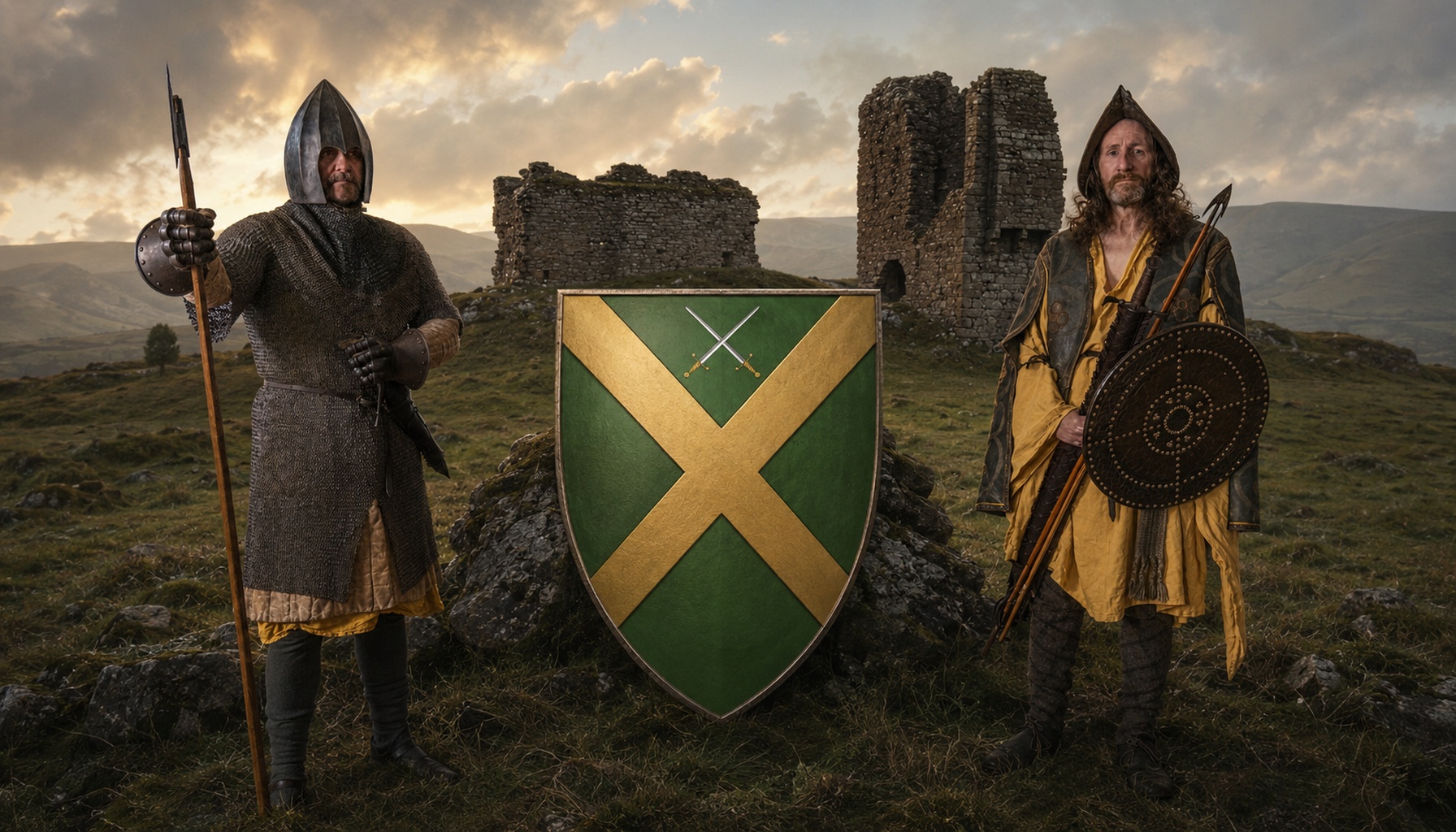
Clan ODowd was one of the great Gaelic lineages of northwest Ireland, rooted in Tireragh in County Sligo and closely tied to the sea-facing world of western Connacht. Their historical identity grew out of territorial rule, warrior leadership, kinship, and command of a coastal lordship that looked not only inland across its own lands, but outward to the Atlantic. In haplogroup terms, the primary family association given here is R1b1a1b1a1a2c1a1a1a1a1a1a, a branch linked with a wider western European paternal story. For the ODowds, though, the important thing is not a string of letters alone, but the way a name, a place, and a political tradition endured together across centuries.
The family emerged within the old Gaelic framework of Connacht, and more specifically among the Princes of Ui Fiachrach Muaidhe, a ruling kindred whose power centered on the River Moy region and the coastlands nearby. This was not a marginal world at all, despite modern maps making it seem a far western edge. In medieval Irish terms it was a strategic frontier of landfalls, fisheries, coastal movement, alliances, rivalries, and lordly control. Chiefs such as Ruadhri ODowd, Chief of Tireragh from 1380 to 1417, Tadhg Riabhach ODowd, Chief of Tireragh from 1417 to 1432, and Maolruanaidh ODowd, Chief of Tireragh until 1447, belong to that long line of leadership. Their story is one of maintaining authority in a landscape where politics, warfare, inheritance, and geography were tightly woven together.
Read more about the Noble House of OMalley
One of the strongest physical anchors of ODowd memory is Ardnaglass Castle, long associated with the clan and dramatically placed in the coastal zone that defined so much of their power. Ardnaglass is not just a ruined tower to be glanced at in passing; it stands as a reminder that the ODowds were lords of a maritime landscape, where strongholds had to watch both sea routes and local approaches. The castle is traditionally connected with the later medieval chiefs of the family and with the defensive, political, and symbolic architecture of Gaelic lordship in Tireragh. Perched above a rugged Atlantic setting, it captures perfectly the ODowd combination of territorial command and coastal awareness. Better still, the site can still be visited, making it one of those rare places where family history is not trapped in parchment or annals, but still visible in stone and setting.
From a DNA perspective, the ODowd-linked haplogroup R1b1a1b1a1a2c1a1a1a1a1a1a also appears in a wider network of related ancient and historical samples across Ireland and beyond. These include Medieval Ireland individuals from Kilteasheen, Roscommon such as KIL033, KIL037, KIL043, and KIL009, alongside linked samples from Viking Warrior Ship Street in Dublin, sample VK545, Viking Age Hofstadir in Iceland, VK95, and the Medieval Faroe Islands, VK44. Related branches also show up in places as varied as Aalborg in medieval Denmark, sample CGG100512, Deersheim in Saxony-Anhalt, sample DRH026, Groningen in the Carolingian Netherlands, GRO005, Alt-Inden in Germany, IND007, Anglo-Saxon Norfolk, SED005, Pech-Maho in France, PECH8, and even colonial Maryland with the Calvert-linked coffins I2097 and 2099. None of this proves direct descent from any one of these individuals, of course, but it does place the ODowd haplogroup within a broad and fascinating web of Atlantic, insular, and northwest European paternal history.
Clan ODowd remains a vivid example of the western Irish clan pattern at its most distinctive: landholding power, coastal strength, named chiefs, remembered castles, and a surname that carried identity through generations. If this is your family story, or even if you are simply curious whether your DNA connects with the ODowds or with related ancient samples from medieval Ireland and the wider Atlantic world, you can explore it further by uploading your DNA to MyTrueAncestry.
Comments