Haplogroup O1a1a1a1
– 5 min read


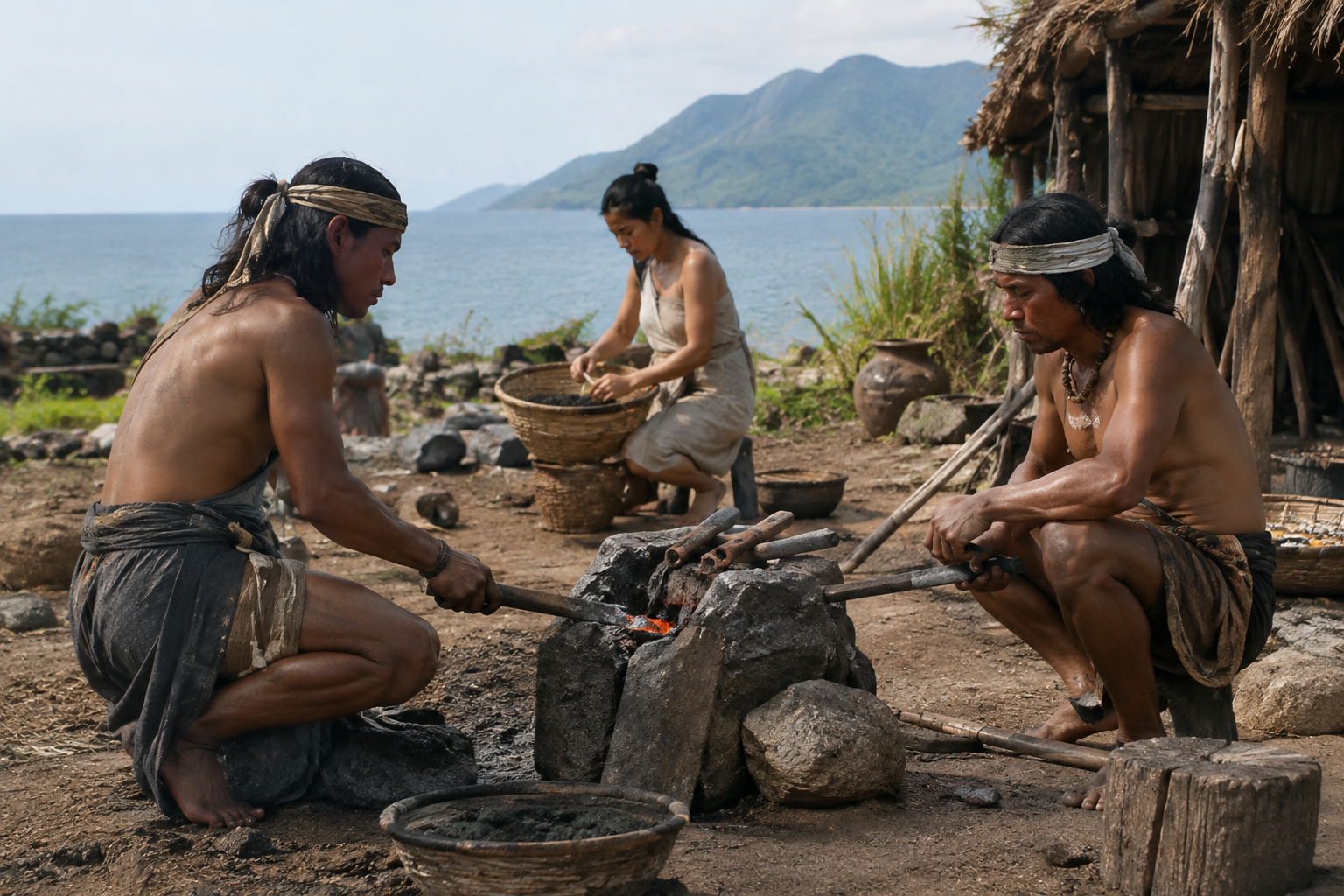
At Hanben on Taiwan's east coast, two men from the Blihun Metalworking Period stand out for a very particular reason. Sample I3731, dated to about AD 305, and sample I3736, dated to about AD 400, both connect to the Y-DNA haplogroup O1a1a1a1. That is a narrow paternal clue, not a whole biography, but in archaeology even a narrow clue can be immensely revealing when it turns up more than once in the same place and period.
Hanben matters because it sits in one of the great crossroads of island history: the mountainous, sea-facing corridor of eastern Taiwan, long discussed in debates about Austronesian origins, local continuity, and coastal movement. The presence of O1a1a1a1 in two Iron Age individuals from the same community does not solve every grand question, but it does give us something much better than grandness: a real, excavated paternal signal tied to a documented archaeological setting.
The two ancient individuals associated here with O1a1a1a1 come from Iron Age Hanben, a site linked to the Blihun Metalworking Period. Their dates, around the 4th century AD, place them in a Taiwan already far beyond first settlement and deep into a period of established local communities, exchange networks, and metal use. In other words, these are not "first arrivals" in any simple sense. They belong to a mature society with its own regional history.
That is important because Y-DNA discussions often become too sweeping too quickly. A lineage like O1a1a1a1 traces one direct paternal line only: father to father to father. It does not define the full ancestry, language, or identity of the men buried at Hanben. But when the same branch appears in more than one male at the same site, it begins to suggest that this paternal line was not an isolated accident. It was part of the living structure of that community.
A genetic study of ancient Taiwan and Island Southeast Asia has helped frame why sites like Hanben are so significant for wider population history, especially in discussions of long-term connections across coastal East Asia and the Austronesian world. For readers who want the scientific background to that broader regional question, one key paper is available here: https://pmc.ncbi.nlm.nih.gov/articles/PMC4083334/.
East Asian Y-Chromosome Migrations
I3731 and I3736 are useful precisely because they are modest pieces of evidence. Archaeology is full of temptation to turn two men into a dynasty, a tribe, or a migration event. We should resist that. What these burials show, more cautiously and more usefully, is that a lineage associated with O1a1a1a1 was present in eastern Taiwan during the Iron Age and present in at least two separate individuals a generation or more apart.
The dating is worth noticing. About AD 305 and AD 400 are close enough to imply continuity within the same broad cultural horizon, yet far enough apart that we are not merely looking at a single moment or a single household snapshot. The branch was evidently established at Hanben across time, not just passing through for a season.
That sort of continuity is often more informative than a single spectacular burial. It hints at a locally rooted paternal history in eastern Taiwan during the late prehistoric to protohistoric period. For people researching this haplogroup today, that is the article's strongest ancient anchor: not a legendary founder, but a repeated archaeological presence in a real settlement landscape.
The phrase "Blihun Metalworking Period" is itself a reminder that genes do not sit in a vacuum. These men belonged to a society identified archaeologically through material culture and technological practice, not through DNA labels. Metalworking in Taiwan's Iron Age points to interaction, skill, and participation in wider exchange networks. Eastern Taiwan was hardly cut off from the world; it was part of a maritime sphere in which people, materials, and ideas moved along coasts and between islands.
That broader setting makes O1a1a1a1 historically interesting. Haplogroups survive through families, but families live inside economies and landscapes. A paternal branch found at Hanben was being transmitted in a community shaped by coastal geography, inter-regional contact, and local adaptation. The lineage's story, therefore, is not simply one of origin, but of persistence within a socially active Iron Age world.
It is also a useful corrective to older habits of thinking about Taiwan only as a launch point for elsewhere. Hanben asks us to pay attention to Taiwan itself: its own communities, its own local histories, and its own long internal continuities. These two men are not just stepping stones in someone else's migration narrative. They were members of an eastern Taiwanese community with a history of its own.
Haplogroup O and its many branches are widely associated with East and Southeast Asian paternal histories, but that broad statement should not be lazily collapsed into a neat tale for O1a1a1a1 itself. The narrower branch in this article must be treated on its own evidence. Here, the hard evidence is eastern Taiwan in late Iron Age contexts, represented by I3731 and I3736.
Even so, that evidence sits in a region central to debates over Austronesian-speaking populations. Taiwan has long been crucial to linguistic, archaeological, and genetic models about the peopling of Island Southeast Asia and the Pacific. Ancient paternal lineages recovered from Taiwan are therefore especially valuable because they add time depth. They show that some branches now discussed in modern populations were already embedded in island communities well over 1,500 years ago.
That is why ancient DNA is so useful when handled carefully. It does not hand us ethnicity in a test tube. What it can do is pin a lineage to a place and period. With O1a1a1a1, Hanben gives us exactly that: eastern Taiwan, Iron Age, around the 4th century AD.
Palau's Early East Asian Links
There is a pleasing discipline in this evidence. We have no need to embroider these burials with invented grave goods or dramatic identities. The interest lies in the pattern itself. Two males from Hanben, I3731 and I3736, both associated with O1a1a1a1, give us a small but credible window into paternal continuity on Taiwan's east coast.
And small windows matter. Much of archaeogenetics advances not by discovering a single "famous" skeleton, but by accumulating repeated, site-specific signals that can later be compared across time and space. Hanben may eventually be read alongside other Taiwan, coastal China, Philippine, or wider Austronesian datasets. For now, it already offers a valuable fixed point.
That fixed point is especially useful because eastern Taiwan is not merely peripheral to mainland narratives. It is one of the places where local archaeological sequences and wider maritime history meet. O1a1a1a1 at Hanben belongs to that meeting point.
The clearest ancient picture for O1a1a1a1 in this evidence is not an empire, a royal house, or a heroic founder. It is Hanben in Iron Age eastern Taiwan, where samples I3731 and I3736 show this paternal branch present across the 4th century AD within the Blihun Metalworking Period. For anyone exploring this haplogroup today, that is a solid and meaningful clue: your direct paternal line belongs to a branch with documented roots in an eastern Taiwanese archaeological community tied to the wider coastal history of East Asia and the Austronesian world.



Comments