Haplogroup Q1a1b1
– 6 min read


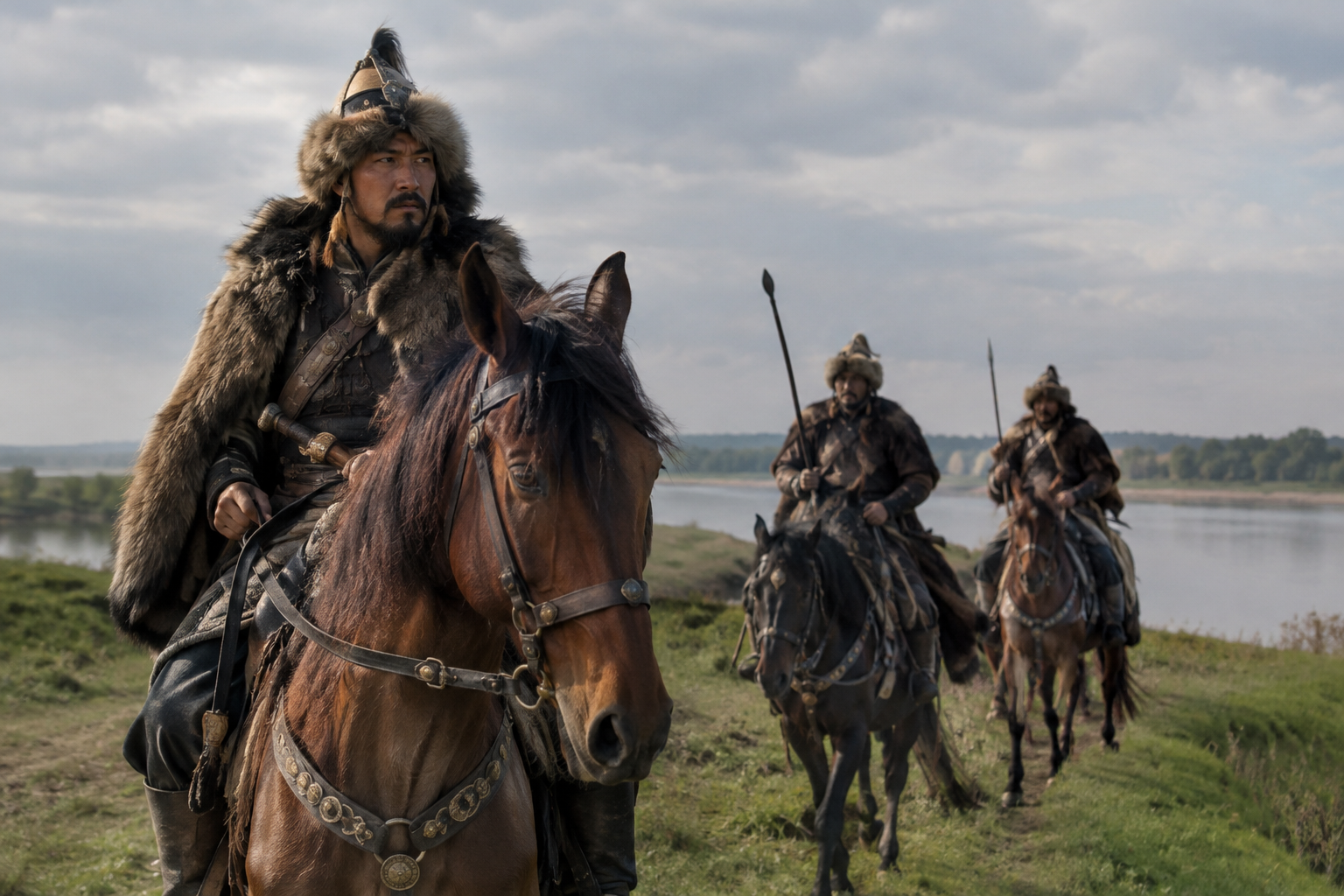
One of the most arresting clues for Y-DNA haplogroup Q1a1b1 in the ancient record comes from a single man buried in the Carpathian Basin during the age of the Huns. He is recorded as HNF075, dated to around AD 450, and described as a Hun invader from Hungary's Danube-Tisza region. That is a small amount of information on paper, but historically it places him in one of the most turbulent and mobile moments in late Roman Europe, when power, people, and military retinues were moving across the steppe and into the heart of the former empire.
For anyone researching Q1a1b1 today, that matters because haplogroup Q is not the lineage most people first associate with fifth-century Hungary. Its appearance in a Hun-period context immediately points eastward, toward the broader Eurasian world from which the Huns emerged. That does not mean every bearer of Q1a1b1 shared the same ethnicity, language, or life story; Y-DNA follows one direct paternal line only. But in this case, the line is a useful historical signal, because it appears in exactly the sort of frontier-setting where archaeologists and geneticists expect to find evidence of long-distance movement.
The Danube-Tisza Interfluve, the broad plain between two of central Europe's great rivers, became a crucial zone in the fifth century. This was not some remote fringe. It was a strategic center of power during the Hun period, tied to raiding, diplomacy, tribute, and the collapse of Roman control across neighboring regions. A man like HNF075 belonged to that historical landscape: not a legend on horseback, but an excavated individual whose paternal line preserves a trace of the wider world behind Hun expansion.
What makes that valuable is context. The Huns were never a simple, biologically uniform people. They were a political formation, drawing in different groups across the steppe and beyond. So when a Hun-period burial in Hungary carries a lineage like Q1a1b1, the interest lies less in trying to pin a single modern identity on it, and more in seeing how eastern steppe-linked paternal lines entered and operated within European settings during late antiquity.
A recent ancient DNA study of Hun-period and related populations in the Carpathian Basin has helped sharpen this picture, showing that some individuals connected with the Hun horizon carried ancestry and lineages with strong eastern Eurasian associations, while others were far more mixed or locally rooted. That broader research frame is the right way to read HNF075: as part of a historically mobile and genetically varied world, not as a lone representative of an entire people. See the research here: https://www.pnas.org/doi/10.1073/pnas.2418485122?sfnsn=mo&sfnsn=scwspmo&fbclid=IwY2xjawIq3rpleHRuA2FlbQIxMQABHZBFk9G4ThAr1GQIOnp-hU6S376GrYkadAYg3fntCaEDF96KrH97_fnftw_aem_mEMvG7-GRaMWM_nz2BLnjg#t01.
It is worth being precise. The article haplogroup here is Q1a1b1, a branch within the wider Y-DNA haplogroup Q. The larger haplogroup has a deep history across northern Eurasia and, in other branches, the Indigenous Americas as well. But that broad fame can be misleading. You cannot simply take the whole prehistoric range of haplogroup Q and paste it directly onto this narrower branch, still less onto one fifth-century burial in Hungary.
What can safely be said is that Q1a1b1 belongs to a paternal lineage family more commonly associated, at broad scale, with northern and eastern Eurasian population history than with the dominant Y-lineages of most ancient European farming or classical Mediterranean populations. In a Hun-period burial, that makes historical sense. It fits a world of steppe confederations, shifting alliances, and male-line networks that could move over very large distances.
The important caution is that a haplogroup is not a tribe. HNF075 may have lived under Hun authority, traveled with a military grouping, descended from earlier eastern migrants, or belonged to a mixed community in the Carpathian Basin. Q1a1b1 cannot decide among those possibilities by itself. What it does provide is a paternal breadcrumb, one that gains meaning only when laid alongside archaeology and the wider historical record.
At first glance, one sample may seem too little to build much on. Yet ancient DNA often works like archaeology itself: a single find can become important because of where and when it appears. HNF075 is not just another isolated chromosome call. He sits at a historical bottleneck, in a region that linked the Pontic steppe, the Balkans, the late Roman world, and central Europe.
That is exactly why fifth-century Hungary matters so much in archaeogenetics. The Carpathian Basin repeatedly absorbed newcomers, local survivors, imperial dependents, and mobile armed elites. When a lineage such as Q1a1b1 turns up there in the Hun period, it helps confirm that some paternal lines reaching central Europe at this time were part of much wider trans-Eurasian movements.
The point is not that Q1a1b1 was uniquely "Hun," nor that everyone carrying it must trace back to the same historical migration. Rather, this sample demonstrates that the lineage had entered the historical stage of late antique Europe in a clearly steppe-connected context. For descendants exploring their paternal ancestry today, that is a more useful and more honest conclusion than any grander myth.
The deeper significance of HNF075 lies in the historical direction he suggests. The Hun world did not arise inside the Roman provinces; it emerged from the larger steppe zone stretching far to the east. Archaeology, history, and genetics increasingly agree that the peoples who entered Europe under the Hun umbrella were heterogeneous, but some of their lineages and ancestry components had roots in Inner Asia and adjacent steppe regions.
That larger eastern horizon helps explain why lineages from haplogroup Q appear so strikingly in discussions of steppe mobility. In popular imagination, Europe after Rome is often told as a story of Goths, Franks, and local provincials. The Hun evidence disrupts that neat map. It reminds us that central Europe in the fifth century was also connected to worlds far beyond the Danube frontier, with paternal lines that had travelled, or whose recent ancestors had travelled, across extraordinary distances.
This is also where genetic evidence is at its best when handled carefully. It does not replace the historical sources on the Huns, which are fragmentary and often hostile. But it does add a different kind of record: one preserved in bones rather than chronicles. A single Y-line such as Q1a1b1 cannot narrate events, yet it can reveal that the men buried in Hun-period Europe were not drawn from a narrow local pool alone.
It is easy to speak of invasions as though they were clean arrows on a map. The archaeology of the Carpathian Basin shows something messier and more human. This region was a meeting ground where imperial collapse, military recruitment, family movement, and political opportunism all overlapped. A man buried there around AD 450 could have been born locally, arrived recently, or belonged to a community already transformed by decades of contact and migration.
That is why the label "Hun invader" should be read as a historical and archaeological classification, not a full biography. HNF075 belonged to a context associated with the Hun horizon in Hungary. His Q1a1b1 paternal line strengthens the impression of eastern links within that milieu, but it does not turn him into a one-man summary of Hun identity. If anything, the value of the sample lies in showing how late antique power in Europe could gather together lineages from very different backgrounds.
The same broader lesson appears across steppe-border archaeology: political confederations often look more diverse genetically than older nationalist histories ever allowed. That is one reason Hun-period genomes have become so interesting. They make visible the mixture behind the labels.
For members of the MyTrueAncestry community, Q1a1b1 is best understood here through one sharply defined window: a fifth-century man, HNF075, buried in Hun-period Hungary at the crossroads of empires and steppe worlds. That does not give this lineage a single ethnicity or a neat heroic narrative. What it does suggest, responsibly, is that this paternal branch was present in the mobile eastern networks that helped reshape Europe after Rome.
If your own direct paternal line falls under Q1a1b1, this ancient find is a reminder that one branch of your ancestry may connect to histories of movement across northern Eurasia and into late antique Europe. Not the whole of your ancestry, and not a guaranteed tie to any named tribe, but a real and intriguing clue from an excavated man who lived at one of history's great fault lines.






Comments