Haplogroup J2a1a2b2a2
– 5 min read


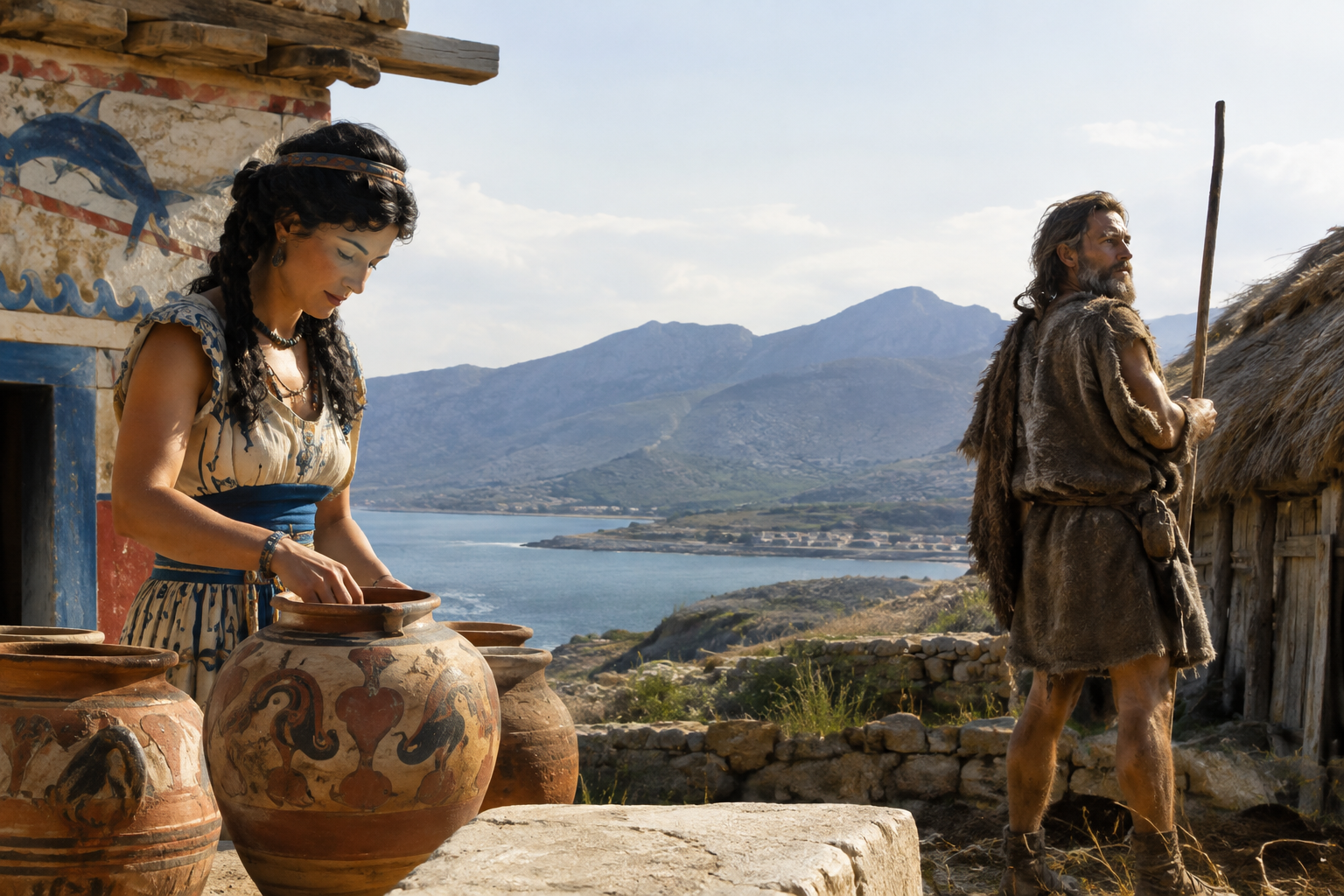
At Chania on Crete, one ancient male labeled XAN029 places this Y-chromosome line in a setting that is instantly recognizable and still slightly elusive: the Minoan world, around 1575 BC. That matters because haplogroup J2a1a2b2a2 belongs within the wider J2 family, a branch often associated in broad terms with eastern Mediterranean and western Asian population history, but here it turns up not as abstraction, but as a man from a real Bronze Age community on Crete.
The other striking point is that the evidence is not confined to one famous island civilization. Another ancient male tied to this haplogroup report, I5078, comes from Osijek in Croatia and is dated here to 4620 BC. Even before one starts telling grand migration stories, that pairing alone is interesting: one sample in the prehistoric Balkans, another in Minoan Crete. It suggests that for men carrying lineages within this branch's wider paternal background, the story belongs to the connected worlds of southeast Europe and the Aegean, where farming, trade, and mobility were reshaping society over millennia.
Y-DNA traces one very narrow line of descent: father to son, back through time. So J2a1a2b2a2 does not describe a person's whole ancestry, language, or ethnicity. What it does offer is a durable thread through the male line, useful precisely because it can sometimes be spotted in very different archaeological settings.
For this article's branch, the safest way to think about it is as a specific subclade inside the broader J2a world. The wider J2a family has a long and complicated history across the Near East, Anatolia, the Aegean, and parts of Europe. But the evidence here should not be stretched beyond what the samples allow. We are not looking at proof of one tribe, one kingdom, or one uninterrupted family. We are looking at glimpses of paternal continuity and movement across regions that were already deeply interconnected in prehistory.
XAN029 is the more historically evocative of the two samples because Chania places us squarely in Bronze Age Crete. By the mid-second millennium BC, Crete was part of a maritime world linked to the Cyclades, mainland Greece, Anatolia, the Levant, and Egypt. A man carrying a lineage reported here as J2a1a2b2a2 fits neatly into that broader eastern Mediterranean context, though one must be careful not to turn "fits" into "proves."
What makes the Minoan evidence so useful is that it anchors this haplogroup in a society famous for palaces, seaborne exchange, and regional connectivity, but whose population history was far more local and layered than older romantic narratives allowed. A major ancient DNA study of the Aegean, published in Nature, helped establish how Bronze Age populations in Crete and mainland Greece can be studied genetically without reducing them to simple origin myths. In that kind of setting, a Y-line such as J2a1a2b2a2 is best read as one paternal strand within a larger Minoan population.
Chania also matters because western Crete is not some remote cul-de-sac. It sat within networks of movement around the Aegean basin. If your paternal line falls in J2a1a2b2a2, this sample does not mean you descend from a palace official, sailor, or merchant at Chania. But it does place your branch, or a very close reported equivalent of it, in a real Minoan-period landscape where sea routes and local ancestry met.
The sample I5078 from Osijek, dated here to 4620 BC, pushes the discussion much earlier and northward into the Balkans. That date sits in the later Neolithic or Copper Age horizon of southeast Europe, a period when farming communities had long been established and regional cultures were already developing distinctive local identities. In other words, this is not yet the age of Homeric memory or Minoan palaces; it is a much older agricultural world.
This earlier appearance is valuable because it shows that paternal lines associated with this haplogroup were present in the Balkans well before the better-known literate civilizations of the eastern Mediterranean. That matters historically. It suggests that when we later encounter related paternal signatures in Aegean settings, we are not necessarily seeing something newly arrived in the Bronze Age. Some branches of the wider J2a family were already part of the demographic fabric of southeast Europe during the long aftermath of the Neolithic transition.
A large-scale study of prehistoric Europe published in Science has been central to showing just how dynamic these post-Neolithic populations were, especially across the Balkans and neighboring regions. For a lineage like J2a1a2b2a2, the key historical lesson is not a single migration arrow on a map, but repeated episodes of settlement, mixture, and local persistence.
It is tempting to separate "Balkan prehistory" from "Aegean civilization," as if one were a prelude and the other the main act. Ancient DNA keeps spoiling that tidy division. The Balkans and the Aegean were linked by movement of people as well as ideas, crops, animals, and technologies. River routes, coastal corridors, and short sea crossings mattered for thousands of years before classical historians began writing about them.
That is the most sensible framework for interpreting the present evidence. I5078 in prehistoric Croatia and XAN029 in Minoan Crete do not prove a direct chain of descent between those two individuals. What they do show is that this paternal branch belongs to a wider human geography in which southeast Europe and the Aegean were repeatedly in contact.
This is also why J2a lineages so often appear historically interesting. They are frequently found in the sorts of regions where early farming spread, villages thickened into towns, and maritime worlds connected distant shores. But the narrower label J2a1a2b2a2 should still be handled carefully. The broad family has a huge range; your exact branch is a much finer twig on that tree.
With only a small number of ancient examples, the right approach is to ask what each one adds. Chania gives us a Bronze Age Aegean context of high connectivity and developed local society. Osijek gives us a much earlier southeastern European context, reminding us that paternal histories in this zone did not suddenly begin with famous civilizations.
Together, they create a stronger picture than either would alone. They place J2a1a2b2a2 in regions that were central to the movement of Neolithic farmers and later to the making of Bronze Age eastern Mediterranean societies. That is a historically meaningful pattern even when we resist the urge to oversimplify it.
There is another quiet lesson here as well. Ancient DNA often shows long maternal continuity alongside changing paternal patterns, or local continuity alongside incoming ancestry. A Y-line can persist, branch, and move through many different social worlds. The men carrying this lineage in prehistoric Croatia and Minoan Crete were not living the same history, even if their direct paternal lines were ultimately related.
For someone researching J2a1a2b2a2 today, the clearest supported insight is that this lineage sits comfortably inside the deep population history of the Balkans and the Aegean. The ancient record here does not hand you a neat label such as "Minoan," "Illyrian," or "Greek" in any exclusive sense. What it does offer is something more interesting and more credible: a paternal line present in the old connective tissue between southeast Europe and the eastern Mediterranean, from prehistoric farming landscapes to Bronze Age Crete.
That is a good reminder that ancestry is rarely a single-origin tale. In this case, the historical weight of J2a1a2b2a2 lies in its appearance within regions that were busy, mixed, and important very early on. It is a line with ancient roots in the worlds around the Balkans and the Aegean, and that alone makes it a fascinating paternal inheritance to explore.
Comments