The Noble House of OMalley
– 3 min read


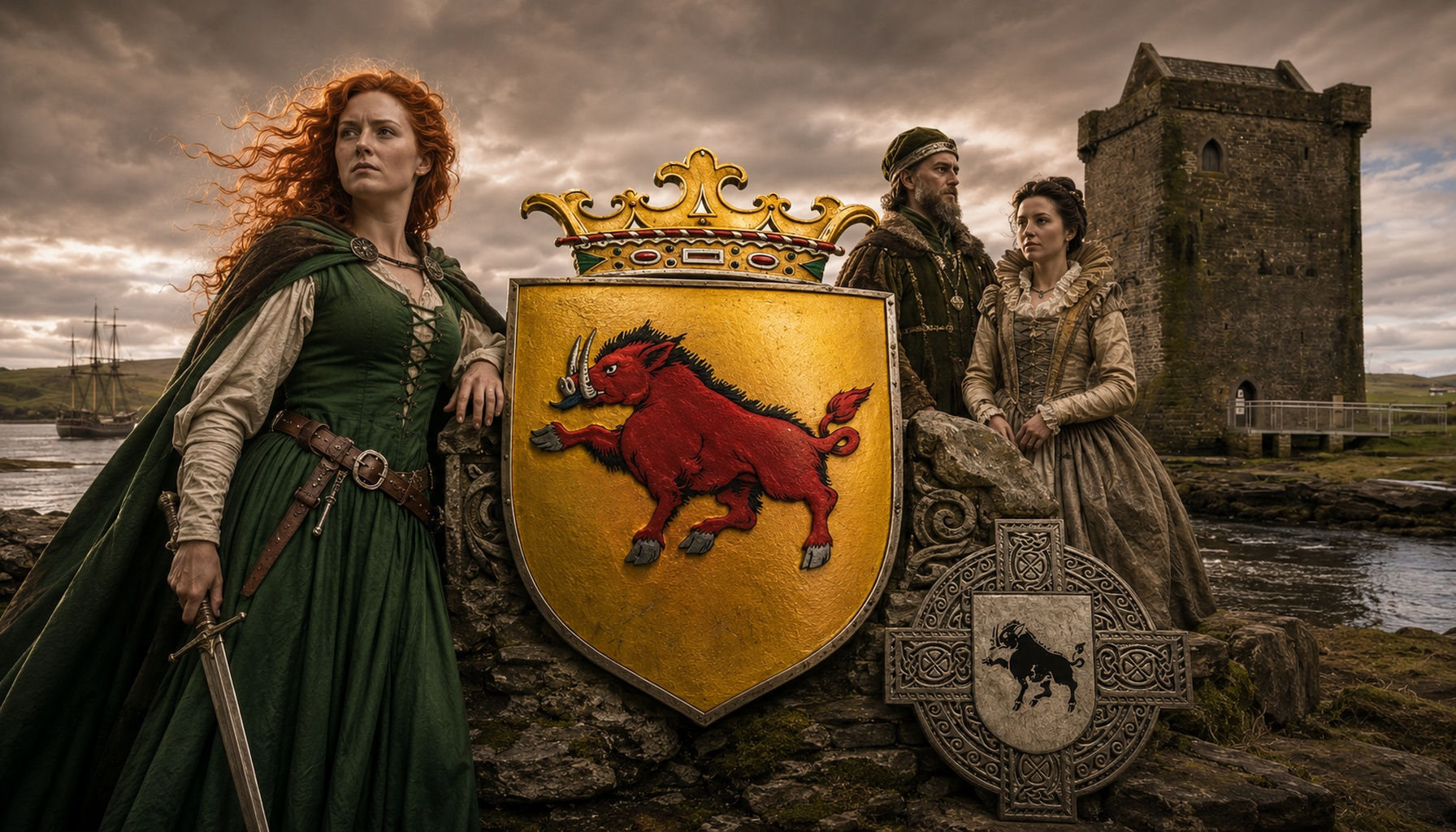
The House of OMalley was one of the great Gaelic noble houses of western Ireland, rooted in Umhall in what is now County Mayo, around Clew Bay and the Atlantic coast. Their heritage is closely associated with the Y-DNA haplogroup R1b1a1b1a1a2c1a1a1a1a1a1a, a lineage linked here as the primary family haplogroup. The OMalley story is not the familiar inland pattern of fields, rents, and manorial estates alone. This was a dynasty made on the water as much as on the land, a ruling family whose authority came from ships, harbours, sea routes, island strongholds, and command of the dangerous western seaboard.
That is what makes the OMalley house so memorable in Irish history. They emerged from a Gaelic world in which kinship, lordship, and military power were intertwined, but they did so in a region where the sea was the chief road. Their name appears deep in the medieval record, with figures such as Maille mac Conall, King of Ui Maille, recorded in 812, showing the antiquity of the dynasty. By the 16th century we meet men such as Donal na Piopa OMalley, active around 1550, and Owen Dubhdara OMalley, Chief of Umhall Uachtarach in 1575, part of a family still asserting local sovereignty in a changing and increasingly pressured Ireland. Above all stands Grace OMalley, whose extraordinary life carried the family into lasting fame, but she belonged to a much older noble tradition built by generations of chiefs, mariners, warriors, and negotiators.
Read more about Clan OFlaherty
One of the most vivid anchors of OMalley heritage is Rockfleet Castle, near Newport in County Mayo, standing close to Clew Bay on a tidal inlet. The tower house most likely dates to the 16th century and is traditionally associated with Grace OMalley, which is hardly surprising, because it sits in exactly the sort of landscape that explains OMalley power: narrow water channels, sheltered access, and a commanding view of movement along the coast. This was not a grand ceremonial palace in the continental style. It was a practical Gaelic stronghold, built for defence, oversight, and quick access to the sea. Like so much of western Irish lordship, Rockfleet was part residence, part fortress, part statement that this coast belonged to a ruling family who understood tides and ships as well as any courtier understood parchment. The castle still stands today as a national monument, and it can be visited, which makes it one of the best places to grasp the real texture of OMalley history on the ground, or rather on the edge between ground and water.
From an ancient DNA point of view, the OMalley-linked haplogroup R1b1a1b1a1a2c1a1a1a1a1a1a belongs to a wider paternal network seen across medieval and post-Roman Europe. Related or linked samples include Medieval Ireland from Kilteasheen, Roscommon, such as KIL009, KIL033, KIL037, and KIL043, which are especially interesting for anyone looking at Irish continuity in the medieval period. Beyond Ireland, linked examples appear in Medieval Jutland, Denmark at Vor Frue Kirkegard Aalborg (CGG100512), among the Thuringii in Germany at Deersheim, Saxony-Anhalt (DRH026), in Carolingian Groningen in the Netherlands (GRO005), in a Merovingian grave at Alt-Inden in North Rhine-Westphalia (IND007), in Anglo-Saxon Norfolk at Sedgeford (SED005), in Viking Age Hofstadir, Iceland (VK95), the medieval Faroe Islands at Sandoy Church (VK44), and a Viking warrior burial at Ship Street, Dublin (VK545). More distant linked examples include Pech-Maho in France (PECH8) and the Calvert family burials in colonial Maryland (I2097 and 2099). None of these should be taken as proof of direct descent from the OMalley chiefs, but together they show how this paternal branch turns up in the same broad Atlantic and northwestern European world in which Gaelic maritime families like the OMalley house took shape.
Read more about the Royal House of ONeill
If you carry OMalley heritage, or simply want to know whether your DNA connects with this remarkable seafaring noble tradition or with related ancient samples from medieval Ireland and the wider Atlantic world, you can explore it directly through MyTrueAncestry. Upload your DNA and see whether you match the House of OMalley, their linked haplogroup R1b1a1b1a1a2c1a1a1a1a1a1a, or the broader network of ancient individuals connected to this deep historical landscape.
Comments