Haplogroup J1a2a1a2d2b2b2c4b1c

– 5 min read


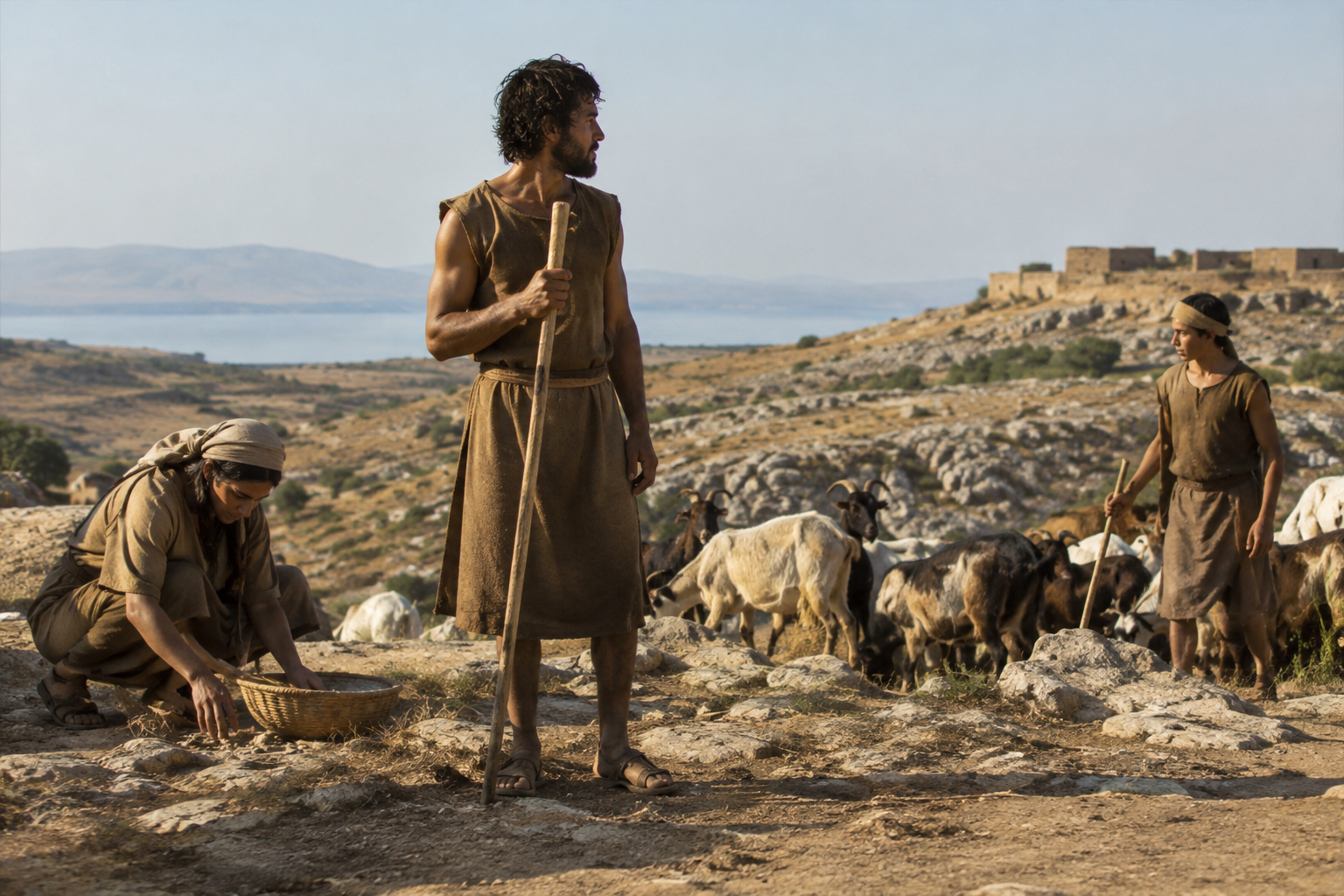
At Baq'ah in Jordan, two men buried in the Late Bronze Age - sample I3706, dated around 1370 BC, and sample I6459, dated around 1350 BC - offer a small but telling glimpse of a paternal line now labeled J1a2a1a2d2b2b2c4b1c. The site sits in the southern Levant at a time when this was no isolated backwater, but a world of towns, fields, trade routes, shifting allegiances, and regular contact with Egypt, inland Syria, and farther Mesopotamia.
That matters because a Y-DNA branch is not a whole identity. It traces one direct male line only. Yet when the same branch appears more than once at one Bronze Age site, it becomes archaeologically interesting: not as proof of a dynasty, tribe, or language, but as evidence that one paternal line was part of the lived population of Baq'ah in the centuries when Levantine societies were deeply interconnected.
The two ancient individuals tied here to J1a2a1a2d2b2b2c4b1c come from the same Jordanian site and from dates close together in time. That is already the main story. We are not looking at a lone outlier buried on the margins of the known world, but at repeated evidence from one place in the Late Bronze Age.
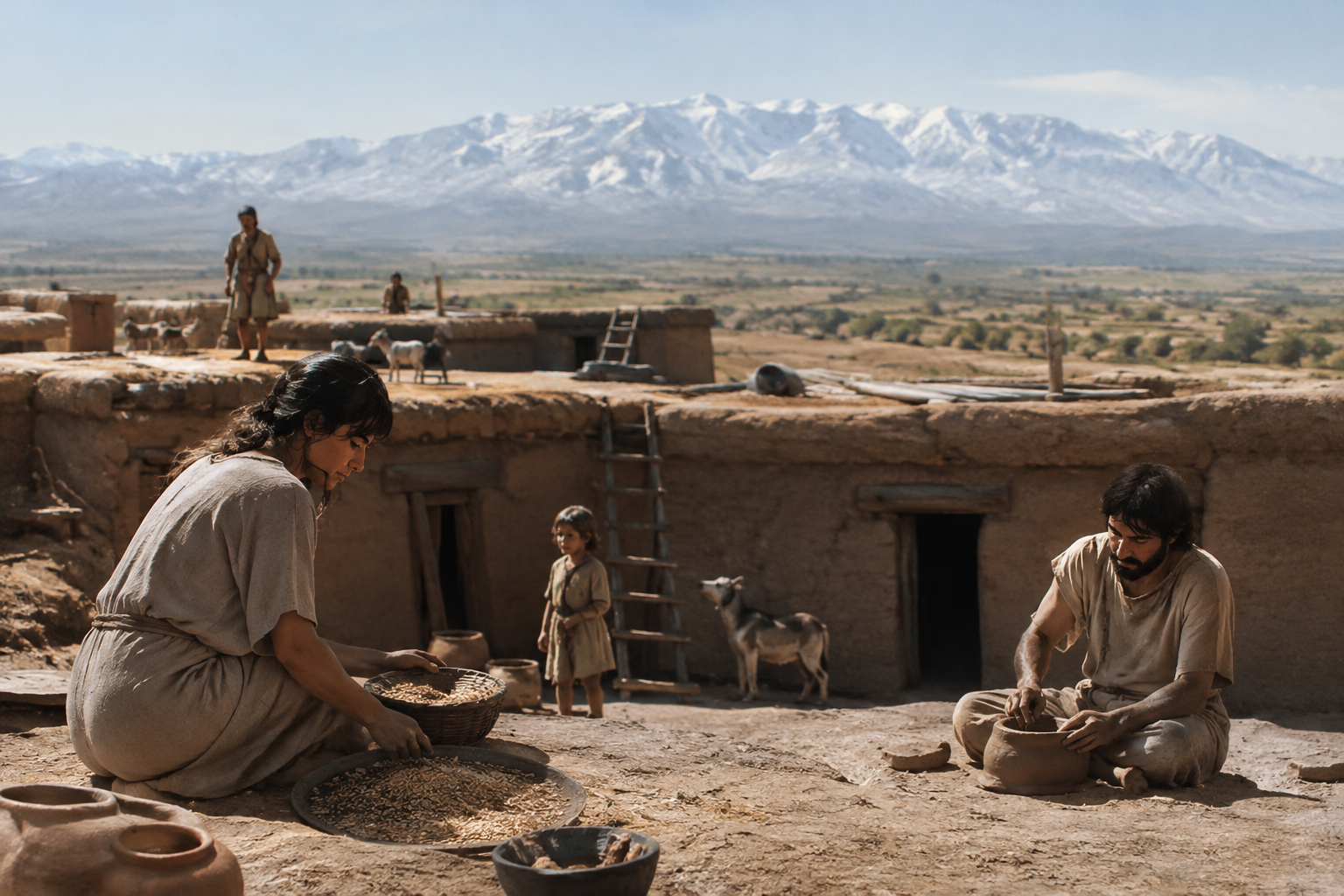
Baq'ah belongs to a period when the southern Levant was crowded with local continuities and outside pressures. Towns were linked by exchange, diplomacy, and sometimes by imperial supervision. In such a setting, paternal lines could persist locally for generations while the wider population around them mixed, moved, married, traded, and adapted.
For this reason, I3706 and I6459 are valuable less for romance than for context. They show that this branch - or at least a closely related paternal lineage associated with it - had a place in Bronze Age Jordan. With only two men, caution is essential. But two men from one site are still more informative than a single isolated find.
An ancient DNA study of populations from the broader region, published in Cell, helped establish just how interconnected Bronze Age and Iron Age peoples of the Near East could be while still preserving substantial local continuity. Baq'ah fits that larger historical picture very well.
Bronze and Iron Age Mesopotamia
The label J1a2a1a2d2b2b2c4b1c is extremely specific: a deep twig on the much larger Y-chromosome tree under haplogroup J1. That wider J1 framework is often discussed in connection with parts of the Near East, but it would be careless to take every broad statement about J1 and pin it directly onto this narrow subclade. The smaller the branch, the more we should stick to the actual evidence in hand.
In this case, the strongest evidence is not a grand migration map but these Late Bronze Age burials in Jordan. The branch's importance lies in its secure appearance in the southern Levant in the second millennium BC. That gives researchers and testers a real historical anchor: this paternal line was present in the region during the age of Canaanite city networks and Egyptian power in the Levant.
It is also worth noting what we cannot responsibly say. Two nearby individuals do not automatically prove a ruling lineage, a clan cemetery, or even close kinship unless a study says so directly. Archaeology is full of overexcited leaps; the better habit is to let the modesty of the evidence sharpen the story rather than flatten it.
The Late Bronze Age southern Levant is sometimes described as though every important change arrived from elsewhere. But sites like Baq'ah remind us that history in this region was made by settled communities as well as by empires and merchants. Men carrying lineages like J1a2a1a2d2b2b2c4b1c were not abstract arrows on a map. They were part of the local demographic fabric.
That local fabric, though, was never sealed off. Jordan sat within a corridor linking Arabia, the Levantine coast, inland Syria, and Mesopotamia. So when a paternal lineage appears there in the Bronze Age, the interesting question is not whether the region was "mixed" or "pure" - those are not useful archaeological categories - but how long certain family lines endured within populations that were continuously interacting.
The paired Baq'ah samples suggest precisely that sort of endurance. Even without elaborate burial descriptions, their shared setting hints at social continuity across at least part of the site's male population. In a period defined by regional diplomacy, trade, and occasional upheaval, continuity at the household or lineage level is historically significant.
Earlier Levantine burial traditions
Ancient DNA often gives us a frustratingly patchy record. A single Y-DNA result can be tantalising, but hard to place. Two results from the same site and period are better because they begin to move us from anecdote toward pattern. Not certainty, of course - archaeology rarely offers that luxury - but pattern.
Here the pattern is small and clear. I3706 and I6459 indicate that a paternal line associated with J1a2a1a2d2b2b2c4b1c was not merely passing through Baq'ah. It had some degree of local presence. That is the sort of detail that matters when reconstructing the male-line landscape of Bronze Age Jordan, where written sources are uneven and often reflect elite or imperial viewpoints rather than ordinary descent.
For modern testers, this is often the most useful kind of ancient match. Not a celebrity skeleton, not a dubious royal claim, but a grounded archaeological signal from a real community. It places the lineage inside a known historical world: fields and settlements, regional politics, and the everyday endurance of families whose names are lost even when their chromosomes survive.
One of the traps in writing about Near Eastern Y-DNA is to drag much later identities backward in time too neatly. The men from Baq'ah lived long before classical Arab genealogies, long before Roman provincial labels, and long before medieval dynastic traditions. Their world should first be understood on its own Late Bronze Age terms.
That does not make later history irrelevant. On the contrary, one reason the Baq'ah finds matter is that they show how deep some paternal continuities in the Near East may run. But deep continuity is not the same thing as unchanged identity. Languages shift, states rise and fall, religions transform, and populations absorb newcomers, while some male lines quietly persist through all of it.
This is exactly why ancient DNA is so useful when handled carefully. It does not replace archaeology or history. It gives them another line of evidence, one that can reveal endurance where texts are silent and complexity where old narratives liked tidy origins.
The clearest supported insight for J1a2a1a2d2b2b2c4b1c is a southern Levantine foothold in the Late Bronze Age, visible at Baq'ah through I3706 and I6459. That is not a complete origin story, and it is certainly not a shortcut to ethnic or royal identity. But it is a solid historical clue: this direct paternal line was present in Jordan more than three thousand years ago, within a region shaped by both long local continuity and constant wider contact.
For someone researching this haplogroup today, that is a useful sort of ancestry signal. It points toward a male-line history embedded in the ancient Near East, not as myth or prestige, but as excavated human evidence.
Comments