Haplogroup E1b1b1a

– 4 min read


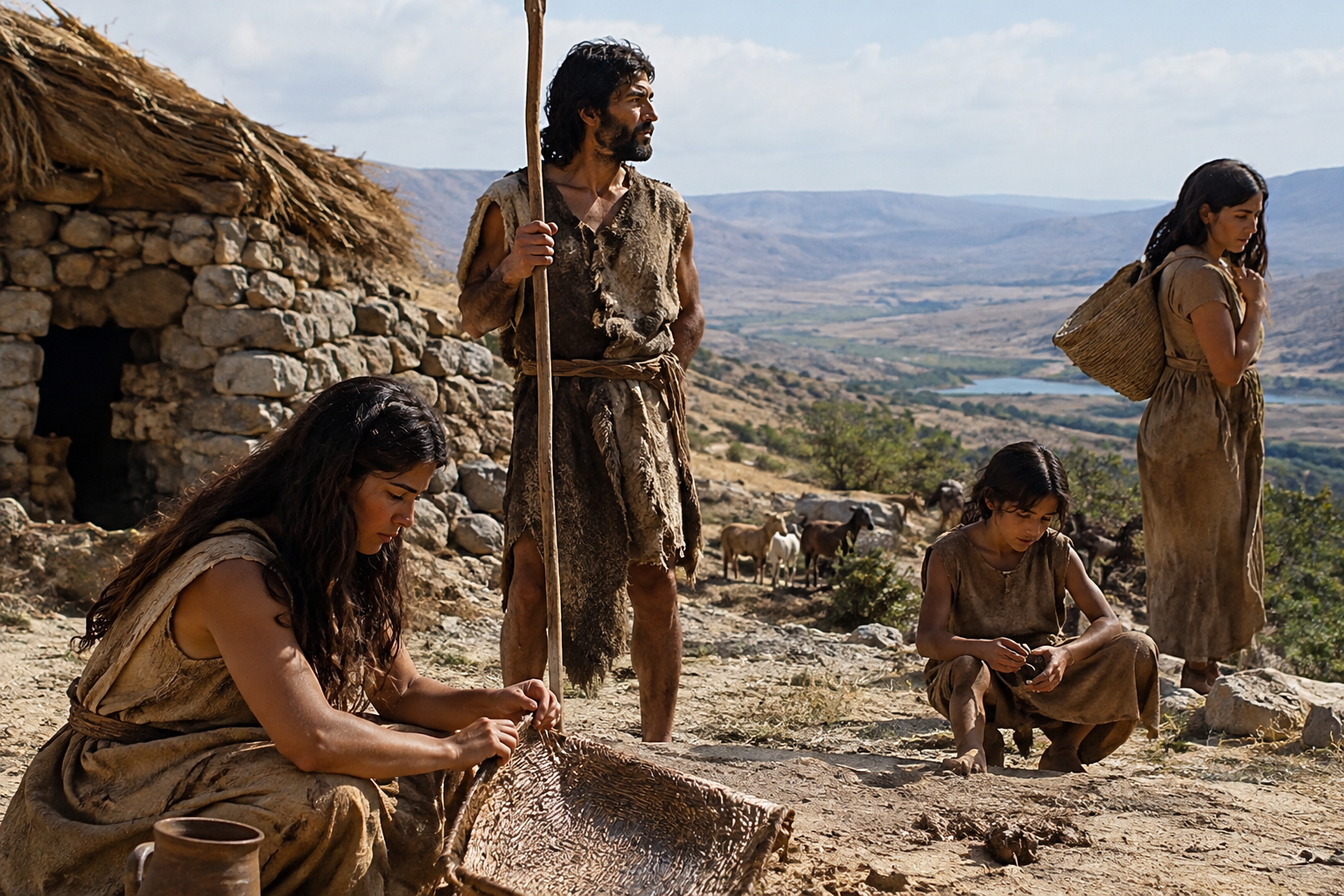
At 'Ain Ghazal, near modern Amman in Jordan, archaeologists uncovered one of the great early farming settlements of the Levant: a place of houses, plastered floors, and some of the most famous ritual statues of the Neolithic world. Among the ancient individuals connected with this settlement is sample I1710, dated here to around 7522 BC and associated with the Y-DNA haplogroup E1b1b1a. That is a striking clue, because it places this paternal line in the world of some of the earliest large settled communities in Southwest Asia.
That does not mean one man from 'Ain Ghazal can stand in for an entire people. Y-DNA traces a direct paternal line only, not a person's whole ancestry. But when a lineage appears in a site as important as this one, it gives us something better than a modern map of percentages: a real archaeological setting, with real people living through the enormous social changes of the Neolithic.
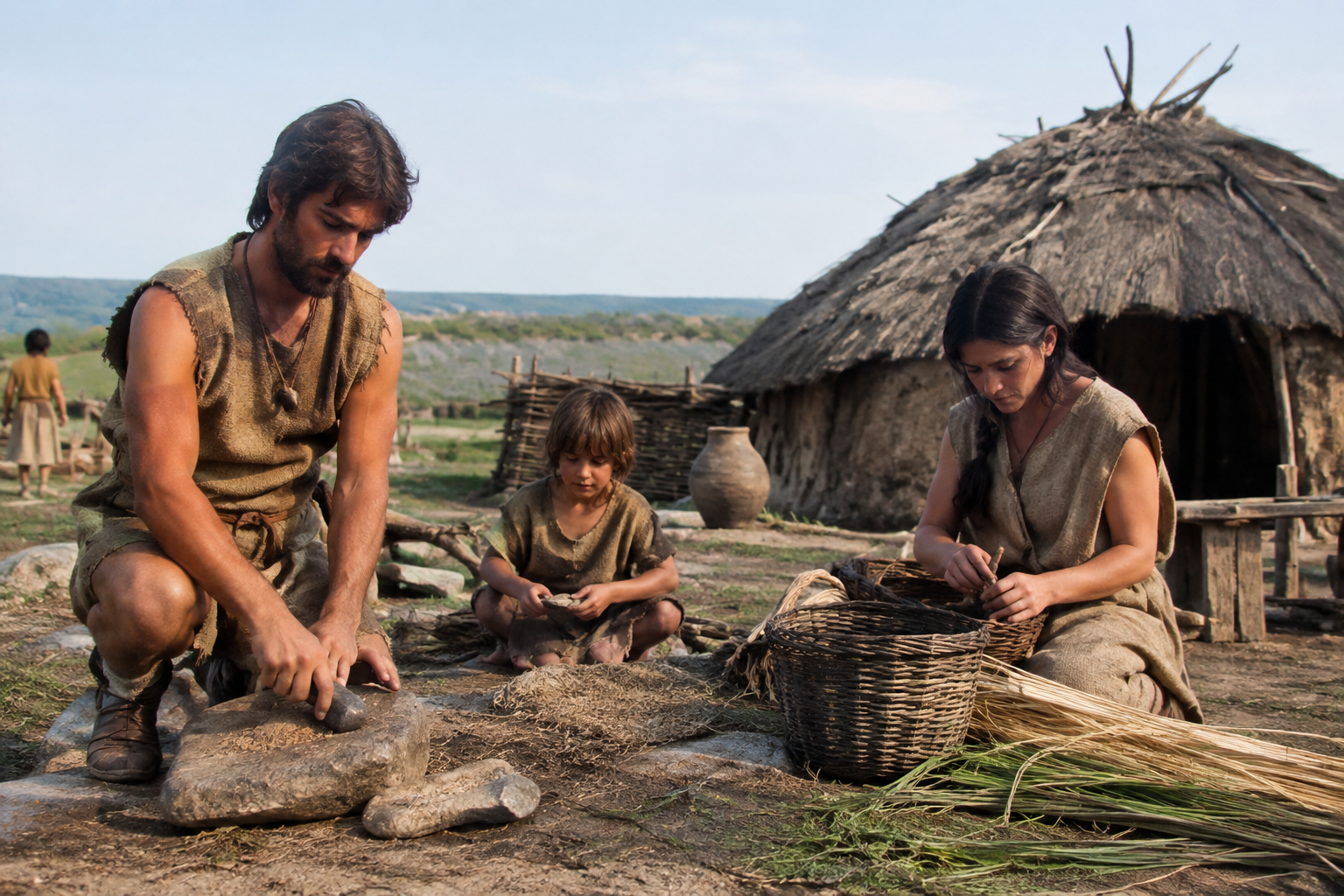
'Ain Ghazal belongs to the Pre-Pottery Neolithic B horizon, when farming villages in the Levant were becoming larger, denser, and more socially complex. This was not yet the age of bronze weapons or written kings. It was a world of herding, cultivation, house building, plaster technology, and increasingly elaborate ritual life. In that setting, I1710 matters because he anchors E1b1b1a within one of the best known early village societies of the region.
The site is famous not because it offers a simple origin story, but because it shows how complicated the Neolithic already was. People at 'Ain Ghazal were not merely "the first farmers" in a bland textbook sense. They lived in a substantial community whose scale and material culture suggest new ways of organizing labor, memory, and ritual. A paternal lineage found there is therefore part of a much bigger historical transformation: the move from small foraging groups to enduring settlements with deep local histories.
A genetic study associated with these ancient populations is linked here. Even without forcing more precision than the present evidence allows, the connection between I1710, the Levantine Neolithic, and E1b1b1a is enough to make this haplogroup archaeologically interesting.
The label E1b1b1a sits within the broader E1b1b family, a major Y-chromosome branch with a long and complicated history across parts of Africa, the Near East, and the Mediterranean. That larger history is important, but it should not be carelessly compressed into a neat single-route tale for this narrower branch. In this article, the secure point is the one attached to the ancient evidence we actually have: E1b1b1a is present in an early Neolithic individual from the southern Levant.
That matters because the southern Levant was one of the central theaters of the Neolithic transition. In other words, this is not a stray appearance in a remote outpost. It places the lineage in a region where settled life, cultivation, herd management, and new social forms were taking root early and then spreading through networks of contact, kinship, and movement.
What we should resist is the old temptation to turn a haplogroup into an ethnicity. A paternal line is not the same thing as a language, an archaeological culture, or a political identity. The man represented by I1710 lived thousands of years before later historical labels that people often try to project backward onto the Levant.
It is worth pausing over the geography. Jordan is sometimes treated as a corridor between more glamorous historical centers, but in prehistory it was no mere passageway. Sites around the Levantine interior preserve evidence for communities experimenting with architecture, animal management, burial customs, and symbolic life on a serious scale. 'Ain Ghazal was one of the places where those experiments became durable enough to leave an extraordinary archaeological footprint.
That gives E1b1b1a a particularly grounded context. Instead of meeting the lineage first in a later imperial cemetery or a medieval family tree, we meet it in a world of lime plaster, packed mudbrick houses, and the difficult business of making farming society work. For people researching this haplogroup today, that is a more revealing beginning than any modern national label.
Neolithic expansion in the Aegean
Once a paternal branch is visible in the Neolithic Levant, the next historical question is not whether every later carrier descends from one famous site, but how lineages like this participated in the immense demographic reshaping of the eastern Mediterranean. The spread of farming was not a single marching column. It involved repeated movements, local continuity, mixture with neighboring groups, and regional bottlenecks.
That is why E1b1b1a attracts attention in discussions of the eastern Mediterranean, the Balkans, and parts of southern Europe. The ancient evidence from Jordan does not by itself map all of those later distributions, but it does fit the broader archaeological picture in which the Levant was one of the early engines of change. Later appearances of related E1b1b branches around the Mediterranean make more historical sense when we remember just how old settled communities in the Levant already were.
Readers interested in how later Mediterranean populations could become genetically mixed without losing local continuity may find a useful comparison in work on island societies and long-term change.
Medieval Sicily's mixed ancestry
With only one named ancient sample here, there is a danger of either underplaying or overstating the evidence. Underplaying it would miss the obvious point: an early, well-contextualized Neolithic individual from a major Levantine settlement is exactly the kind of find that gives a haplogroup historical substance. Overstating it would be equally wrong, because one individual cannot define the full range or origin story of all later E1b1b1a men.
Still, archaeology often advances by these small but stubborn anchors. I1710 gives us one such anchor. He ties the haplogroup not to legend, not to a retrospective genealogy, but to a settlement that was helping invent the daily routines of village life in the 8th millennium BC.
That also makes this sample a useful reminder that ancient DNA is most interesting when it stays close to the ground. It works best when read alongside architecture, settlement history, and burial practice, rather than as a detached label floating free of place and time.
For someone carrying E1b1b1a today, the most defensible insight from the present evidence is that this paternal line was already part of the human landscape of the Neolithic southern Levant, and specifically appears at 'Ain Ghazal in the person of I1710. That places the lineage in a region central to the earliest centuries of large settled farming life. It does not hand you a neat ethnic badge or a royal pedigree. But it does offer something better: a plausible connection to one of the foundational worlds of Old World prehistory.

Comments