Haplogroup K2a
– 5 min read


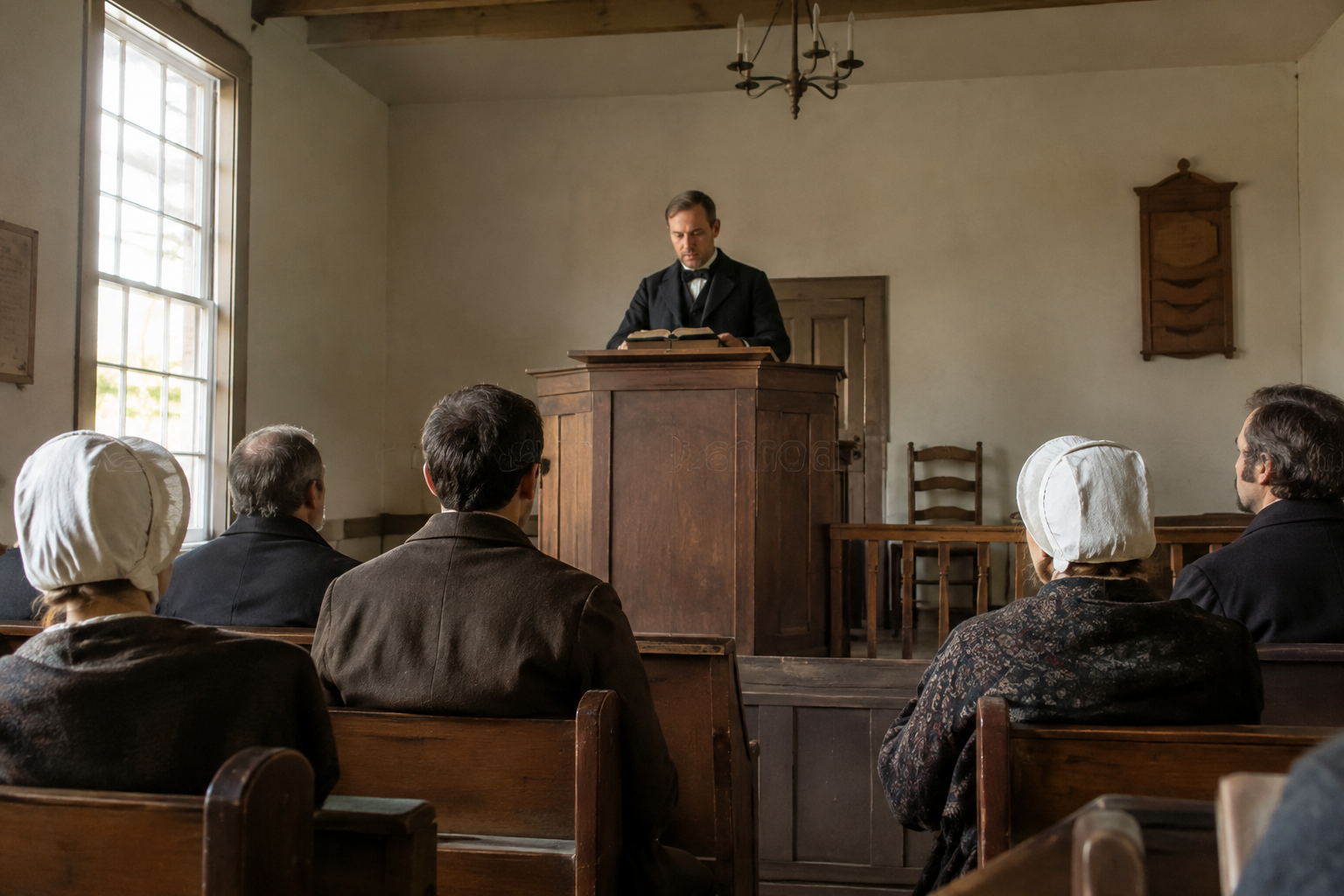
One of the few concrete ancient anchors here is unexpectedly recent: sample ATP_PSN_880, dated to 1833 AD from the Providence Calvinist Baptist Chapel in England. That is not the sort of find people usually imagine when they hear "ancient DNA". Yet burials from the early modern and industrial eras can be archaeologically invaluable, because they sit at the hinge between documentary history and genetics. In this case, the individual has been associated with the Y-DNA haplogroup K2a, an unusually deep and ancient paternal branch whose appearances in historic burials are far rarer in popular discussions than the better-known European lineages.
That contrast is precisely what makes K2a interesting. It is not a shorthand for ethnicity, nation, or social rank; Y-DNA traces only one direct paternal line among thousands of ancestors. But when a lineage as old and broad in human prehistory turns up in a named burial context in 19th-century England, it invites a different sort of historical question: not "which tribe was this man from?" but how such a paternal line survived, moved, and became part of the densely mixed populations of the modern world.
The Providence Calvinist Baptist Chapel setting places ATP_PSN_880 in a recognizably Christian burial world of post-medieval England. Chapel graveyards and associated burial grounds are often treated as "too recent" to be glamorous, but that misses the point. They preserve real communities caught in an age of migration, dissenting religion, industrial change, and expanding record-keeping. A lineage assigned to K2a in such a context is therefore historically intriguing not because it proves some exotic biography, but because it shows how deep paternal branches can surface in apparently ordinary local cemeteries.
That matters for MyTrueAncestry readers because recent archaeological burials often reveal the final visible stretch of a much longer genetic story. The man buried as ATP_PSN_880 lived in a century when England was tied into global networks of empire, trade, seafaring, labor mobility, and urban growth. None of that lets us reconstruct his life in detail from haplogroup alone, but it does remind us that by the 19th century English burial grounds could contain paternal lines with histories reaching far beyond the island.
A broader genetic study connected with these kinds of historical-period English remains is available at https://www.biorxiv.org/content/10.1101/2023.03.03.531048v1. Even without leaning too hard on any one paper, the larger lesson is clear enough: post-medieval cemeteries are now part of archaeogenetics, and they complicate any tidy idea of what an "English" paternal lineage ought to look like.
K2a is a very old branch within the wider K lineage of the Y chromosome. In plain terms, that means it belongs to a deep layer of paternal human history, far upstream from many better-known later branches. What we should not do is collapse that enormous timespan into a neat story about a single people or migration. A man reported as K2a in 1833 England is not thereby being identified as belonging to some preserved prehistoric population.
Still, the age of the branch matters. Deep lineages like K2a are reminders that modern and early modern populations are made from many accumulated histories, not just the most recent national or linguistic ones. In genealogy, people often look for a surname-scale answer from a haplogroup; with K2a, the more responsible answer is that you are looking at a paternal line with a very long backstory indeed, one that may have taken numerous turns long before it entered the documentary worlds of Britain.
There is a temptation in genetic history to prefer princely tombs, weapon burials, or spectacular ruins. But an individual like ATP_PSN_880 can sometimes tell us something more useful. In an ordinary chapel burial, there is less danger of confusing status with ancestry. The value lies in the combination of date, place, and genetic assignment: a direct paternal line associated with K2a was present in a real English religious community in the early 19th century.
That sits neatly beside a growing body of work on British population history showing that the islands were never genetically static. Roman mobility, early medieval migration, medieval trade, Atlantic connections, and modern imperial entanglements all helped shape later populations. The important point is not that K2a must have arrived in one specific episode, but that England's past repeatedly created opportunities for rare or less locally common paternal lines to become part of settled communities.
Roman and early medieval Britain
If we step back from the single burial, England becomes a very sensible place to find this kind of surprise. Archaeology and ancient DNA alike have shown Britain to be a meeting ground rather than a sealed container. Some lineages arrived in prehistory, others with the Roman world, others through North Sea and Channel migration, and still others through far wider global movements in the medieval and post-medieval periods.
That is why unusual paternal assignments in later burials should not be treated as anomalies to be explained away. They are part of the normal untidiness of real human history. Recent MyTrueAncestry coverage of regional diversity, such as Norman Conquest DNA: Viking, Saxon and French Ancestry in a Rural Surrey Community, points in the same direction: local English communities often contain deeper and more mixed histories than written labels suggest.
There is also a useful comparison with studies of diverse burial populations elsewhere in Europe. When ancient DNA reveals varied origins at a cemetery, it does not mean every individual was a first-generation migrant. Often it shows that populations had already been blending for centuries. That is exactly the kind of historical caution worth applying to ATP_PSN_880 and K2a: the finding is real and interesting, but its meaning lies in long-term population history, not in a simplistic one-step origin story.
The Providence Calvinist Baptist Chapel context also raises a social point. Nonconformist religious communities in Britain were often embedded in local life yet connected to wider social change: new towns, commercial networks, artisan families, laborers on the move, and kin groups crossing county boundaries. A burial in such a place is therefore a reminder that genetic history does not survive only in elite monuments. It survives in chapel yards, parish grounds, and urban cemeteries where ordinary people were laid to rest.
For someone carrying K2a today, that may be the most valuable historical lesson. Your direct paternal line can be both very old and historically elusive. It may not align neatly with the dominant story of the region where your recent ancestors lived. And yet, as ATP_PSN_880 shows, such a lineage could become entirely woven into the fabric of an English-speaking Christian community by the 1800s.
With K2a, the strongest supported insight is not a grand claim about one kingdom or dynasty, but something subtler and more human. This is a deep paternal branch that appears, in the evidence here, in an early modern English burial rather than a legendary royal pedigree. That is a useful corrective. Paternal ancestry is often preserved not through fame, but through continuity: one father to one son, over and over, until a chapel burial in 1833 leaves a trace that archaeology and DNA can recover.
So if K2a appears in your own results, think less in terms of a single badge of identity and more in terms of durability. It is one narrow line through a vast family tree, but it is a line with extraordinary chronological depth - and, as the burial of ATP_PSN_880 suggests, one that could surface in places and communities where history at first glance looks perfectly familiar.
Comments