Haplogroup J2a1b1
– 5 min read


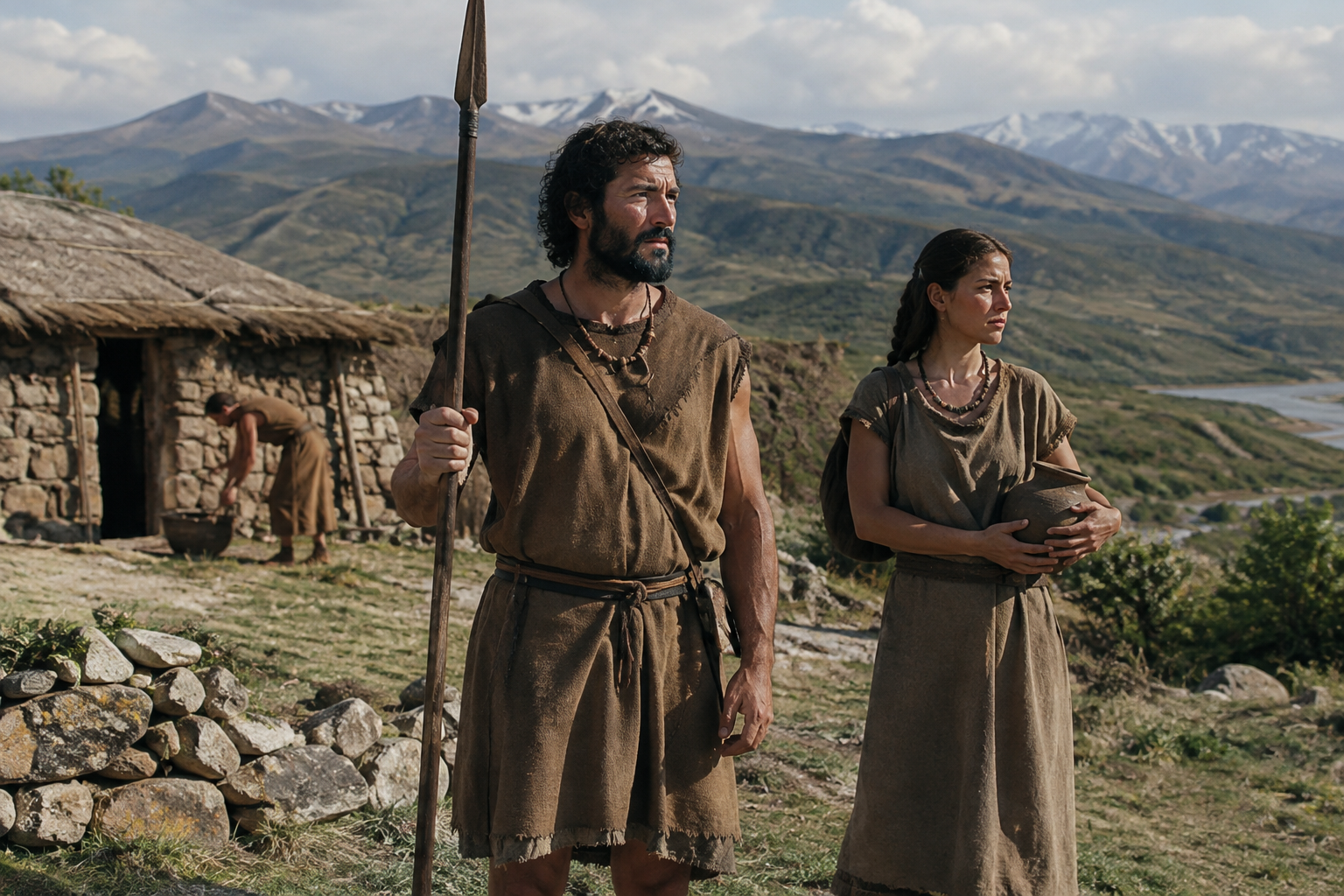
At Didnauri in eastern Georgia, archaeologists uncovered an Early Iron Age burial landscape that has become unexpectedly important for the history of Y-DNA haplogroup J2a1b1. One of the ancient men from the site, sample geo015, dated to around 1049 BC, places this paternal line firmly in the South Caucasus at a moment when local societies were reorganising after the Bronze Age world had fractured.
That matters because J2 is one of the best-known West Eurasian Y-chromosome families, often associated in broad terms with populations of the Near East, Anatolia, the Caucasus, and the Mediterranean. But broad labels are not enough. J2a1b1 is a narrower paternal branch, and ancient DNA is valuable precisely because it lets us stop speaking in generalities and start looking at real men in real places. In this case, the place is Didnauri, and the period is the early first millennium BC.
The date attached to geo015 puts him in a world that was neither prehistoric in any simple sense nor yet part of the great written empires that later dominated the region. The South Caucasus in the Early Iron Age was a frontier in the proper archaeological sense: not an empty edge, but a zone of contact between highland and lowland, local traditions and wider exchange networks, steppe connections and southern influences.
Research on ancient populations of the region has made clear that the Caucasus was not genetically static. At the same time, it was not merely a corridor through which everyone passed. Communities there preserved local continuities while also absorbing new influences over long stretches of time. A genetic study of the South Caucasus published in Current Biology helped show just how deep and complicated that regional history was from the Bronze Age into the early medieval period.
Within that setting, geo015 is useful not because one man can stand for an entire people, but because he gives us a securely ancient point for this paternal branch in a region long suspected to have played an important role in the history of J2 lineages. Y-DNA tracks one direct male line only, yet those single lines can illuminate patterns of settlement, inheritance, and male continuity that broader genome-wide ancestry sometimes blurs.
It is worth being precise here. The article haplogroup is J2a1b1, not simply J2 or J2a. The larger haplogroup J2 has a long and geographically wide history across western Asia and the Mediterranean. But one should not casually pour the whole history of J2 into this narrower subclade. Ancient DNA works best when it narrows the frame.
So what can be said responsibly? Sample geo015 shows that a paternal line associated here with J2a1b1 was present in Early Iron Age Georgia. That fits well with the broader picture of the Caucasus as one of the major long-term homes of J2-related male lineages. It does not mean that every later bearer of J2a1b1 descends from Georgia specifically, nor that this branch belonged to a single ethnic group, language community, or ruling house.
Still, for members of the MyTrueAncestry community, there is something satisfyingly concrete about this evidence. Instead of an abstract phylogenetic label floating above a map, we can attach the branch to an excavated human being from an identifiable archaeological setting in the South Caucasus more than three thousand years ago.
The Caucasus often appears in history books as a mountainous threshold between worlds: Black Sea and Caspian, steppe and plateau, Anatolia and the Iranian sphere. Archaeologically, that description is fair enough, but it should be handled with care. Regions like Georgia were not simply passageways for other peoples' stories. They were places where local communities built their own durable traditions, and those traditions can now be glimpsed through ancient genomes as well as burials, settlements, and material culture.
For a haplogroup such as J2a1b1, this is especially relevant. Many J2-related lines are often discussed in connection with the spread of farming, later Bronze Age exchange, and the urban and proto-urban networks of western Asia. The South Caucasus sat near all of these developments without being reducible to any one of them. A lineage present there in the Early Iron Age may reflect very old regional roots, later movements from neighbouring zones, or some mixture of continuity and mobility across centuries.
That is exactly why geo015 is so valuable. He does not solve the whole puzzle, but he anchors one piece of it. He shows that by about the eleventh century BC, this branch had already entered the human landscape of eastern Georgia.
The date of geo015 is also historically suggestive. Around 1049 BC, the great palace systems of the eastern Mediterranean had already collapsed or transformed, and the political map of western Asia was in motion. In the centuries that followed, the lands around the Caucasus were drawn into new constellations of trade, raiding, local state formation, and imperial expansion.
That does not allow us to assign this individual to some named polity from later written history. But it does remind us that paternal lineages do not sit still while history happens around them. A branch like J2a1b1 could persist through local male descent while languages shifted, alliances changed, and cultural styles came and went. Archaeology is full of such quiet survivals.
The broader South Caucasus record increasingly shows that the region carried forward deep ancestry components across many centuries even as contacts with surrounding worlds intensified. That is one reason Caucasus samples matter so much in ancient DNA studies: they help test whether later populations reflect replacement, continuity, or repeated blending. The answer is usually some combination, and paternal data adds one more layer to that picture.
For modern men with J2a1b1, the temptation is to ask for a single grand migration story. Usually history is less tidy than that. The larger J2 family appears in many later settings linked to the eastern Mediterranean, Anatolia, the Balkans, and parts of the Near East. But the point of an ancient sample like geo015 is not to force a straight line from one burial in Georgia to every later appearance of the branch.
Rather, it provides a historically plausible anchor in one of the regions where such a lineage makes sense archaeologically and geographically. If your paternal line belongs to J2a1b1, this Early Iron Age Georgian evidence suggests that one part of your branch's deeper story may lie in the old interaction zone between the Caucasus and the wider Near Eastern world.
That wider world later fed into Greek colonisation, Persian imperial systems, Hellenistic kingdoms, Roman expansion, and the medieval reshaping of the eastern Mediterranean. Some descendants of J2-related lines certainly moved through those histories. But ancient DNA is strongest when it begins with what can actually be pinned down, and here that starting point is not Rome or empire, but a man buried in Early Iron Age Georgia.
The most distinctive thing about J2a1b1 in this case is not glamour or dynasty, but context. Sample geo015 shows this paternal branch in the South Caucasus around 1049 BC, in a region that sat at the meeting point of several major historical worlds while preserving its own local continuity. For someone researching a J2a1b1 paternal line today, that is a meaningful clue: your direct male ancestry may connect, at least in part, to the long-lived populations of the Caucasus and their neighbours, rather than to a single later empire or identity.
Comments