Haplogroup R1b1a2a1a2b1c2b1a
– 5 min read


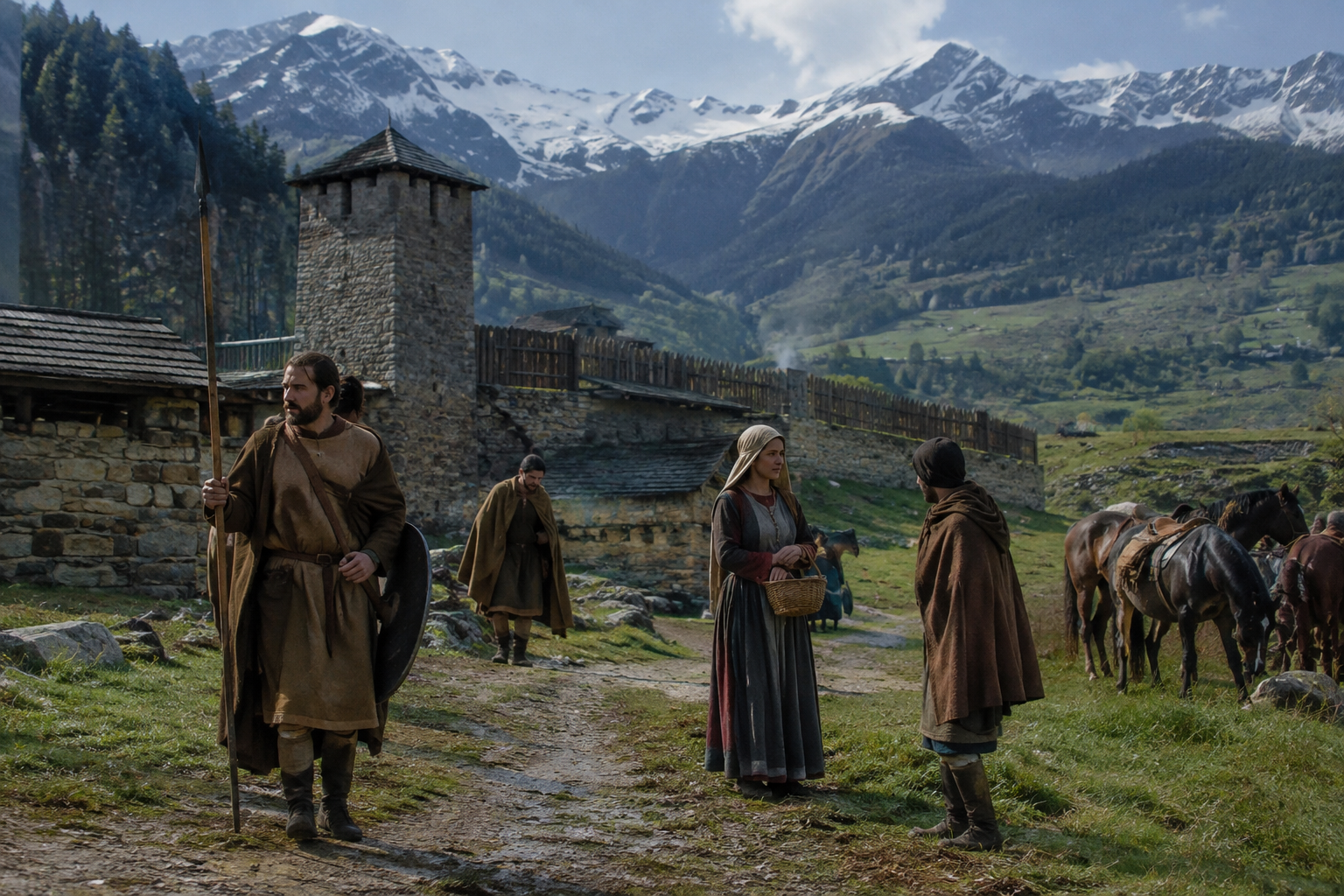
In around AD 450, in South Tyrol at Malles Burgusio Santo Stefano, one man now known to us only as sample 2417 became part of a landscape caught between worlds. This was late antique northern Italy, where Roman provincial habits, Alpine routes, military movement, and new post-imperial identities were all pressing against one another. For anyone carrying the Y-DNA haplogroup R1b1a2a1a2b1c2b1a, that makes this burial especially interesting: not because one grave can explain a whole lineage, but because it places this paternal branch inside a very specific historical frontier.
The important thing to say at once is that Y-DNA traces one direct paternal line only. It does not sum up a person's whole ancestry, language, or social identity. Even so, when a branch like R1b1a2a1a2b1c2b1a appears in an ancient individual from a borderland such as South Tyrol, it gives us a precious fixed point: a documented male line present in the Alps during the unsettled centuries after Roman rule had begun to fragment.
Malles, in the upper Adige region, sits in one of Europe's classic passage zones. The Alps are often imagined as barriers, but historically they are also funnels: roads, passes, toll points, military approaches, and routes for traders, pilgrims, herders, and armed groups alike. A burial from this setting is never just local in the narrow sense. It belongs to a corridor that linked northern Italy with Raetia, the Danube world, and lands beyond.
That is why sample 2417 matters beyond its single grave. A paternal lineage found here around AD 450 belongs to a moment when old Roman institutions were weakening, but movement through the Alpine passes had certainly not stopped. The man buried at Malles lived in a zone where ancestry could be local, mixed, recently arrived, or several of those things at once.
An ancient DNA study examining individuals from the wider Alpine region has helped show just how informative these mountain communities can be for reconstructing long-term population history. For context on that broader setting, see this research on ancient genomes from the Alps.
The label R1b1a2a1a2b1c2b1a is a very narrow twig on the much larger R1b tree. That broader R1b family is widespread in western Eurasia and especially well known in European paternal history, but it would be careless to pour the whole grand story of R1b directly into this one sub-branch. Ancient DNA works best when we keep the scale straight: a huge parent lineage can span many regions and periods, while a precise descendant branch may only be visible in a handful of securely placed men.
In practical terms, sample 2417 tells us that a man associated with this branch was present in early medieval South Tyrol. It does not, by itself, prove whether his recent paternal ancestors had lived in the Alps for centuries or had arrived more recently through late Roman military service, marriage networks, or Migration Period mobility. That ambiguity is not a flaw. It is exactly the kind of real historical uncertainty that makes frontier archaeology so worthwhile.
People often talk about the fifth century as if the Roman world simply vanished and was replaced overnight. Archaeology is far less tidy than that. In northern Italy, communities continued to bury their dead, use long-established routes, and inhabit places whose importance predated the empire and outlasted it.
For a burial in South Tyrol around AD 450, the historical backdrop includes the disintegration of western imperial authority, the presence of military and civilian populations with varied origins, and the increasing importance of local strongholds and church sites. A male line such as R1b1a2a1a2b1c2b1a in this setting is therefore best understood not as a tribal badge, but as part of a socially mixed world in which Roman, provincial, and so-called barbarian categories overlapped constantly.
That point has emerged repeatedly in ancient DNA work on late Roman and early medieval Italy. The most useful studies do not present neat ethnic boxes; they show communities shaped by continuity in some places and marked diversity in others.
There are articles built on royal tombs and famous dynasties, and then there are articles built on one less glamorous but arguably more revealing burial. Sample 2417 belongs to the second category. The strength of the evidence here is not prestige; it is location and date. A single well-placed ancient man can anchor a lineage in a historical landscape far more securely than a hundred romantic family traditions.
Malles Burgusio Santo Stefano sits near routes that mattered long before modern borders. If you are exploring this haplogroup today, that matters because paternal lines often survive political collapse remarkably well. Empires fall, administrations shift, languages change, and yet male lines can persist through all of it, sometimes locally, sometimes by being carried along the roads that connect regions.
That is also why the Alpine context deserves attention in its own right. Mountain communities are not sealed jars. They can preserve local continuity, but they can also record mobility with unusual clarity because passes channel movement through recognizable places.
Ancient Italy was never genetically uniform, and neither was early medieval Italy. The peninsula drew people from across the Mediterranean and from continental Europe, while Alpine zones added another layer of north-south interaction. A find like sample 2417 belongs to that broader mosaic.
Research on Italian ancient populations has made this increasingly clear: local sequences of continuity could sit alongside striking episodes of new ancestry arriving through trade, colonization, military service, or post-Roman migration. South Tyrol is especially valuable because it stands at the hinge between Italy and the transalpine world rather than deep inside either one alone.
That means R1b1a2a1a2b1c2b1a, in this case, should be read as evidence of presence rather than a ready-made narrative of origin. The lineage was there. The man was real. The challenge is to place him in a landscape where cultural identity and biological ancestry were related, but never identical.
Medieval Italian Paleogenomics
The best-supported insight from this evidence is a modest but powerful one: the paternal branch R1b1a2a1a2b1c2b1a is represented in the historical record of the Alpine world by around AD 450, at Malles Burgusio Santo Stefano in South Tyrol. That places the lineage in a real community living through the long transition from Roman rule to the early medieval order. For modern testers, that does not promise a named dynasty or a single migration story. What it does offer is something better grounded: your direct paternal line belongs to the same kind of historical world documented in one of Europe's most important crossroads, where continuity and movement met in the high valleys of late antique Italy.
Comments