Haplogroup R1b1b2a2b
– 4 min read


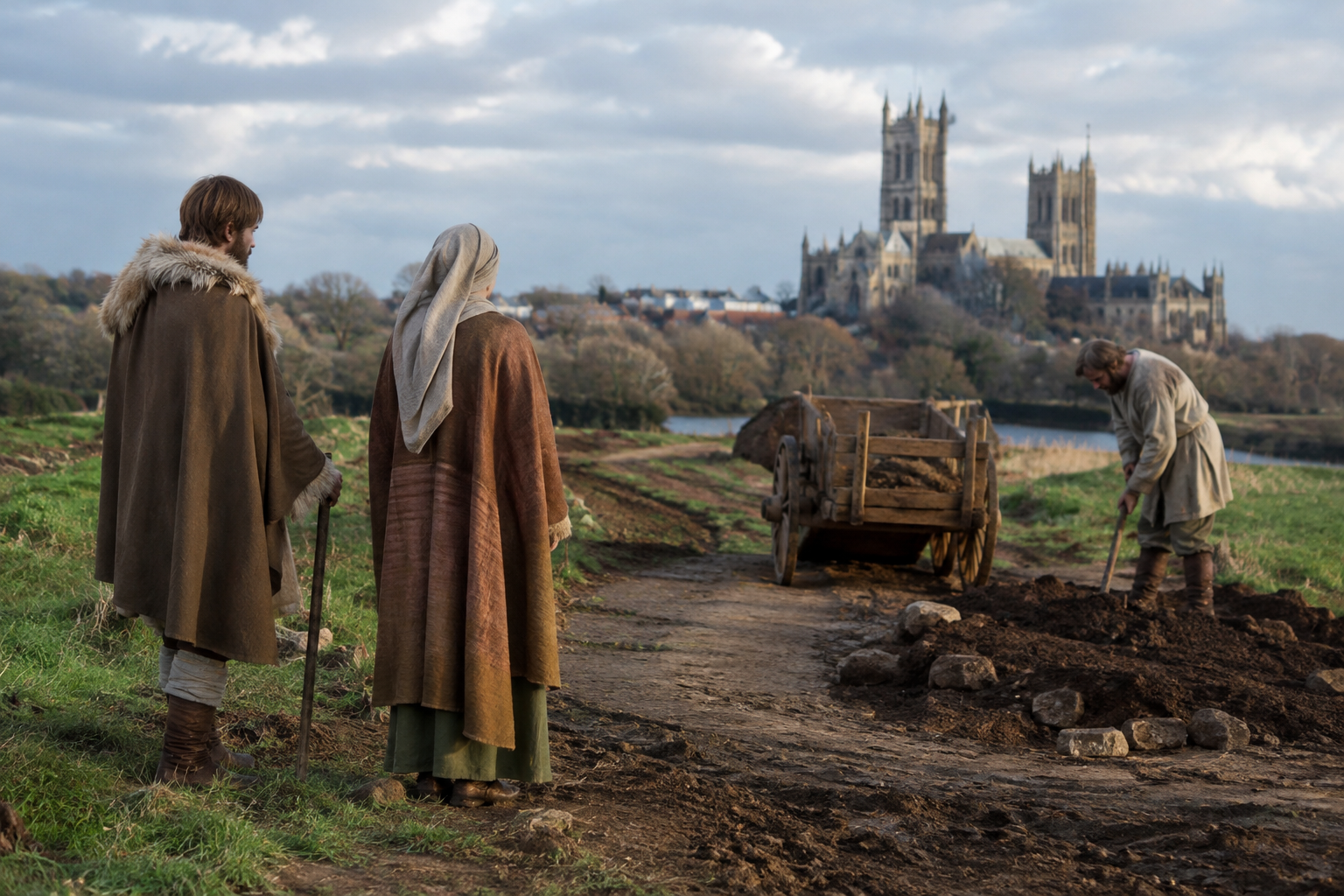
At Lincoln Eastern Bypass in England, archaeologists uncovered an early medieval burial dated to around AD 800 and identified as sample C13582. On its own, that might sound like one more grave from one more road scheme. But for anyone interested in paternal ancestry, this individual matters because he was associated with the Y-DNA haplogroup R1b1b2a2b, a branch within the larger and very widespread R1b family that appears again and again in western European population history.
The fascination here lies in scale. A single man buried in early medieval Lincolnshire cannot stand for all of England, still less for all bearers of R1b. Yet one securely placed ancient individual can anchor a lineage in a real landscape: not an abstract migration arrow on a map, but a person living in a historically busy region of eastern England, in the centuries after Rome and before the fully formed medieval kingdom we usually imagine.
Lincolnshire in the early medieval period sat in a zone of movement, farming, political change, and long memory. Roman Lincoln, or Lindum Colonia, had left a powerful imprint on the region, and the countryside around it continued to be occupied and reused in new ways. By about AD 800, this was an England of kingdoms, monasteries, estates, and communities whose identities were shaped locally as much as by any grand narrative of "Anglo-Saxon" settlement.
That is what makes C13582 so useful. A Y-chromosome result gives us one direct paternal line, and only that line, but it ties the burial to a paternal branch that is entirely at home in the western European genetic record. In plain terms, haplogroup R1b1b2a2b belongs to a much broader family of lineages that became prominent across large parts of Europe in later prehistory and remained common into the historic period.
Roman and Early Medieval Britain DNA
Older haplogroup naming systems can look formidable, and R1b1b2a2b is one of those labels that preserves an earlier style of classification. The important point is that it sits inside a larger paternal structure rather than describing an isolated or mysterious lineage of its own. It should therefore be read with care: the specific article haplogroup is narrower than broad R1b, but without further confirmed downstream detail we should not pile onto it every migration story ever told about the parent branch.
Still, even cautious interpretation has value. In an early medieval English context, a lineage of this kind fits well with the long biological continuity and reshaping of populations around the North Sea world. The paternal line seen in C13582 does not prove whether this man identified with any particular kingdom, dialect group, or ethnic label. What it does show is that the male lineages present in early medieval eastern England included branches deeply embedded in the wider demographic history of western Europe.
Ancient DNA often works by accumulation, but single burials are not trivial. A person like C13582 gives researchers a fixed point in place and time: early medieval Lincolnshire, around AD 800, in a region later shaped by both Anglo-Saxon and Scandinavian political worlds. That makes this sample especially interesting for MyTrueAncestry users with English, eastern English, or broader British paternal roots.
The burial also belongs to a period when eastern England was anything but isolated. Trade and travel linked the region to the North Sea, to the Midlands, and to the old Roman road network. If later centuries would bring the Danelaw and stronger Scandinavian political influence, the world of AD 800 was already one of contact and layered ancestry rather than neatly sealed populations.
Lincolnshire is a particularly good place to think about how genetics and archaeology meet. Historically, it belongs to the eastern side of Britain most closely tied to migration and exchange across the North Sea. Archaeologically, that does not mean every burial represents a newcomer, nor that every lineage maps neatly onto a named people from chronicles. The reality is more interesting: communities formed through mixture, persistence, and local adaptation over generations.
This broader picture has been strengthened by recent work on early medieval England, including studies of regional diversity and mobility. MyTrueAncestry readers interested in that larger setting may want to compare the Lincolnshire evidence with work on other early medieval cemeteries, such as the discussion in Ancient DNA reveals diverse origins at a 7th-century Madrid burial site, which shows in another part of Europe how burial communities could include varied ancestral backgrounds without collapsing into a single genetic story.
For Britain, the key lesson is similar. A paternal lineage such as R1b1b2a2b may appear in a man buried in early medieval Lincolnshire, but that does not make him simply "Celtic," "Anglo-Saxon," or "Viking" by DNA alone. Those are historical and cultural terms. The chromosome tells us about one male line; the grave's date and region tell us about the society in which that line was living.
The wider R1b family is often discussed because of its deep roots in later prehistoric Europe, especially after the Bronze Age. That background matters here only in a limited way. It helps explain why a branch like R1b1b2a2b turning up in early medieval England is not surprising: by this date, R1b lineages had long since become part of the demographic furniture of much of western Europe.
But early medieval evidence is valuable precisely because it moves us beyond prehistory. It shows those paternal lines not in a world of barrows and bronze hoards, but in documented historical landscapes of shires, churches, farmsteads, and emerging kingdoms. In that sense, C13582 stands at an important threshold. He belonged to a world beginning to look recognisably medieval, while still carrying a paternal lineage whose deeper roots stretched far behind him.
For someone exploring R1b1b2a2b today, the Lincoln sample does not offer a ready-made surname story or a shortcut to nobility. What it offers is something better grounded: evidence that this paternal branch was present in early medieval England, in a region central to the making of later English history. That places the lineage firmly within the lived human world of post-Roman and early medieval northwestern Europe.
If your direct paternal line belongs to this haplogroup, the most sensible historical picture is one of long western European continuity shaped by repeated episodes of migration, local marriage, and changing political identities. Sample C13582 gives that picture a human scale. He was not an abstract branch label, but a man buried in Lincolnshire around AD 800, carrying one thread of a much larger inheritance.
Comments