Haplogroup G2a2b2a4a1a1b
– 5 min read


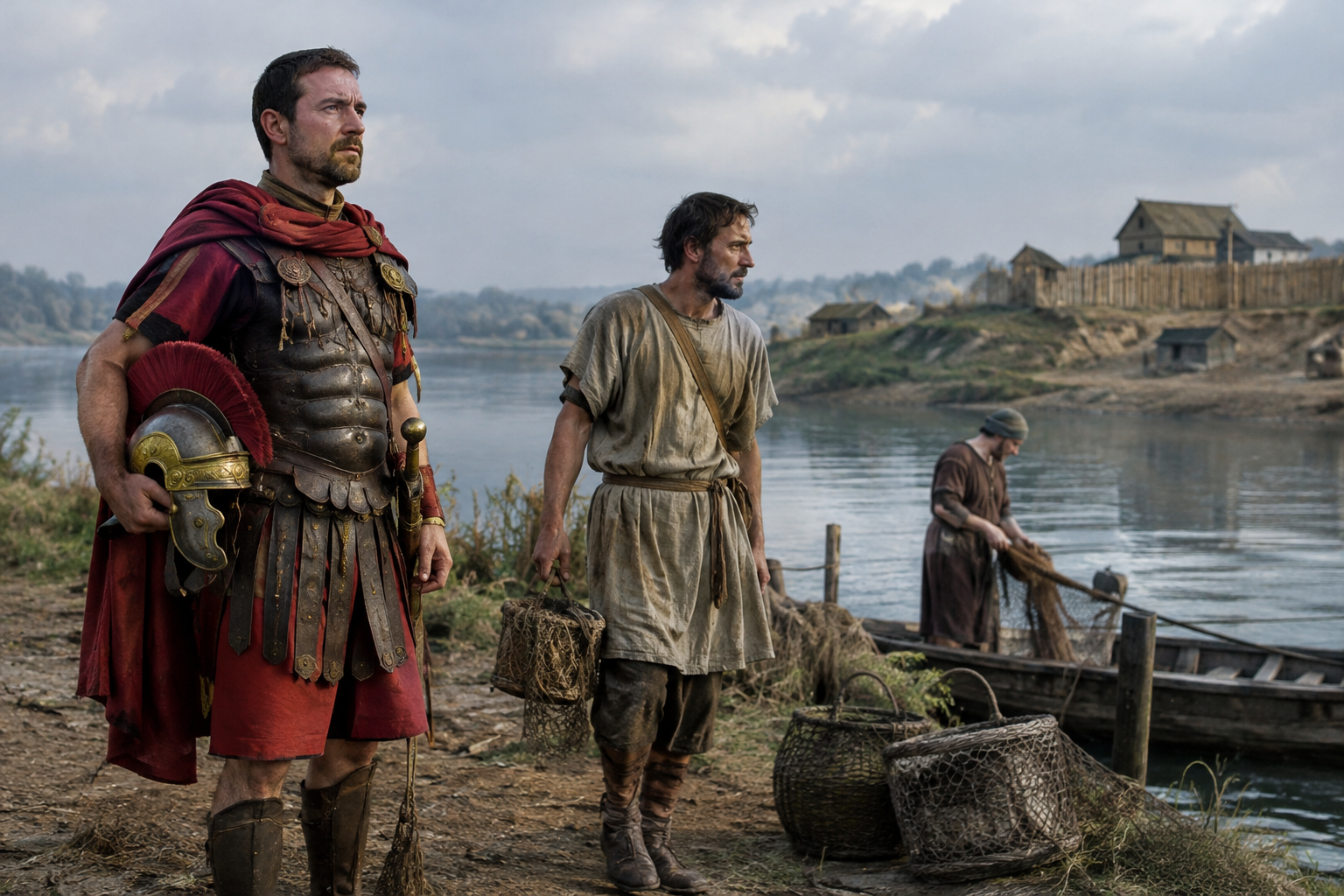
At Pogorelec near Sisak in Croatia, one late Roman man, catalogued as I26765 and dated to around AD 375, offers a small but revealing glimpse into a much bigger historical problem: who, exactly, was living in the borderlands of the Roman world as imperial power began to strain? His reported Y-DNA assignment is G2a2b2a4a1a1b, a very specific paternal line carried by one individual in a region where armies, merchants, farmers, officials, and migrants had been mixing for centuries.
That is what makes this find interesting. A Y-chromosome lineage traces one direct paternal line only, not a person's whole ancestry, but in a late Roman frontier landscape even that single line can be informative. Rather than pointing neatly to one named people or one simple migration, I26765 sits in a world where local continuity and long-distance movement existed side by side.
Sisak, ancient Siscia, was no obscure village. It was an important Roman center on the Sava, connected to the military and administrative life of the province and to routes linking the Adriatic, the Danube, and the interior Balkans. By the later fourth century, when I26765 lived, this was a region shaped by imperial logistics, taxation, recruitment, and repeated episodes of insecurity.
The value of a sample like I26765 lies precisely in that setting. A paternal lineage such as G2a2b2a4a1a1b appearing in late Roman Croatia is a reminder that the Balkans were not simply a stage on which outside groups arrived one after another. They were also home to long-settled populations whose histories ran back well before Late Antiquity, while new movements kept layering over older local foundations.
Research on ancient genomes from Croatia has emphasized this complicated pattern of persistence and change across long stretches of time. One MyTrueAncestry discussion of that broader picture is worth keeping in mind here.
Croatia: continuity and changing paternal lines
The wider haplogroup G, and especially branches of G2a, is well known in ancient DNA because it appears frequently among early farming populations in Neolithic Europe. That broad fact, however, should not be flattened into an overconfident claim about this exact branch. G2a2b2a4a1a1b is a much narrower paternal subclade, and the ancient evidence here is limited.
So the careful way to read I26765 is this: his direct male line belongs to a wider paternal family with deep roots in the prehistoric and ancient Near Eastern and European story, but this one late Roman individual cannot by himself tell us when that precise branch entered the Balkans or whether it had been local for centuries. What he does show is that such a line was present in a late imperial community in inland Croatia.
That matters because Late Antiquity in the Balkans is often narrated through large labels - Roman, Gothic, Hunnic, barbarian, provincial - that can make the ground-level population seem simpler than it was. Ancient DNA keeps disrupting that tidy picture. One cemetery, one town, even one household may contain very different ancestral histories.
For older histories, the temptation was to match every burial to a people named in texts. Archaeology and genetics have made that much harder. A fourth-century man from near Sisak cannot be cleanly turned into a "Roman" in the bureaucratic sense, nor into a Goth, nor into any other identity, just from Y-DNA. The historical setting is late Roman; the paternal lineage is G2a2b2a4a1a1b; the rest requires caution.
Still, caution does not mean vagueness. The actual historical point is sharper than that. This was an era when the Roman state was still functioning, but under pressure; when military frontiers were porous; and when communities in the middle Danube and western Balkans were absorbing people from multiple directions. In such a world, a lineage like this could belong to a man from a locally rooted family, or to someone whose paternal line had arrived generations earlier through imperial mobility.
An ancient DNA study of populations connected to the Roman world and its neighboring regions has helped underline just how mixed such frontier zones could be, even when the archaeology looks outwardly familiar. See the broader regional research published here.
Roman military Croatia at Mursa
Geography is doing a great deal of work in this story. Siscia stood in a corridor of movement. Rivers, roads, and military supply lines connected this part of Croatia to Pannonia, northern Italy, the Danube frontier, and deeper Balkan provinces. People did not need to be dramatic invaders to move through such a landscape; ordinary imperial life moved them.
That helps explain why a rare or narrow paternal lineage can turn up in a place like Pogorelec without requiring a single spectacular event behind it. Soldiers were recruited and discharged. Administrators relocated. Traders married locally. Rural families survived repeated political changes. The result, over generations, was a population that could be provincial and cosmopolitan at the same time.
This is where Y-DNA becomes most useful when it is handled modestly. It does not solve identity on its own, but it can show that the male-line history of a region was not uniform. The Balkans, especially under Rome and after Rome, repeatedly show that kind of complexity.
At first glance, a single identifier - I26765 - may seem too slight to carry much historical weight. But ancient DNA often advances in exactly this way: one securely placed individual adds a point on the map, then another, and then a pattern emerges. A late Roman man near Sisak with haplogroup G2a2b2a4a1a1b is one of those points.
He matters especially because Croatia sits at a junction in European population history. It is part Mediterranean, part central European, part Balkan, and always entangled with the Danube world. That makes it a good place to watch how paternal lines survive, disappear, or reappear under changing political regimes.
For a wider look at how ancient DNA is reshaping the history of Roman-era populations farther west, this related article offers a useful comparison.
Roman Hispania's genetic legacy
If the deeper ancestry of G-related lineages feels older than the Roman Empire, that is because it is. The Balkans had already seen millennia of demographic change before I26765 was buried: early farmers, later Bronze Age and Iron Age transformations, and then the dense connectivity of the classical and Roman periods. By late antiquity, no community here was untouched by that long build-up.
That longer background is essential because it prevents a common mistake. A late Roman sample with a G2a-derived paternal line is not evidence for one sudden fourth-century arrival. It may reflect something much older in southeastern Europe, preserved through many cultural turnovers and political rebrandings. The Balkans are particularly rich in that sort of deep continuity beneath changing historical labels.
For readers interested in those deeper regional foundations, this broader piece on Balkan prehistory gives useful context.
The most responsible conclusion for haplogroup G2a2b2a4a1a1b is also the most interesting one. In the ancient record supplied here, it appears in a real late Roman person from Pogorelec near Sisak, around AD 375, in a region where local depth and imperial mobility overlapped. That does not make the lineage uniquely Roman, uniquely Balkan, or uniquely tied to any named people. It does show that this paternal branch belonged to the human mix of the late Roman frontier.
For someone researching this haplogroup today, that is the useful historical takeaway: your direct paternal line can surface in places where history was messy, layered, and unmistakably connected. One man from late Roman Croatia cannot tell the whole story, but he does place this branch inside a very real ancient world.
Comments