Haplogroup G2a2a1a2a1a1b
– 4 min read


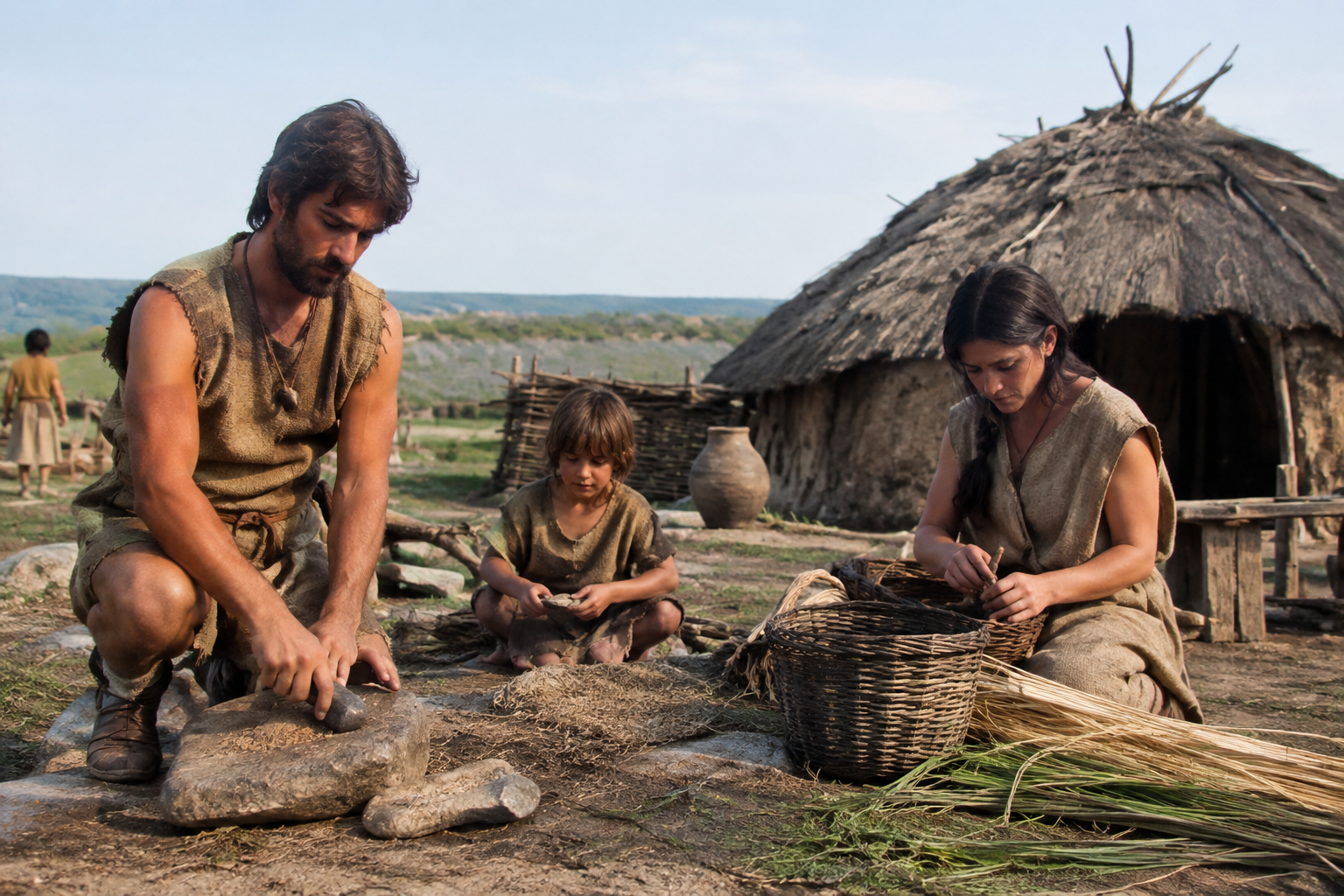
At Urziceni in present-day Romania, one ancient male identified as Urzi51 has been associated with the Y-DNA lineage G2a2a1a2a1a1b and dated to around 4000 BC. That is a small scrap of evidence in one sense, just a single paternal line from one burial. But in another sense it is exactly the kind of find that matters, because a lineage like this turns up not in the age of kings and chronicles, but in the deep agricultural past of southeastern Europe.
The important point is not that one man can stand for an entire population. He cannot. Y-DNA tracks only one direct paternal line out of a person's many ancestors. Yet Urzi51 is still historically revealing, because haplogroup G lineages are repeatedly linked with early farming worlds in Europe, and southeastern Europe was one of the great thresholds through which farming societies expanded, mixed, settled, and changed.
By about 4000 BC, the lands of modern Romania were not some remote edge of prehistory. They were part of a very active zone of Neolithic and Chalcolithic communities, tied into networks of settlement, exchange, and local innovation that stretched across the Balkans and beyond. A man like Urzi51 belonged to a world in which farming had already been established for millennia, but its social and genetic consequences were still unfolding.
That matters for understanding G2a2a1a2a1a1b. This is a very specific sub-branch, much narrower than the broader haplogroup G family. What the wider record suggests, cautiously, is that many G paternal lines were prominent among early European farmers. What this single Romanian sample adds is a fixed point in place and time: one branch of that wider paternal legacy was present in the lower Danube-Carpathian zone during the later Neolithic or Copper Age horizon.
A genetic study of ancient populations in the North Pontic and nearby regions, published in PNAS, has helped clarify just how dynamic this broader landscape was between the sixth and third millennia BC. Even without forcing Urzi51 into a grand migration tale, the study's regional frame is useful: this was a contact zone where ancestry from southeastern European farmers, local hunter-gatherers, and steppe-related groups could meet in shifting proportions over time.
If this branch feels unusually ancient, that is because it belongs to a paternal family with deep roots in the first farming expansions into Europe. Across many ancient DNA studies, various branches of haplogroup G appear in Neolithic communities from Anatolia into the Balkans, central Europe, and the western Mediterranean. That does not mean every G lineage followed the same route or survived in the same numbers. It does mean that G is one of the signatures repeatedly encountered when archaeologists and geneticists examine the male lines of early farmers.
For southeastern Europe, this is especially interesting. The region was not merely a corridor through which people passed. It was also a place where communities stayed, intermarried, developed local traditions, and sometimes persisted long enough for their descendants to become part of later populations with quite different archaeological identities. In that sense, Urzi51 is not simply evidence of arrival. He is evidence of settlement.
The long subclade name also deserves a brief note. A designation like G2a2a1a2a1a1b reflects fine branching within the Y chromosome tree, produced by later high-resolution genetic analysis. It is much more precise than saying merely "haplogroup G." That precision is useful for matching paternal lines today, but historically we should be careful: a narrow branch cannot automatically inherit every story told about the whole of G2a.
It is easy, from the modern map, to imagine prehistoric Romania as peripheral to Europe's big developments. Archaeology says otherwise. The lower Danube and adjacent plains connected the Balkans, the Carpathian Basin, and the western steppe. Goods, ideas, and people circulated through this zone for thousands of years. By the fifth and fourth millennia BC, it was one of the most consequential regions in European prehistory.
That setting gives Urzi51 his real significance. A paternal line in G2a2a1a2a1a1b appearing here suggests continuity of male lineages associated with farming communities in a region later transformed by major demographic shifts. In other words, before steppe-associated Y lineages became so prominent in many parts of Europe during the Bronze Age, there were older male lineages already established across the continent's farming societies.
This is one reason Neolithic and Copper Age Y-DNA findings can feel so striking to modern testers. They often point to a paternal landscape very different from later historic Europe. Some lineages that were once widespread became rarer; others expanded dramatically. Ancient DNA lets us see that lost distribution, even when the evidence survives only in scattered burials.
There is a temptation in genetics to turn every branch into a saga with a clear route, tribe, and destination. For G2a2a1a2a1a1b, the honest story is narrower but still compelling. We can say that this lineage is represented in the ancient record by at least one male from Urziceni around 4000 BC, in a region central to the making of prehistoric southeastern Europe. We can also say that its broader paternal family belongs to the world of early European farmers more than to the later steppe-dominated male expansions.
What we should not do is pretend that Urzi51 was the founder of a people, or that everyone carrying this branch today descends from one dramatic migration event visible in a single grave. Ancient Y-DNA works best when treated as a series of anchors. Each anchor fixes one lineage to one place at one time. The larger pattern emerges only gradually.
That caution is not a disappointment. It is, in fact, the strength of archaeogenetics. Instead of mythic origin stories, we get something better: real men from real places, recovered from the ground and placed back into history with increasing precision.
5th millennium Carpathian Basin
For someone researching a present-day lineage in G2a2a1a2a1a1b, the Urziceni evidence points toward a remarkably old paternal horizon in Europe's early farming age. Not a royal house, not a medieval surname, but something deeper: a male line already present in the Danube-Carpathian world long before written history. That does not define your whole ancestry, of course, but it does place one strand of it in one of the formative landscapes of prehistoric Europe.
And perhaps that is the most evocative thing here. A modern Y-DNA result can sometimes lead not to a famous dynasty, but to a farmer's world on the edge of the Balkans around 4000 BC, where the paternal map of Europe looked very different from the one that came later.






Comments