Haplogroup J2a1a1b2a1b2b1
– 5 min read


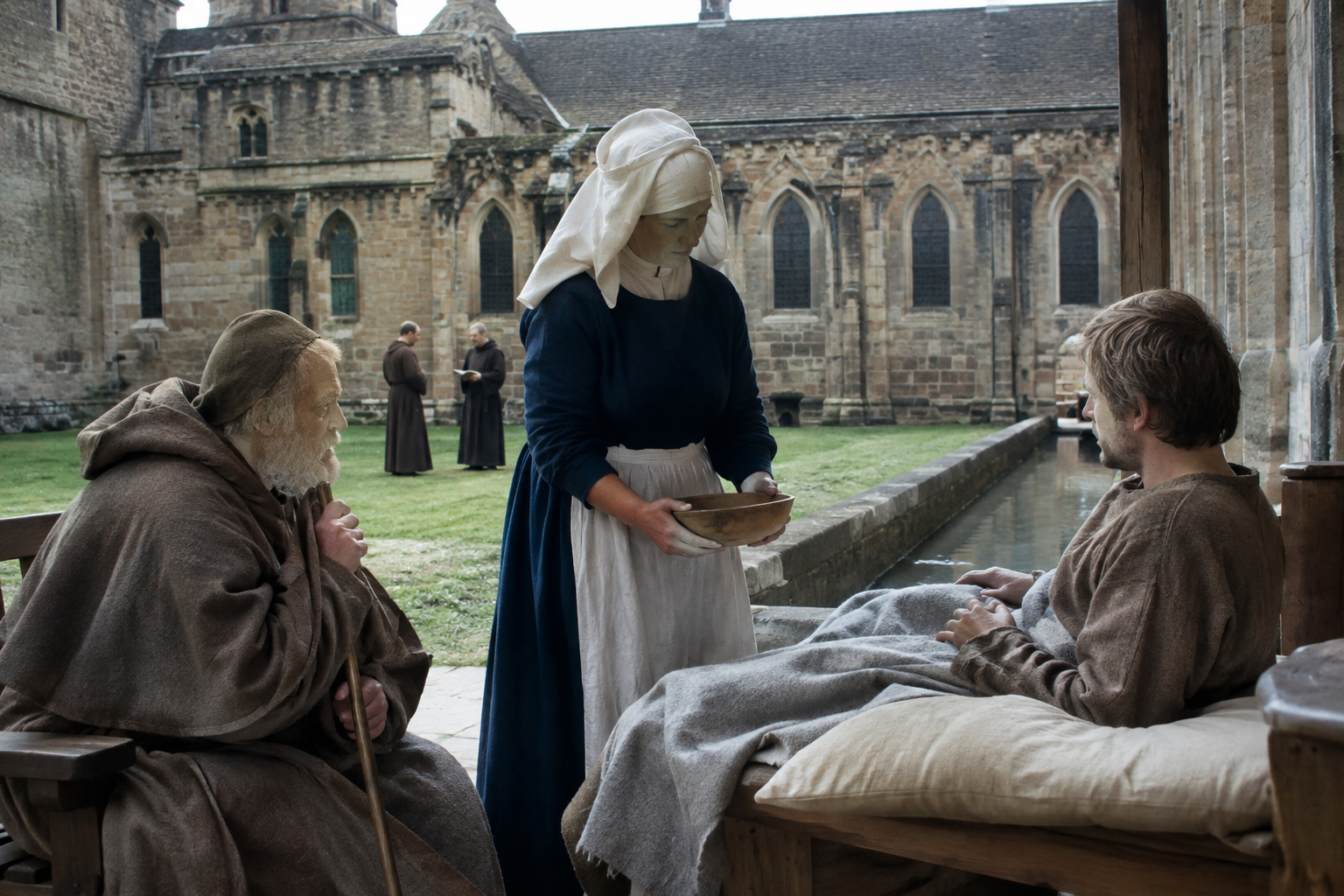
In around AD 1250, one man buried at St John's Hospital in Cambridge entered the genetic record under the identifier ATP_PSN_57. The setting matters. This was not a prehistoric cave or a princely mausoleum, but a medieval English hospital cemetery: a place tied to urban life, care, hardship, religion, and the ordinary churn of a busy town. What makes him especially striking is his reported connection to the Y-DNA haplogroup J2a1a1b2a1b2b1, a very specific paternal branch found here in the middle of medieval England.
That is the kind of finding that stops you, because it neatly punctures any lazy idea that medieval English populations were simple or genetically uniform. A Y-chromosome line traces one direct paternal line only, not a whole identity or ancestry profile, but even so, this is a reminder that towns like Cambridge were part of much wider worlds. Hospitals, markets, churches, schools, and roads gathered people together, and their family histories did not all begin locally.
St John's Hospital in Cambridge was a religious and charitable institution before the foundation of St John's College later occupied the site. Cemeteries connected to such hospitals are historically valuable because they preserve something more varied than a narrow warrior elite or a single village lineage. They can contain townspeople, migrants, laborers, dependants, and people living on the edges of security.
That makes ATP_PSN_57 a useful historical witness. The importance of this individual is not that he proves some dramatic one-man migration tale. It is that his paternal line, reported here as J2a1a1b2a1b2b1, appears in a medieval Cambridge context where we might once have expected only the broadest "local English" story. An ancient DNA study investigating burials from medieval England is linked here, and the wider lesson is clear enough even without overclaiming from a single sample: medieval towns drew in lineages with long and complicated histories.
The first thing to say, before anyone rushes off imagining crusaders, merchants, or lost princes, is that this label is very narrow. J2a1a1b2a1b2b1 sits deep inside the broader haplogroup J2, a major West Eurasian paternal lineage with a long history in the Mediterranean, the Near East, and adjoining regions. But the history of the large parent branch is not automatically the history of every tiny descendant twig.
That distinction is vital. Broadly speaking, J2 lineages are often discussed in connection with the spread of farming, urban societies, and later movements around the Mediterranean and western Asia. Yet a man in AD 1250 Cambridge carrying a much more precise subclade does not let us draw a straight arrow from one ancient civilization to one medieval grave. What it does suggest is that a paternal line with deeper connections beyond northern Europe had, by the High Middle Ages, become part of an English urban population.
And that, in its own quiet way, is historically exciting. Medieval England was linked by trade, pilgrimage, clerical networks, war, scholarship, and marriage to the Continent and beyond. Cambridge in particular was no sealed box.
There is a tendency in popular history to prefer glamorous contexts: kings, horsemen, weapons, treasure. But hospital cemeteries often tell us more about how populations actually looked on the ground. They catch people in the fabric of everyday institutions. In a place like Cambridge, that includes students, clergy, servants, craft workers, the poor, and incomers of varying distances.
So the value of ATP_PSN_57 is partly contextual. His burial does not stand for all of medieval England, of course, but it belongs to precisely the kind of archaeological setting where diversity is historically plausible and socially meaningful. If one specific J2-derived paternal line appears there, the sensible interpretation is not exotic fantasy, but medieval connectivity.
That broader picture fits well with other work on post-Roman and medieval Britain, where ancient DNA keeps showing that local continuity and incoming ancestry were not opposites so much as partners in a long historical process.
Roman and Early Medieval Britain
It is worth lingering on the place. Cambridge in the 13th century was a growing ecclesiastical and commercial town, increasingly shaped by the university but still embedded in the wider economy of eastern England. Roads, river traffic, church patronage, and scholastic exchange made it far more connected than the word "medieval" sometimes encourages us to imagine.
In that setting, a paternal lineage like J2a1a1b2a1b2b1 need not represent a recent arrival from some distant homeland. The line could have reached England generations or centuries earlier through any number of historical routes: Roman-era mobility, Norman and Angevin connections across the Channel, mercantile movements, clerical travel, or family lines that had already become thoroughly local long before this man was buried.
That is one of the most important habits in archaeogenetics: resisting the urge to make the last movement the only movement. A Y-line in medieval Cambridge is evidence for presence, not a ready-made biography. The historical interest lies in how such presences accumulated over time.
Seen in a wider European frame, the appearance of a J2-derived lineage in medieval England is not bizarre at all. Ancient and medieval DNA from the Mediterranean world, Roman provinces, and later urban centers has repeatedly shown that people moved, mixed, and settled across considerable distances. England sat at the far northwestern end of many of those networks, but it was still inside them.
That matters because J2 is often associated in popular imagination with somewhere else: the Aegean, Anatolia, the Levant, Italy, Iran. Fair enough, at the broad level. But Europe's medieval towns were full of the afterlives of older empires and newer trade routes. A branch ultimately nested within that larger world turning up in Cambridge is exactly the kind of thing a serious historian would expect to happen sometimes, even if the exact family path remains unknown.
For readers interested in those southern and eastern Mediterranean connections, MyTrueAncestry has also explored how movement and settlement reshaped populations in Roman and post-Roman settings far from England.
If you belong to haplogroup J2a1a1b2a1b2b1, the best-supported lesson from this evidence is modest but real. Your direct paternal line is not only part of the broad J2 story often linked with the Mediterranean and western Asia; it is also documented, at least in this case, within a medieval English burial from Cambridge around AD 1250. That does not make every bearer of the branch "English," still less identify a named family. But it does show that this paternal line had already entered the lived population history of medieval Britain.
So the real story here is not one of neat ethnic boxes. It is a story of how a very specific paternal branch appears in an urban cemetery tied to charity and care, in one of medieval England's most connected towns. A lineage with deeper roots beyond northern Europe had, by then, become part of the human crowd of Cambridge.






Comments