Medieval Sicily’s Multi-Faith Genetic History
– 6 min read


Medieval Sicily was a hinge of the world. Set between Europe, North Africa, and the Near East, it drew Byzantine officials, Muslim governors, Norman kings, merchants, and travellers to its wheat fields, ports, and crowded markets. Yet political conquest never produced one neat human result. The island did not empty and refill with each new ruler. Instead, older communities remained, newcomers arrived, and identities layered rather than replaced.
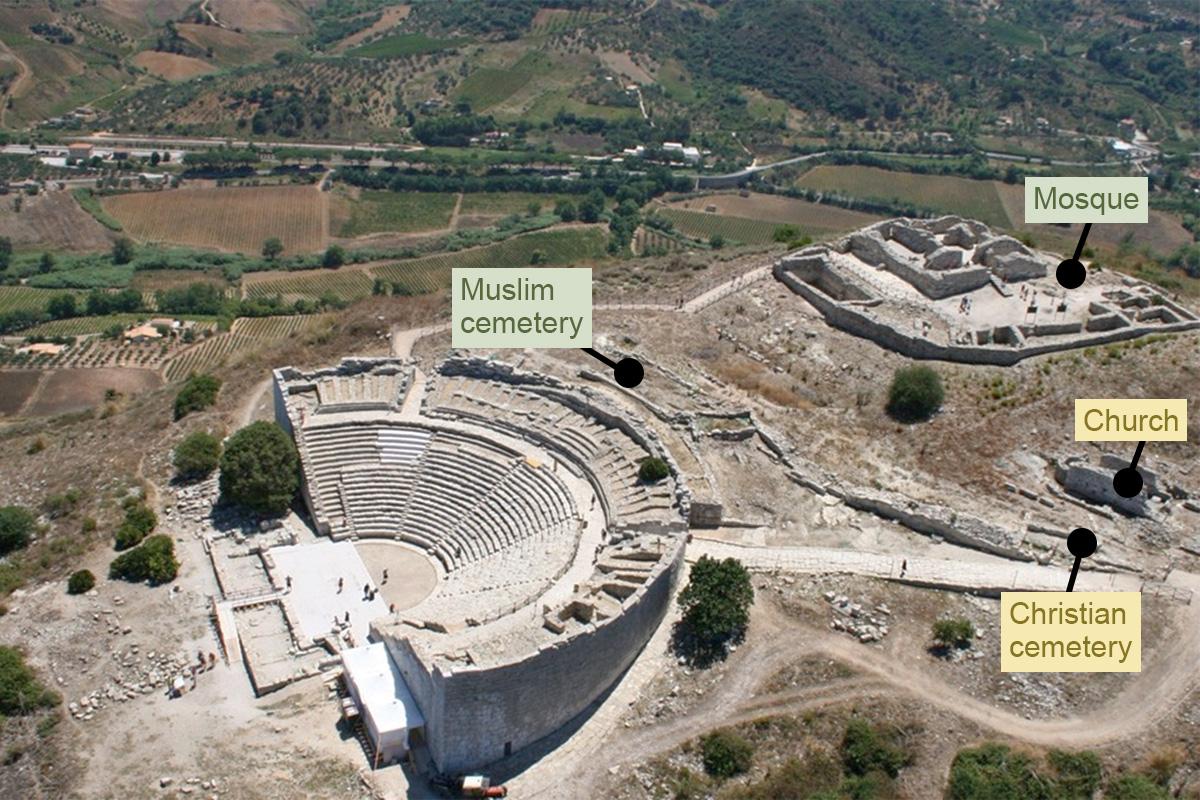
Human remains from eighteen sites across Sicily — from Palermo to Catania, from hilltop settlements like Monte Iato to coastal cemeteries in Agrigento and Segesta — reveal this complexity in bone and soil. Burial practice opens a striking window: some graves follow Islamic custom, others Christian, yet ancestry and rite do not align simply. A person buried as a Muslim might carry ancestry linked to northern Europe; a Christian burial might belong to someone with strong North African roots. The cemetery ground of Sicily preserves entanglement, not clean ethnic or religious blocks.
The Mediterranean was not a barrier but a road, and Sicily stood at its centre — receiving grain, ceramics, captives, pilgrims, soldiers, and families. That cosmopolitan reality was not new in the Middle Ages. Greek, Punic, and Roman networks had already made the island a meeting ground. What changed were the political frameworks and the particular routes by which people entered and settled. What endured was mixture itself.
Palermo's cemeteries reflect its status as one of the great medieval Mediterranean cities. At Castello San Pietro and La Gancia, burials in Islamic rite preserved a strikingly mixed population with ancestry ranging from North Africa to West Africa and northern Europe. The direction a body faced, the posture of limbs, the spacing of graves — these careful acts by the living reveal communities committed to particular practices, yet the ancestry results show those communities united people of very different origins.
Beyond Palermo, rural and hilltop sites add further texture. Segesta's neighbouring Islamic and Christian cemeteries show sharper clustering by ancestry than most other sites, demonstrating how varied local situations could be. On the south coast, Agrigento and San Leone face Africa directly, and their burials confirm that people with North African-linked ancestry were present even before the Islamic conquest. The Villa del Tellaro in eastern Sicily, better known for Roman remains, quietly preserved individuals carrying African maternal lineages from a later phase — exactly the archaeological surprise that makes cemetery evidence so powerful.
Together, the sites refuse simplification. Urban Palermo, hilltop Segesta, and coastal Agrigento each tell a different story, yet all point toward the same conclusion: medieval Sicily was not one uniform social experiment but a series of local worlds tied together by sea routes, overlapping traditions, and shared ground.
One of the most powerful revelations is that links with North Africa did not begin with Muslim conquest. Cemetery evidence shows that some Sicilian individuals buried before the Islamic period already carried substantial North African-linked ancestry. Earlier Punic and Roman networks had brought people whose ancestry fell between modern European and North African populations. Medieval Sicily inherited this older connected world; when Muslim rulers arrived, they entered an island already accustomed to Mediterranean entanglement.
During Islamic and then Norman rule, many individuals continued to occupy a broad middle zone between modern European and North African populations, suggesting sustained diversity and repeated arrivals across generations. Crucially, this range did not collapse when rulers changed. The Norman period still preserved much of the same variety. Only in the later medieval centuries does the picture shift more strongly toward the ancestry profile seen in modern European populations — a slow rebalancing rather than a sudden break.
Ancestry and faith were related only loosely. Similar North African ancestry components appear in earlier Christian contexts and in individuals whose burial customs resist clean labelling. A person could belong to an Islamic cemetery without being a newcomer from North Africa. The great story, then, is continuity through change: Sicily's multi-faith society grew from older roots, and its North African connections predated Islamic rule by centuries.
Several individuals stand out with extraordinary force. CSPBN2 from Castello San Pietro in Palermo was buried in Islamic rite during the period of Islamic governance. Genetically, he aligns closely with West African populations from regions such as Gambia, Mali, and Sierra Leone, with both maternal and paternal lineages strongly associated with sub-Saharan Africa. Whether he arrived through trade, military service, or enslavement cannot be known, but his burial in Palermo proves that West African lives formed part of the human reality of medieval Sicily.
GABN6 from La Gancia, also showing almost entirely West African ancestry, belongs to a later medieval or post-medieval phase — a warning against imagining Sicily as a closed European society at any point. SGBN2 from Segesta, identified in earlier work, carried strong sub-Saharan African ancestry pointing toward West-Central Africa, including areas around Cameroon and Gabon.
Perhaps the most intriguing individual is MABN4 from Monte Maranfusa. Osteological study suggested a male body, but genetic evidence revealed a woman. Buried in Islamic tradition during the Norman period, her ancestry combines African and European-related elements in a way that makes her the clearest example of a person whose recent family history involved mixing between populations travelling very different routes into Sicily. She makes the social world of medieval Sicily feel intimate and domestic.
The contrast sharpens further with CSPBN1, also from Castello San Pietro, buried in an Islamic cemetery yet carrying ancestry pointing strongly toward northern or eastern Europe. Within one Palermo cemetery lie men whose backgrounds span the medieval world. These individuals expose the limits of tidy categories. A burial rite does not reveal a whole life. An ancestry profile does not reveal a childhood language. Behind every data point was a person who may have experienced coercion, adaptation, kinship, and survival in equal measure.
Modern Sicily did not spring into being fully formed. Its population accumulated across centuries of layered ancestry and mobility. By the time Byzantine, Muslim, and Norman rulers competed for the island, Sicily already carried a mixed inheritance from Neolithic farmers, Iron Age changes, and Punic and Roman contact. The medieval cemeteries catch that process in motion.
The most important social result is that regime change did not erase diversity. Christian and Islamic burials alike contained people of varied ancestry across several centuries. The balance eventually shifted — later medieval phases show ancestry patterns closer to modern European populations — but the change was gradual. Some earlier North African and sub-Saharan African elements persisted, and modern Sicilians still carry traces of this long history.
Culture and religion could spread without matching shifts in ancestry. People joined communities, adopted practices, and were buried within religious systems that did not always reflect their ancestral origins. That is an extraordinarily resonant lesson: the making of medieval Sicily involved not just population movement but cultural belonging. Coexistence could involve hierarchy and coercion as well as exchange, and some of this diversity was produced by suffering. Yet even that dark truth reinforces the importance of the burials.
Sicily appears not as a borderland but as a centre — a place where the Mediterranean repeatedly remade itself in flesh, family, and faith. A burial in Palermo, a grave at Segesta, a woman at Monte Maranfusa, a West African man laid to rest in Islamic rite: these are the pieces from which a genuinely human history is built.
 Aurore Monnereau ,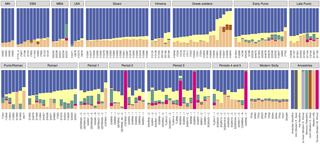
Comments