The Noble House of OHanlon
– 3 min read


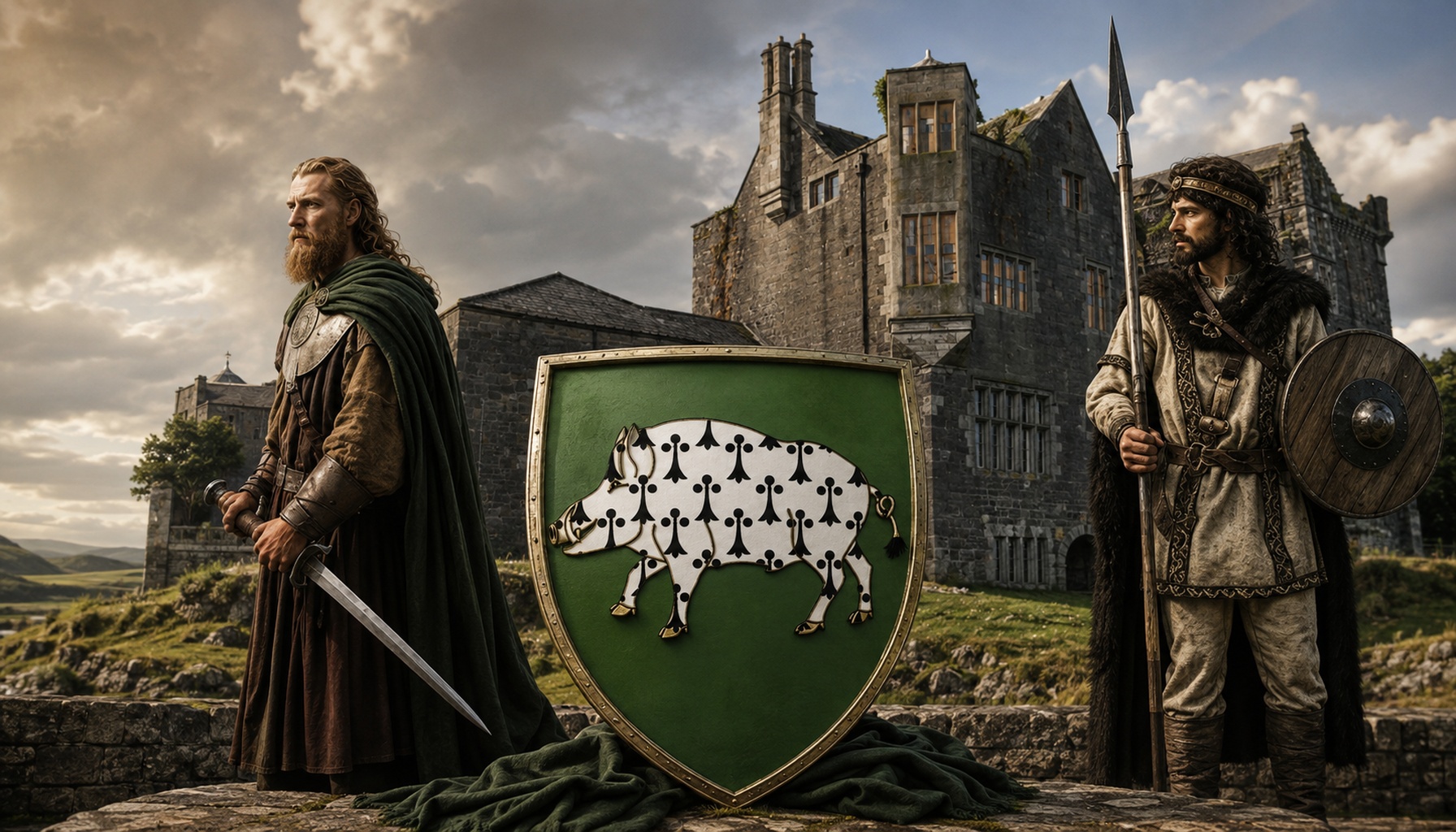
The House of OHanlon was one of the notable Gaelic noble houses of Ulster, rooted in Orior in what is now County Armagh, and remembered as a frontier lordship shaped by war, kinship, land, and survival. Their heritage belongs to that distinctly northern Irish world of chiefs, client families, defended territory, and shifting alliances, where power was personal, local, and constantly tested. The family is linked here with the haplogroup R1b1a1b1a1a2c1a1a1a1a1a1a3a, presented as the primary family haplogroup tag for this house.
In origin terms, the OHanlons emerged from the Ui Niallain, a people traditionally connected with Niallan, placed around 450, whose name echoes behind both lineage and territory. This was not a polite backwater but a borderland, pressed by rivals and entangled in the larger politics of Ulster. The OHanlons became Lords of Orior, exercising regional authority through lordship, military leadership, and control of land in a landscape where a strong family could hold a district together and where a weak one could quickly lose it. Among the figures most often remembered are Niallan, ancestor of the Ui Niallain; Sir Oghy OHanlon, Chief of Orior in 1605; and Redmond OHanlon, the celebrated and feared Irish rapparee leader who lived from 1640 to 1681. Taken together, they show the long arc of the house: from early kin-based origins to Gaelic lordship and then into the violent upheavals of the seventeenth century.
Read more about the Royal House of ONeill
The great location anchor for OHanlon memory is Tandragee Castle, in County Armagh, a site deeply tied to the political geography of Orior. Tandragee itself sits in a strategic part of the Armagh landscape, and that matters, because this was a region where roads, rivers, and defensible places were never just scenery. The castle is traditionally associated with the OHanlons before later possession passed into other hands during the upheavals of plantation and conquest. The present building reflects substantial later rebuilding, especially from the seventeenth century onward, so what visitors see today is not a pure medieval Gaelic fortress frozen in time, but a layered historical site carrying the memory of earlier lordship beneath later architecture. It is also well known in modern times through its later association with the Duke of Manchester and, more recently, with the Tayto brand. Yes, it can still be visited in a practical sense, as Tandragee Castle remains a well-known and extant local landmark, though access may depend on site use and current arrangements rather than on it functioning simply as an open ruined monument.
From the DNA angle, the OHanlon tag is linked here to R1b1a1b1a1a2c1a1a1a1a1a1a3a, and there are related ancient DNA signals from medieval Ireland that help place this paternal line in a broader Irish context, without claiming direct descent from any excavated individual. Especially relevant are the many Ballyhanna, County Donegal medieval samples, including Sk197an, Sk197y, Sk197q, Sk197am, Sk197s, Sk197ab, Sk197u, Sk197t, Sk197r, Sk197ad, Sk197x, Sk197n, Sk197aa, Sk197z, Sk197ak, Sk197w, Sk197ai, Sk197m, Sk197ah, Sk197ag, Sk197v, Sk197ac, Sk197al, Sk197af, Sk197ae, Sk197o, Sk197aj, HAN197x, Sk197a, Sk197b, Sk197c, Sk197d, Sk197e, Sk197f, Sk197g, Sk197h, Sk197i, Sk197j, Sk197k, Sk197l, Sk197p, and HAN197, along with Kilteasheen, Roscommon samples KIL041, KIL044, KIL033, KIL037, KIL009, and KIL014. These are best understood as related or linked ancient comparanda from medieval Gaelic Ireland, useful for giving genetic depth to the sort of world in which families like the OHanlons lived, ruled, fought, married, and buried their dead.
If the story of the OHanlons speaks to your own family history, this is where history becomes personal. Upload your DNA to MyTrueAncestry and see whether you match the House of OHanlon, its haplogroup tag R1b1a1b1a1a2c1a1a1a1a1a1a3a, or related medieval Irish ancient DNA samples from places such as Ballyhanna and Kilteasheen.
Comments