Clan Doherty
– 3 min read


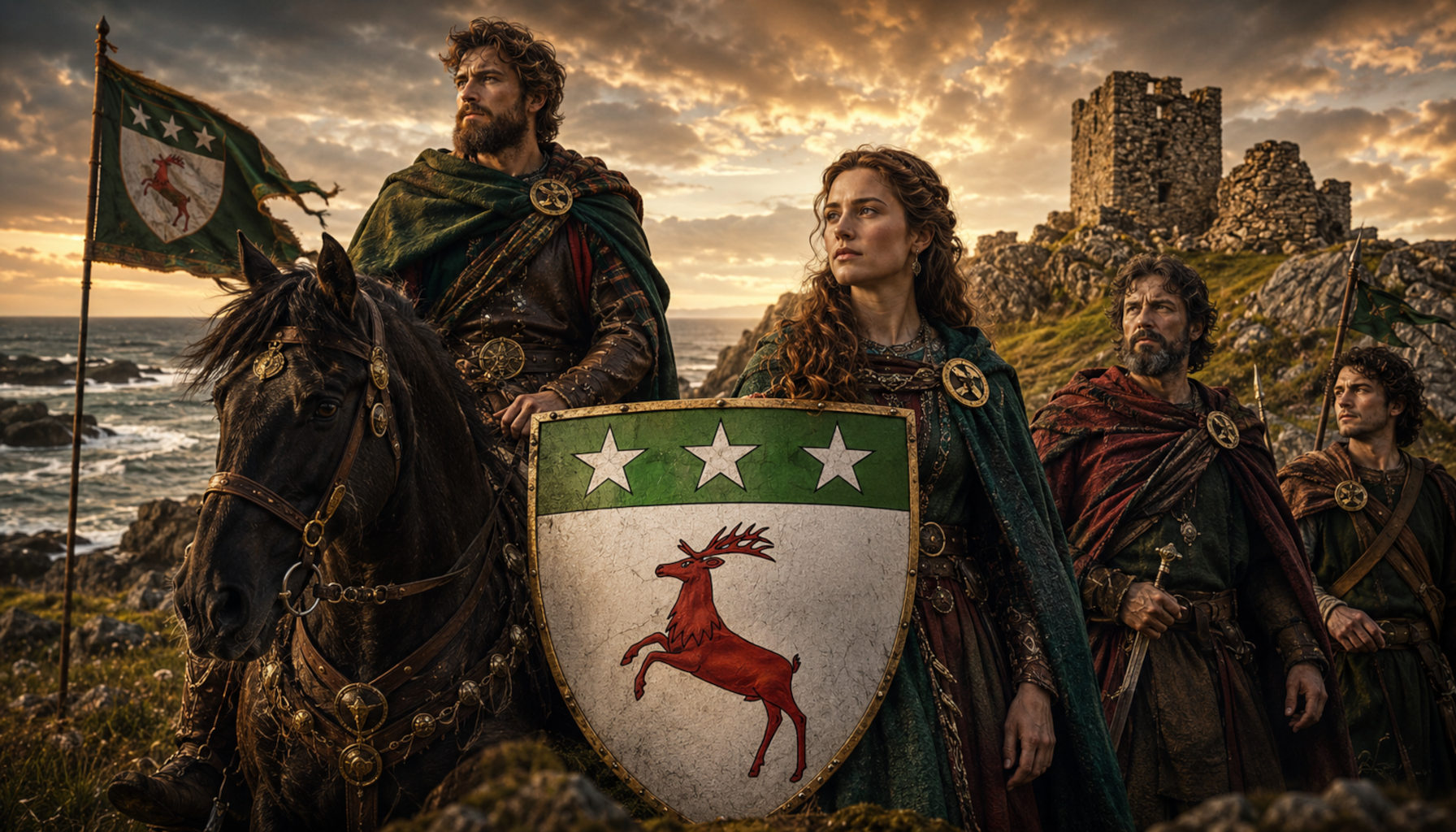
Clan Doherty, also written O'Doherty and in Irish O Dochartaigh, was one of the great Gaelic families of Inishowen in County Donegal, rooted in the rugged northwestern edge of Ireland and traditionally linked here with the primary family haplogroup R1b1a1b1a1a2c1a1a1a1a1a1a1a1a2a. They belonged to the Cenel Conaill branch of the northern Ui Neill, which places them in that old royal world of early medieval Ireland where kinship, territory, and lordship mattered as much as crowns. This was a family shaped by headlands, harbours, mountain passes, and sea roads, ruling a peninsula that looked both inland toward Ulster and outward toward the North Atlantic world.
Their story is not just one of a surname, but of a political landscape. The O'Dohertys rose as lords of Inishowen in a Gaelic order built on alliances, rivalries, fosterage, tribute, and fortified places. Among the early named figures remembered in the family tradition is Donagh Dochartach, noted around 900, a reminder of how deep these roots run in Donegal. In later centuries the clan stood close to the O'Donnells and moved through the great upheavals of late medieval and early modern Ulster. Sir Cahir O'Doherty became the best-known member of the family when he led O'Doherty's Rebellion in 1608, one of the last dramatic armed challenges by the Gaelic elite after the Flight of the Earls. His sister Rosa O'Doherty, or Roisin Ni Dhochartaigh, belongs just as much to this history: a Gaelic noblewoman caught in the age of collapse, exile, marriage diplomacy, and survival, linked in turn to the O'Donnell and O'Neill dynasties. Even the clan arms, with a red stag beneath three stars, seem to capture something of Donegal itself: bold, stark, and memorable.
Read more about Clan Mac Lochlainn
A fine anchor for Doherty history is Carrickabraghy Castle, on the Inishowen peninsula near the coast at Ballyliffin, a place where the landscape still explains the politics. The castle stands on a rocky height with wide views over land and sea, exactly the sort of commanding site a Gaelic lordship needed in a contested region. The present ruin is usually dated to the 16th century, though the site itself is older in strategic importance, and it became closely associated with the O'Dohertys as chiefs of Inishowen. In the turbulent years around the Nine Years' War and its aftermath, such castles were not simply residences; they were statements of control, lookout points, defensive nodes, and symbols of a Gaelic order under pressure. Carrickabraghy was damaged and eventually fell into ruin in the violence of the early 17th century, but its remains still survive, and yes, it can still be visited as a historic ruin. It is one of those places where the broken walls are almost the least interesting thing about it, because all around you are the coastlines, sea lanes, and horizons that made the O'Dohertys powerful in the first place.
From a DNA point of view, the haplogroup tag linked here with Clan Doherty is R1b1a1b1a1a2c1a1a1a1a1a1a1a1a2a, and a striking cluster of related ancient DNA samples comes from medieval Ireland itself. These include numerous Ballyhanna, County Donegal individuals such as Sk197an, Sk197y, Sk197q, Sk197am, Sk197s, Sk197ab, Sk197u, Sk197t, Sk197r, Sk197ad, Sk197x, Sk197n, Sk197aa, Sk197z, Sk197ak, Sk197w, Sk197ai, Sk197m, Sk197ah, Sk197ag, Sk197v, Sk197ac, Sk197al, Sk197af, Sk197ae, Sk197o, Sk197aj, HAN197x, Sk197a through Sk197p, and HAN197, alongside related medieval Irish examples from Kilteasheen in Roscommon such as KIL041, KIL044, and KIL014. These samples should be described carefully: they are not proof of direct descent from the O'Doherty chiefs, but they are valuable as linked or related genetic evidence from medieval Irish populations living in the same broader historical world. In other words, they give us something wonderfully tangible: actual people from medieval Ireland whose paternal lines connect into the same wider haplogroup story associated with families like the Dohertys of Donegal.
Read more about Clan Gallagher
If Clan Doherty is part of your family story, this is exactly the sort of history worth testing against both records and deep ancestry. Uploading your DNA can help you see whether you match the family's linked genetic profile or connect with related ancient DNA samples from medieval Ireland and beyond. It is a fascinating way to place your own roots back into the world of Inishowen, Gaelic lordship, and the long memory of Donegal.
Comments