Clan ODomhnaill
– 3 min read


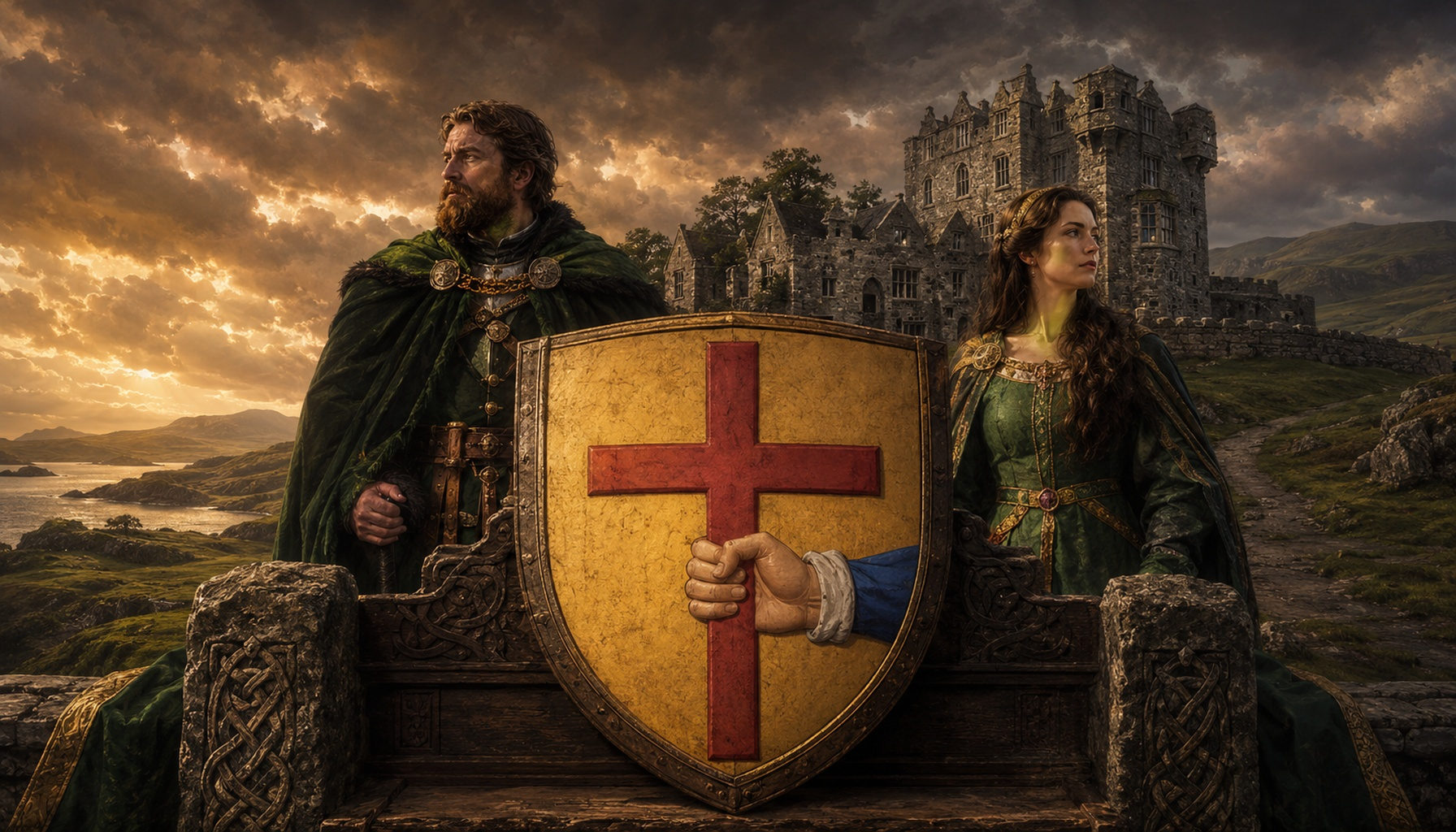
Clan ODomhnaill, the great O'Donnell dynasty of Gaelic Ireland, came from Tir Chonaill in the far north-west of Ireland, centered in what is now County Donegal. Their primary family haplogroup is tagged here as R1b1a1b1a1a2c1a1a1a1a1a1a1, a lineage strongly associated with parts of Gaelic Ireland in genetic discussions. Historically, though, the family matters above all because they were not just landowners with a good pedigree, but rulers: kings, lords, war leaders, patrons of poets, and one of the most formidable dynasties in the Irish political world.
The ODomhnaills emerged from the wider northern Ui Neill world and tied their prestige to the memory of very early royal ancestors, above all Niall Noigiallach, High King of Tara, traditionally dated to around 405, and the wider claims of the northern dynasties that also evoked the title King of Leth Cuinn. In practical terms, their power was built in the old Gaelic way: control of territory, tribute, fosterage, alliance, church connections, and fighting ability. For centuries the Kings of Tyrconnell stood as major players in Ulster politics. By the late medieval and early modern period, the ODomhnaills were among the chief opponents of English expansion, especially in the age of the Nine Years War, and their story runs directly into the drama of the Flight of the Earls, that bleak and famous moment when the old Gaelic order began to collapse into exile, confiscation, and memory.
One of the best physical anchors for the family story is Donegal Castle, in Donegal Town, a place still open to visitors and very much visitable today. The castle was originally built by the O'Donnell dynasty in the fifteenth century, most often associated with Red Hugh O'Donnell's father, Hugh Roe O'Donnell. It stands at a strategic point beside the River Eske, close to Donegal Bay, which tells you something important straight away: this was not a remote romantic ruin dropped into the landscape by accident, but a seat chosen for control, movement, and display. After the collapse of Gaelic lordship, the castle passed into the hands of Sir Basil Brooke in the early seventeenth century, and he altered it in a Jacobean style, so the building visitors see now is really a conversation between two political worlds, Gaelic and plantation. That makes it especially interesting. It is not just an ODomhnaill monument, but a record in stone of conquest, adaptation, and survival.
From an ancient DNA point of view, the most relevant linked material comes from medieval Ireland, especially the Ballyhanna cemetery in County Donegal, not far from the ODomhnaill heartland. A large cluster of related or linked R1b1a1b1a1a2c1a1a1a1a1a1a1-associated samples has been identified there, including individuals such as Sk197an, Sk197y, Sk197q, Sk197am, Sk197s, Sk197ab, Sk197u, Sk197t, Sk197r, Sk197ad, Sk197x, Sk197n, Sk197aa, Sk197z, Sk197ak, Sk197w, Sk197ai, Sk197m, Sk197ah, Sk197ag, Sk197v, Sk197ac, Sk197al, Sk197af, Sk197ae, Sk197o, Sk197aj, HAN197x, Sk197a through Sk197p, and HAN197. Other related examples appear at Kilteasheen in Roscommon, including KIL041, KIL044, KIL033, KIL037, KIL009, and KIL014, with more distant linked cases noted in Viking Age Iceland at Hofstadir sample VK95 and the Faroe Islands at Sandoy Church sample VK44. These do not prove direct descent from the ODomhnaill dynasty, and it is important not to pretend they do. What they do offer is a valuable genetic backdrop for the kind of male-line ancestry found in medieval Gaelic and Norse-Gaelic worlds connected to Ireland's Atlantic zone.
Read more about Clan OFlaherty
If the ODomhnaill story sounds familiar, that is because it captures so much of what made Gaelic Ireland tick: dynastic kingship, poetry and prestige, castles and churches, warfare and alliance, and then the wrenching break of conquest and exile. If you have Irish roots, especially from Donegal or the wider northern Ui Neill world, you can explore whether your DNA shows links to this family story or to related medieval Irish samples.
Comments