Haplogroup I2a2a1b1b1

– 4 min read


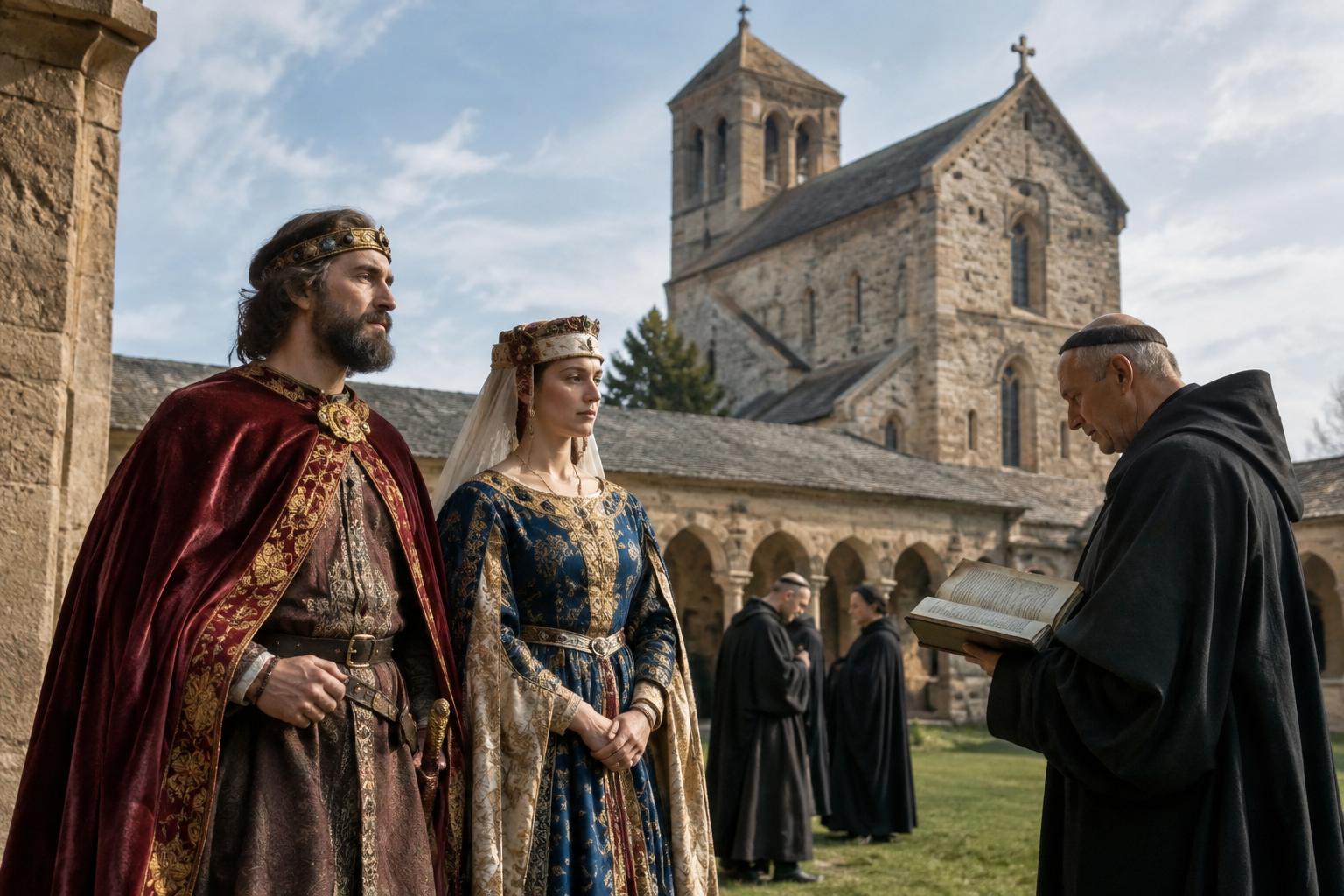
In 1312 AD, a man connected with the Hungarian nobility was buried at the Benedictine monastery associated with the Royal House of Aba. In the genetic record he appears simply as HUAS257, but that sparse label is enough to make him historically interesting. He places the Y-DNA haplogroup I2a2a1b1b1 in a very specific setting: not a prehistory cave, not a vague modern frequency map, but the world of late medieval aristocratic Hungary.
That matters because Y-DNA is at its most useful when it can be tied to a real person in a real historical landscape. It traces one direct paternal line rather than a person's whole ancestry, yet in a monastic burial tied to a noble house it gives us a rare glimpse of how one paternal lineage sat inside the power structures of the Carpathian Basin after the great transformations of the early Middle Ages.
The single best anchor for this haplogroup in the material provided is HUAS257 from the Benedictine monastery linked to the Aba kindred, one of the important noble lineages of medieval Hungary. The date, 1312 AD, places the burial in a turbulent period. This was the age when old aristocratic houses, royal authority, and regional power blocs were being renegotiated after the decline of the Árpád dynasty and during the consolidation of Angevin rule.
In that sense, the sample is valuable even without embroidered detail. We do not need invented grave goods or family drama to see why it matters. A paternal lineage assigned to I2a2a1b1b1 appears here in a Christian monastic burial environment, within a documented noble setting, and that alone tells us that this branch was part of the social fabric of medieval Hungary at elite level.
A recent ancient DNA study on medieval Hungary's elite, available as research on these burials and their wider genetic background, has helped bring this sort of context into sharper focus. Even where one individual sample must be handled cautiously, the broader significance is clear: elite burial grounds in Hungary were not genetic curiosities detached from history, but part of a lived and political medieval landscape.
The haplogroup name here is very specific: I2a2a1b1b1 is a downstream branch within the wider I2 family, one of the old Y-chromosome lineages of Europe. That broader family has a long and complicated past stretching across different regions and periods, but it would be a mistake to pour all of that deep history straight into this one medieval Hungarian burial.
What we can say more responsibly is narrower, and more interesting for that very reason. By the early 14th century, a direct paternal line assigned to I2a2a1b1b1 was present in a noble ecclesiastical context in Hungary. That does not make the House of Aba a "haplogroup dynasty" in any simplistic sense, nor does it mean everyone tied to that monastery shared the same paternal ancestry. It does, however, show that this branch participated in the social world of Christian lordship, landholding, commemoration, and monastic patronage.
Medieval Hungary is a particularly good place to be careful. Political identity, language, legal status, burial custom, and Y-DNA lineage did not line up in tidy one-to-one fashion. The kingdom had been shaped by earlier Roman provinces, post-Roman populations, the Hungarian conquest period, Slavic-speaking communities, steppe influences, western Christian institutions, and constant regional mobility.
So a lineage like I2a2a1b1b1 appearing in a Hungarian noble setting should not be treated as evidence for a single simple origin story. It is better understood as part of a layered population history in which paternal lines of different antiquity could all end up serving, marrying, inheriting, fighting, praying, and being buried within the same medieval kingdom.
That larger background is one reason ancient DNA from Hungary has become so important. The country sits at a crossroads where archaeology has long shown interaction between local continuity and incoming groups. Genetics does not erase that complexity; if anything, it confirms it.
One of the most useful ways to read HUAS257 is not as an isolated aristocrat, but as a late point in a much longer regional story. By 1312 AD, Hungary had already passed through centuries of state formation, dynastic change, church organization, and noble consolidation. A monastery burial connected with a major house belongs to that mature medieval order, not to the initial conquest horizon.
That distinction matters. Readers are often tempted to jump straight from a medieval Y-DNA result to the first famous migrants in the region. But the gap between the 10th-century conquest period and the early 14th century is large. Over those centuries, paternal lines could persist, shift in status, branch, or enter new political networks. A lineage found among later nobility may reflect deep local roots, integration into Hungarian elite society, or both; the sample alone cannot reduce that history to a single event.
In other words, I2a2a1b1b1 here is evidence of survival and placement as much as of origin. It shows a paternal line established firmly enough to appear in a high-status medieval context centuries after the kingdom's foundation.
It is easy to underestimate a haplogroup article built around one securely placed ancient individual. Yet archaeologically, a well-contextualized single burial can be more useful than a dozen poorly described ones. HUAS257 is tied to a date, a monastery, a noble association, and a historical region whose documentary record is unusually rich.
That gives the sample interpretive weight. It helps move I2a2a1b1b1 out of the abstract world of branching diagrams and into a social setting where lineage intersected with patronage, memory, and elite identity. Monasteries in medieval Europe were not merely burial containers; they were institutions of legitimacy. To be buried in such a place was to belong to a world of inheritance and remembrance.
If your paternal line belongs to I2a2a1b1b1, this evidence does not hand you a ready-made medieval pedigree. What it does offer is something subtler and more solid: a documented case of this lineage appearing in late medieval Hungary in a noble monastic setting, attached to the historical orbit of the Aba house. That is a real foothold in the past.
For family historians, that means this branch is at home in the complicated human landscape of central and southeastern Europe, where old European paternal lines could be woven into medieval kingdoms, Christian institutions, and aristocratic society. HUAS257 is not the whole story of I2a2a1b1b1, but he is a reminder that even a single ancient burial can turn a string of letters and numbers into a historical life.


Comments