Haplogroup O2a2b1a2a1a1b1b2b1

– 4 min read


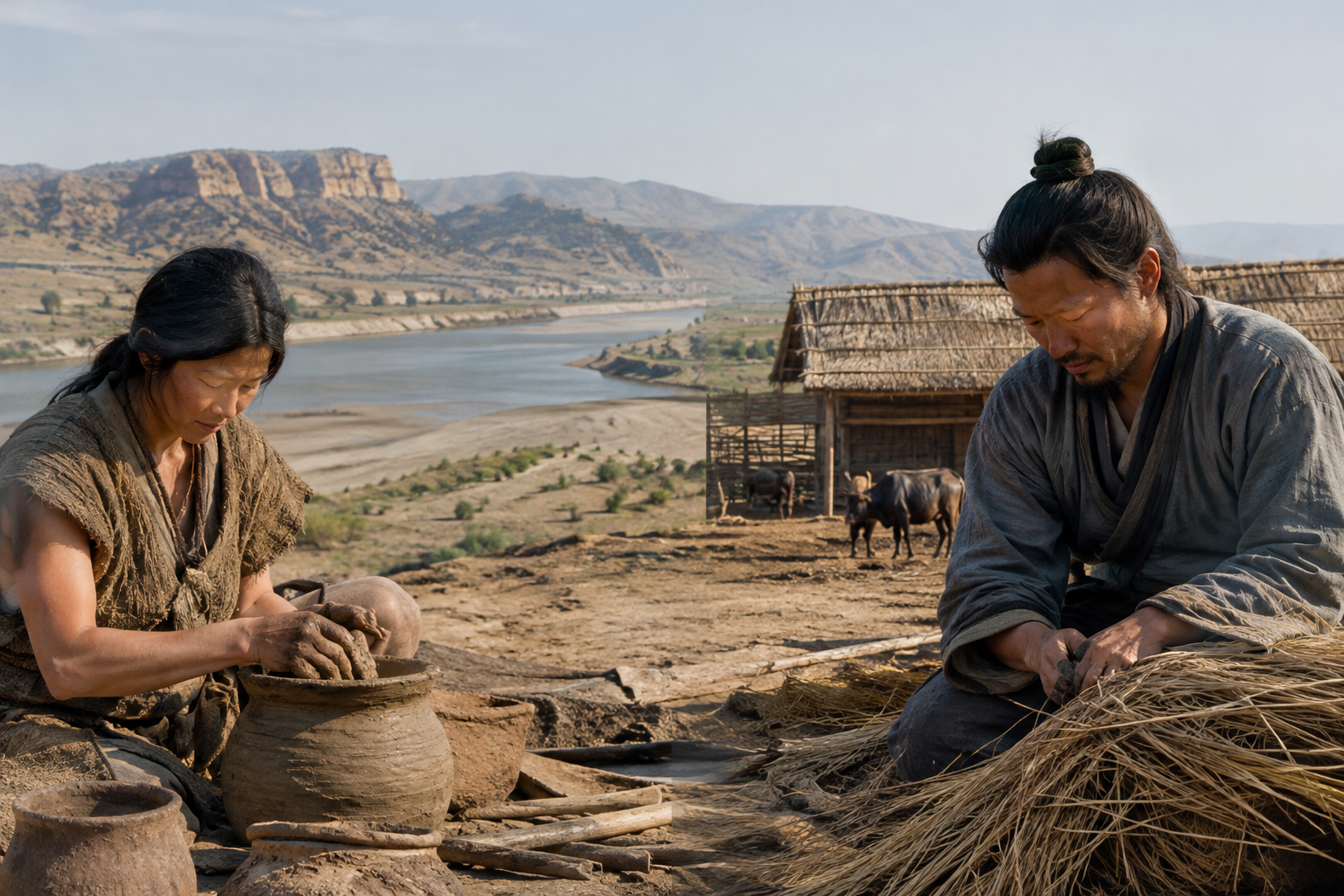
At Lajia village in Minhe County, Qinghai, one ancient male dated to around 1900 BC appears in the evidence for the Y-DNA branch O2a2b1a2a1a1b1b2b1. The sample is identified as LJM14. That matters because Lajia is not just any prehistoric settlement: it sits in the upper Yellow River world, a region long discussed as a meeting ground between early farming communities, highland routes, and the societies that would shape northwestern China in the Bronze Age.
For anyone tracing this paternal line today, that is the real point of departure. A Y-DNA haplogroup follows one direct male line only, not a person's whole ancestry, but ancient finds like LJM14 let us ask a very precise historical question: where do we actually see this paternal branch, or a closely reported association with it, in the archaeological record? In this case, the clearest pattern is early and northern Chinese, with another later appearance at Jiaozuoniecun in ancient China, where sample JXNTM2 is dated to around 1000 BC.
Lajia has become famous in archaeology because the site belongs to a dramatic period of change in northwestern China. Communities in this broad region were tied to farming, river settlement, and local exchange, but they also stood near corridors leading outward toward Gansu, the plateau edge, and the wider interior of East Asia. That makes any securely identified paternal lineage from Lajia especially useful, because it is anchored in a place where local continuity and wider contacts both mattered.
Sample LJM14, dated around 1900 BC, places this paternal branch in the Bronze Age landscape of Qinghai. Even with just one individual, the context is important. This is not evidence for a dynasty, a tribe, or a single migration event; it is evidence that a man associated with this Y-lineage was living within a community on the upper Yellow River during a formative period of regional history.
A broader genetic study of the region, published in Nature Communications, helped frame Bronze Age Gansu-Qinghai populations as part of a complex human story rather than an isolated pocket. That wider setting is useful here because it reminds us that a paternal line like O2a2b1a2a1a1b1b2b1 did not exist in a vacuum. It belonged to real populations shaped by settlement, marriage networks, and movement across ecological zones.
The label O2a2b1a2a1a1b1b2b1 is a very narrow twig on a much larger East Asian Y-DNA tree. That distinction is worth keeping in view. The wider O lineages have deep histories across East Asia, but a very specific terminal branch should not automatically inherit every story told about its parent clades.
In practical terms, that means caution. The archaeological evidence here supports association with this branch in ancient northwestern and northern China, but it does not by itself tell us the original birthplace of the exact subclade, the language spoken by every carrier, or the full path by which it spread. Ancient DNA works best when it is tied to named individuals, dates, and sites, which is why LJM14 and JXNTM2 matter more than sweeping maps.
The second ancient individual linked here is JXNTM2 from Jiaozuoniecun, dated to around 1000 BC. This pushes the evidence forward by nearly a millennium from Lajia. We are no longer in the same Bronze Age moment, and that alone makes the pair interesting: they hint at persistence of this paternal branch, or closely related reporting of it, across substantial historical time in northern China.
Just as importantly, Jiaozuoniecun belongs to a different archaeological setting from Lajia. Even when the surviving summary is brief, the combination of two separated sites suggests that this lineage was not confined to one isolated mountain-side community or one single burial cluster. Instead, it appears within the broader northern Chinese world across changing political and cultural landscapes.
That is exactly the sort of pattern archaeogenetics is good at exposing. One sample can be an anecdote. Two samples, separated by both space and time, begin to look like historical signal.
Middle Yellow River Genomic History
It is easy, from a modern map, to imagine Qinghai and neighboring regions as marginal to the main current of early Chinese history. Archaeology has steadily corrected that picture. The upper Yellow River zone was a place where farmers, herders, and mobile communities interacted, and where local populations could connect to wider networks running east into the Central Plains and west into Inner Asia.
That matters for understanding O2a2b1a2a1a1b1b2b1. A paternal lineage found in this setting may have been carried through generations of men who lived in communities shaped by exchange, adaptation, and local continuity rather than by one neat, single migration. In other words, the archaeology argues for complexity. The lineage is ancient in the region, but the human story around it is one of interaction, not isolation.
This is also why northwestern Chinese finds often repay comparison with other regional studies. Broader ancient-DNA work across northern China has repeatedly shown that prehistoric and early historic populations were structured, but not static. Communities could keep local roots while still absorbing newcomers and sending descendants outward.
One of the most useful lessons from ancient DNA is that paternal lines can persist even as material culture changes around them. Pottery styles shift, exchange networks expand or contract, and burial customs evolve; meanwhile, some male lines continue quietly through the centuries. The spacing between LJM14 and JXNTM2 fits that larger lesson rather well.
That does not mean every later carrier descends from one famous ancient man, or that one lineage equals one people. It means that this branch was part of the demographic fabric of ancient northern China. For descendants today, that is often the most valuable kind of result: not a mythic founder, but a documented place in the real archaeological record.
There is also a useful historical contrast here with many later elite or surname-based narratives. No noble house is needed to make this lineage interesting. Its significance lies in appearing among ancient individuals from regions central to the long formation of Chinese civilization and its frontier connections.
East Asian Y-Chromosome Migrations
Based on the evidence here, O2a2b1a2a1a1b1b2b1 has a documented ancient presence in northern and northwestern China, with one associated individual at Lajia in Qinghai around 1900 BC and another at Jiaozuoniecun around 1000 BC. That is a strikingly old foothold in the archaeological record. For someone researching this paternal line, the strongest supported takeaway is continuity within the broad northern Chinese world, especially in regions where early farming societies and frontier interactions met.


Comments