Ancient DNA reveals population history and burial practices in Bronze Age Gansu
– 5 min read


Northwest China looks like a margin on modern maps, but in deep history it was anything but. Gansu sat at a great hinge of the ancient world, where landscapes, peoples, crops, animals, metals, and ideas met. Long before formal roads or caravans, this was already a zone of motion — and archaeology preserves that motion in wonderfully concrete ways: a painted pot, a bronze knife, a sheep bone, a grain of wheat caught in the earth for four thousand years.
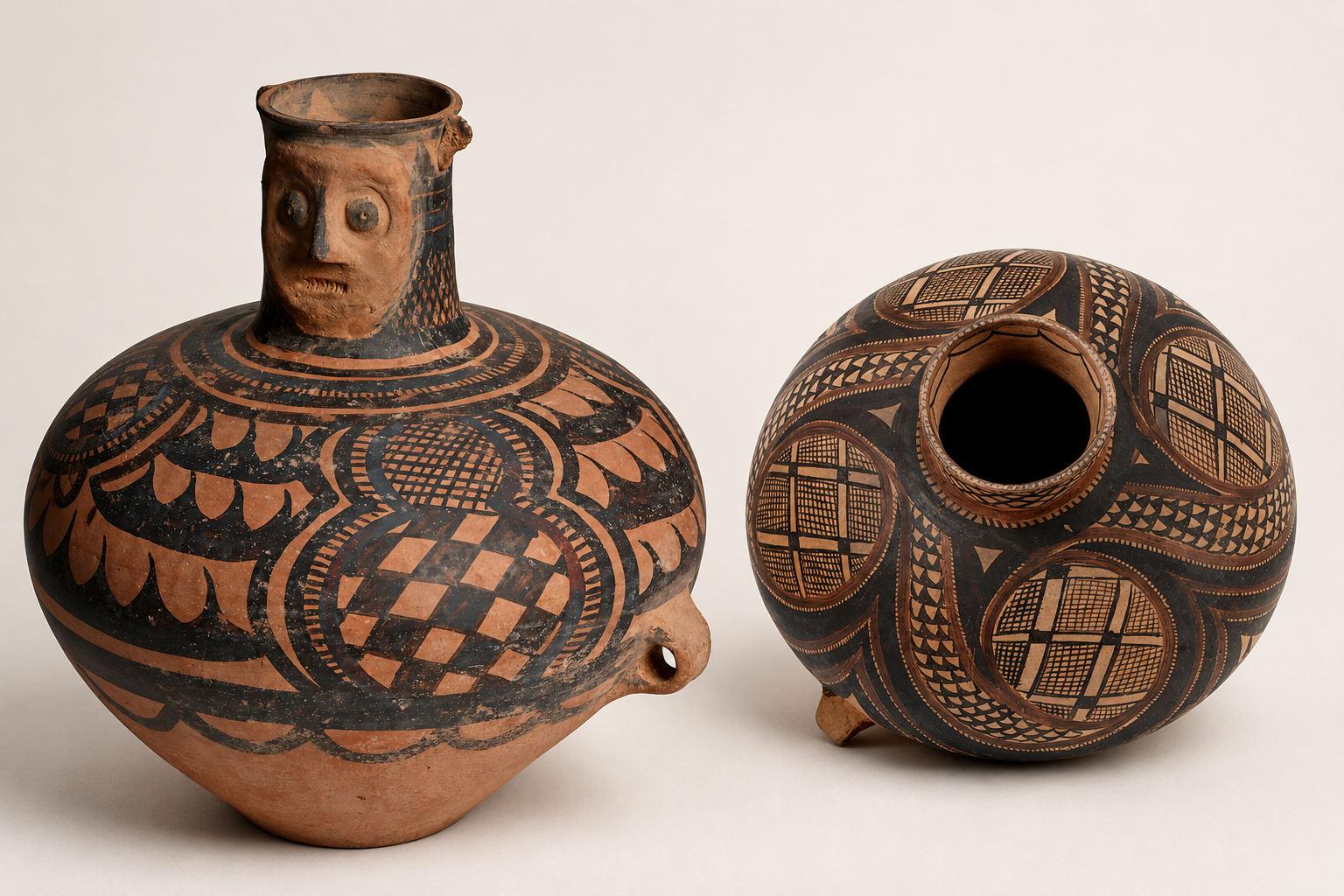
Several cultural traditions flourished across Gansu during the late Neolithic and early Bronze Age, including the Majiayao world with its vivid painted pottery, the Qijia culture, and the Siba culture. Then came western crops, domestic animals, and new metallurgical skills. Wheat, barley, sheep, goats, and cattle became prominent. At sites such as Mogou, Huoshaogou, and Xichengyi, archaeologists recovered tools, ornaments, and weapons hinting at contacts stretching over vast distances.
The excitement lies in the complexity. Exchange did not mean foreign peoples replaced everyone. Crops, animals, and craft techniques traveled through communities, being adopted, reworked, and absorbed. Ancient Gansu was not peripheral — it was a laboratory of contact, showing history happening not as grand proclamation, but as thousands of small choices made by real people in real places.
When wheat, barley, sheep, and metalworking appear in a region, the obvious question is whether migrants brought them or locals adopted them through contact. In Gansu, the answer is unexpected. New crops and technologies arrived, but the people buried across these sites remain, in biological ancestry, overwhelmingly tied to East Asian populations.
Communities were not passive recipients — they were active choosers. They could take in wheat while still eating millet, herd sheep while keeping older practices, and transform metal objects without becoming copies of distant societies. Cultural exchange moved faster, and differently, than people themselves.
The implications for food are vivid. At Mogou and Huoshaogou, people consumed mixtures linking both millet-rich and wheat-barley-rich systems. Animal bones tell the same story: sheep and goats became prominent alongside cattle, while pig's role shifted site by site. At Xichengyi, evidence for smelting and production shows communities managing the entire metalworking process — not merely possessing metal goods, but mastering their creation.
There is a delicious irony here. The artefacts often look foreign in inspiration, yet burial populations remain locally rooted. People can adopt things from afar without surrendering who they are. A bronze knife or barley field does not erase ancestry. Ancient Gansu reveals prehistoric exchange in which goods, crops, and technical knowledge crossed regions with astonishing success, while local populations remained biologically continuous and socially creative.
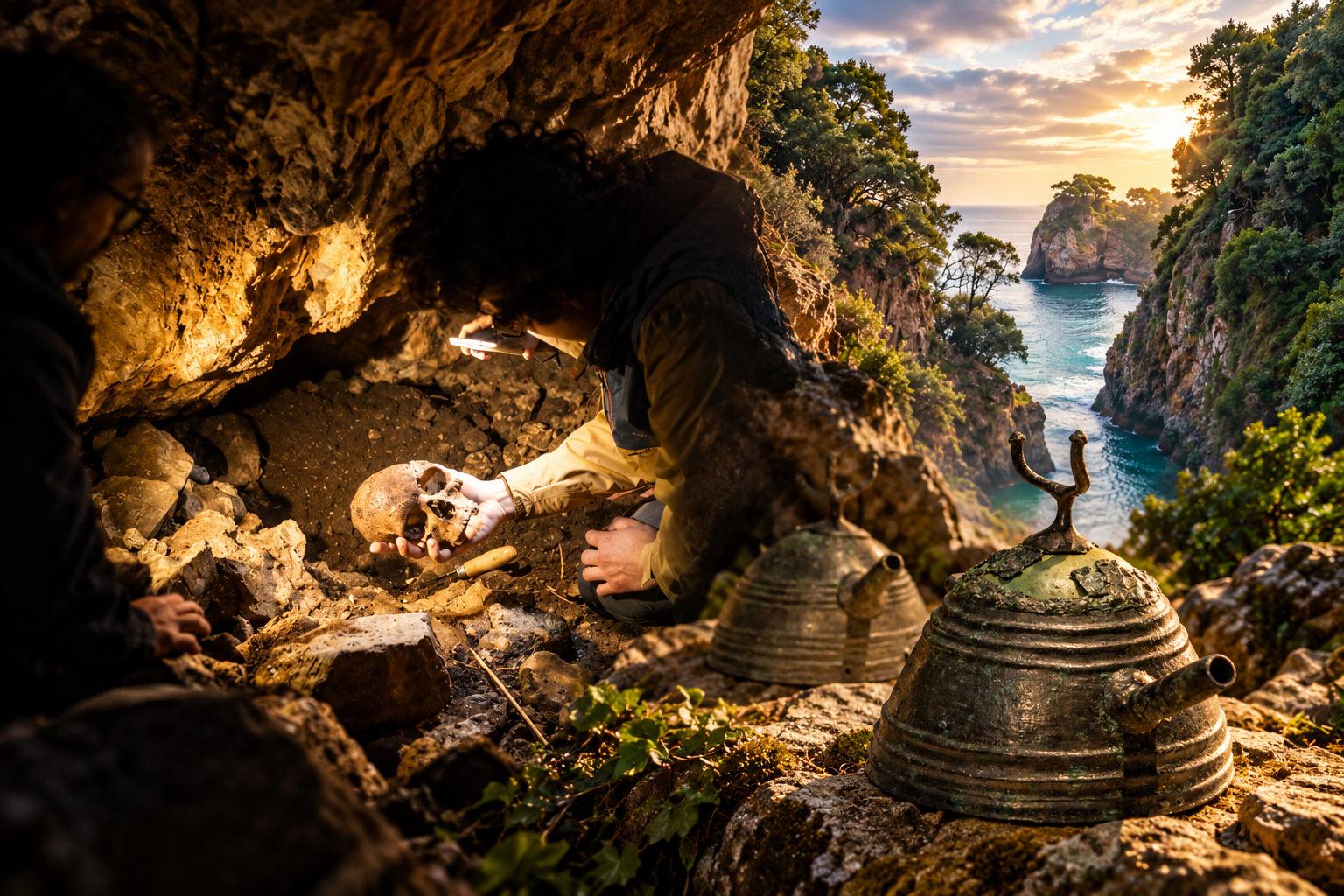
If one site captures the richness and emotional force of ancient Gansu, it is Mogou. This vast cemetery near the Tao River contains more than a thousand tombs spanning the Qijia into the early Siwa period. It is one of those places where archaeology stops being abstract.
The grave goods are extraordinary: pottery vessels, bone ornaments, turquoise, shell items, and an exceptional quantity of copper and bronze — knives, chisels, pendants, earrings, bracelets, and striking trumpet-shaped earrings. Metal had become part of the social language of burial. Two smelted iron items were even reported, hinting at a community already experimenting with materials associated with later eras.
Diet changed across generations too. Plant remains show wheat, buckwheat, millet, nuts, and beans. Pig bones decline through time while cattle and deer become more common — a community ledger written in food and bone.
Some individuals stand out sharply. One woman was buried with reversed head orientation, marked out from local norms, apparently unconnected by family ties to others at the cemetery. Multiple burials are especially haunting: tombs were repeatedly reopened, bones shifted aside, earlier dead making room for later ones. Shared burial space did not mean close kinship. Mogou was a social arena where memory, status, and ritual were constantly renegotiated.
Violence shadows the cemetery too. A notable proportion of skeletons show physical trauma, placing the community in a harder world than romantic prehistory might suggest. Yet Mogou was no chaotic society. It reveals stability alongside tension — burial traditions shifting while the people themselves maintained biological continuity across centuries. Styles changed; communities endured.
Ancient cemeteries tempt a simple question: who was family? At Mogou, the answer refuses to be tidy. Many individuals were biologically connected through distant shared ancestry, creating a broad web suggesting a stable community persisting across generations. Yet many close relatives were not buried together, while multiple burials often contained no close biological relatives at all. Social closeness and biological closeness are not the same thing.
Some individuals stood apart from the local genetic pattern — linked to populations from the Tibetan Plateau edge or the Mongolian Plateau. Not all outsiders were treated alike. Those woven into the local kinship web through marriage were integrated into the community. Those who remained unconnected were more likely to receive lower-status burial treatment and appear among probable sacrificial individuals. Belonging mattered, and not everyone belonged equally.
At the same time, signs of close inbreeding are limited. Some marriage beyond the immediate local group appears likely, fitting a wider regional picture of movement and exchange. A high-altitude genetic trait associated with Tibetan Plateau populations even appears in lowland Gansu individuals — evidence of upland marriage networks reaching into valley communities. Ancient Gansu was neither sealed nor simple. It was layered, practical, and deeply social.
The burials of ancient Gansu speak sharply about status and ritual. At Mogou, tomb form mattered enormously. Elaborate vertical shaft tombs with side chambers carried greater prestige. Individuals in passage areas or simple pit burials had fewer goods and apparently lower standing. Body posture sharpened the distinction — flexed bodies with restricted offerings contrast with those extended on their backs, and several such burials have been interpreted as possible sacrifices.
Specific tombs are unforgettable. In one multi-person burial, a likely sacrificial individual lay flexed in the passage while another occupied the honored side chamber. In another, reopening across generations turned the grave into a stage where status and memory were repeatedly rearranged. Grave goods — bronze knives, shell items, turquoise, pottery — were not merely possessions but choreography. A weapon in a grave is always more than a weapon.
Outsiders were more likely to receive lower-status treatment, suggesting social inequality could map directly onto origin. Yet men and women were not treated radically differently in burial placement or goods overall — whatever gendered divisions existed in daily life, the mortuary system was not built on obvious blanket inequality between the sexes.
The result is a richly uneven mortuary world: ordered but unequal, continuous but not uniform, commemorative but also exclusionary. The dead of Gansu map the moral landscape of a community as it actually functioned — with all its tensions. Who received a chamber? Who lay in the passage? Who was returned to the same tomb generations later? These are not minor details. They are the archaeology of power, kinship, ritual, and fear — and they feel, remarkably, very close to us still.
https://www.cell.com/action/showPdf?pii=S0092-8674%2826%2900919-0






Comments