Haplogroup O2a1b

– 5 min read


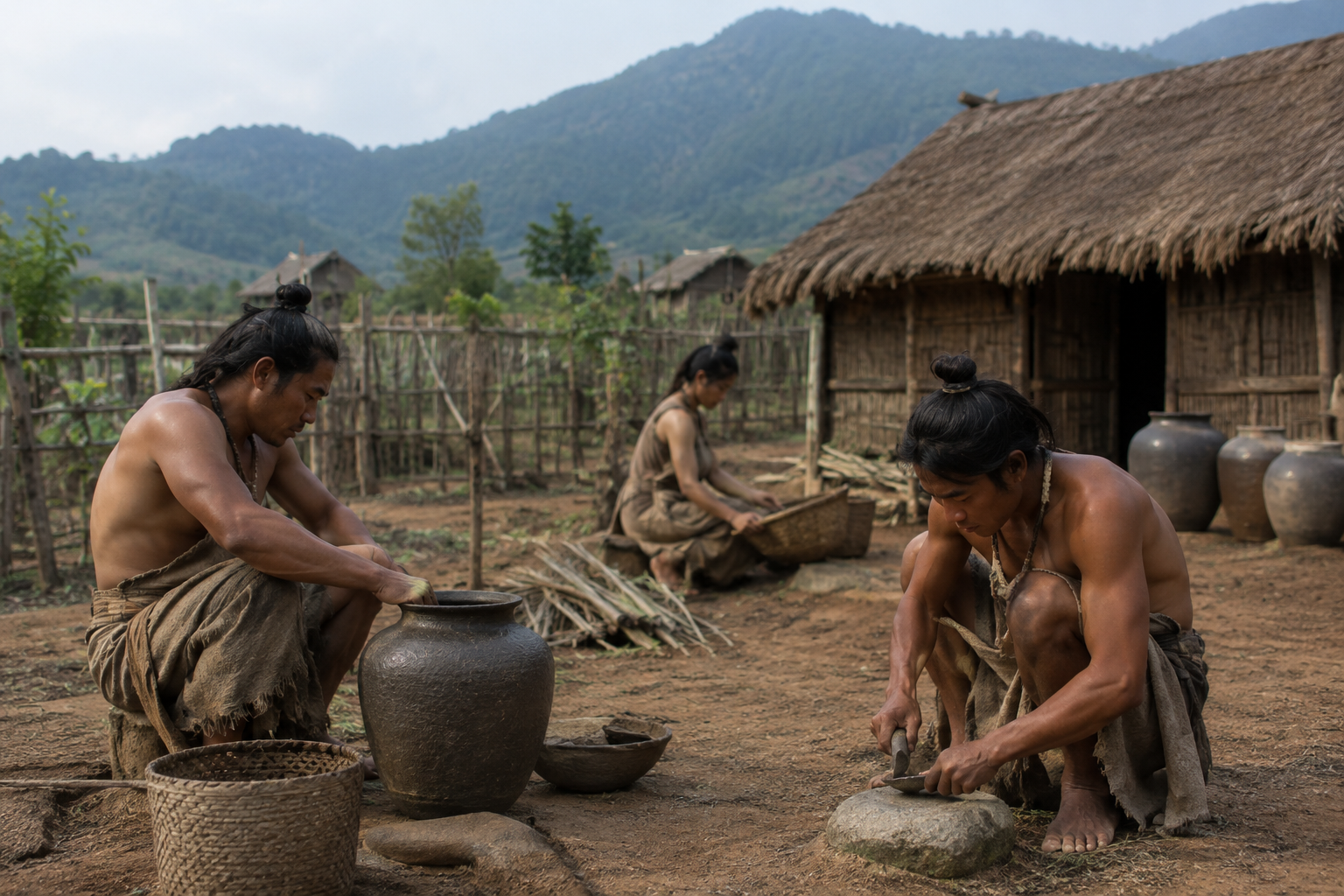
At Man Bac in northern Vietnam, one Bronze Age male, sample I0626, offers a particularly useful glimpse into the paternal history behind haplogroup O2a1b. Dated here to about 1750 BC, he comes from a site that has become central to debates about how mainland Southeast Asia was peopled: not by a single wave, but by repeated movements, mixing, and local continuity.
That matters because Y-DNA traces one direct paternal line only. It does not describe a whole person or an entire community. But when a branch like O2a1b appears in ancient burials tied to major prehistoric transitions, it gives us something more concrete than a modern frequency map: an actual man, in an actual archaeological setting, from a world undergoing change.
Man Bac has long attracted attention because it sits near the frontier between older foraging populations and incoming farming groups. Ancient DNA research on the region, including work published at https://www.ncbi.nlm.nih.gov/pmc/articles/PMC6476732/, helped show that early agricultural communities in Southeast Asia were not genetically uniform. Instead, they carried ancestry linked both to populations moving southward from what is now southern China and to earlier inhabitants of the region.
Within that broader picture, I0626 is important because he places O2a1b in northern Vietnam during the Bronze Age. That does not mean every Man Bac male belonged to the same paternal line, nor does it turn one lineage into an ethnic label. What it does show is that an O2a1b-associated paternal ancestry was present in a community living through one of the great transformations of Southeast Asian prehistory.
Archaeologically, Man Bac belongs to a period when settled life, farming, and new social links were reshaping the Red River region. The site's importance lies precisely in this borderland character. It is one of those places where genetics and archaeology begin to speak to each other rather well: not in slogans about "replacement" or "migration," but in the slower, messier reality of population mixture.
Ancient DNA and archaeogenetics
O2a1b is a branch within the wider O haplogroup family, one of the major paternal lineages of East and Southeast Asia. For readers tracing this haplogroup today, the ancient evidence suggests depth in the broad southern East Asian and mainland Southeast Asian world. But it is worth being careful: a wider parent haplogroup can be old and widespread, while a narrower branch may have a more specific history that still needs better sampling.
That is especially true in archaeogenetics, where ancient Y-DNA resolution can vary from study to study. In some cases, a sample may be assigned clearly to a downstream branch; in others, the evidence supports only a broader placement. For O2a1b, the safe historical point is not a grand claim about a single "people," but the repeated appearance of related paternal ancestry in populations tied to farming expansions and regional interaction zones.
The second sample in this small but telling set is EDM124 from Erdaojingzi, associated here with the Lower Xiajiadian horizon in China and dated to about 1600 BC. This is a striking contrast with Man Bac. We are no longer in the riverine world of northern Vietnam, but in the northeastern zone where steppe contacts, millet farming, and local Bronze Age traditions met.
Research on the site and its wider context, including a study published at https://www.nature.com/articles/s41467-020-16557-2, has helped illuminate how communities in this region balanced agriculture, herding, and exchange across ecological frontiers. That makes EDM124 especially interesting in an article on O2a1b. The haplogroup's presence here suggests that paternal lineages associated today with East and Southeast Asia were not confined to one neat cultural zone. They also formed part of the human background in northern frontier societies with very different economies and contacts.
It would be a mistake to flatten Erdaojingzi into a simple staging post on some single migration route. Lower Xiajiadian communities were shaped by local developments as much as by long-distance connections. Still, EDM124 shows that by the middle of the second millennium BC, O2a1b-related paternal ancestry could be found far beyond the tropical or subtropical settings with which readers may instinctively associate it.
One sample from northern Vietnam and one from northeastern China are not enough to write a complete history of O2a1b. But they are enough to make the haplogroup archaeologically interesting. Together, they place this paternal branch in two quite different Bronze Age worlds: one in mainland Southeast Asia, where early farming populations mixed with local groups, and another in a northern Chinese frontier zone where farming and herding overlapped.
That spread should caution us against tidy stories. Haplogroups do not carry pots, languages, or political identities all by themselves. Yet repeated ancient appearances across varied settings often point to something historically real: enduring paternal lines moving within larger population systems, surviving cultural shifts, and being absorbed into communities whose daily lives could look very different from one another.
For O2a1b, the present evidence fits that pattern. It looks less like the signature of one dramatic episode and more like part of the deep paternal background of populations connected to the broad southern and eastern Asian prehistoric world.
Ancient East Asian Y chromosomes
There is a temptation, whenever a Y lineage appears in ancient remains, to match it directly to a named language family or a modern nation. Archaeology is rarely that obliging. Man Bac sits in a region later associated with many language shifts and political transformations; Erdaojingzi belongs to a northeastern landscape where cultural boundaries were equally fluid.
So the sensible historical reading is a modest one. O2a1b appears in men living in communities shaped by mobility, exchange, and mixture during the Bronze Age. In northern Vietnam, that places it in the story of early mainland Southeast Asian population formation. In northeastern China, it places it in a frontier society tied to millet agriculture and wider northern networks.
That combination is, in fact, more revealing than a simple one-to-one ethnic label would be. It suggests that this paternal lineage was part of the human traffic linking regions that archaeologists too often treat separately: the agricultural south, the continental interior, and the contact zones between them.
South China and language formation
If your paternal line belongs to O2a1b, these ancient finds suggest a lineage with real prehistoric depth in East and Southeast Asia, and with documented Bronze Age presence in both northern Vietnam and northern China. The most distinctive point is not a claim to one tribe or dynasty, but the breadth of setting: this was a paternal line present in communities shaped by farming, frontier exchange, and regional mixture.
For family historians, that is often the most useful kind of deep ancestry result. It places your direct paternal line inside the long human history of Asia's Bronze Age worlds, where local communities were forming, meeting, and changing in ways that archaeology is only now beginning to map with confidence.


Comments