Millet Farmers on the Steppe: Ancient DNA and Isotopes Reveal Mixed Farming–Herding at Bronze Age Erdaojingzi

– 7 min read


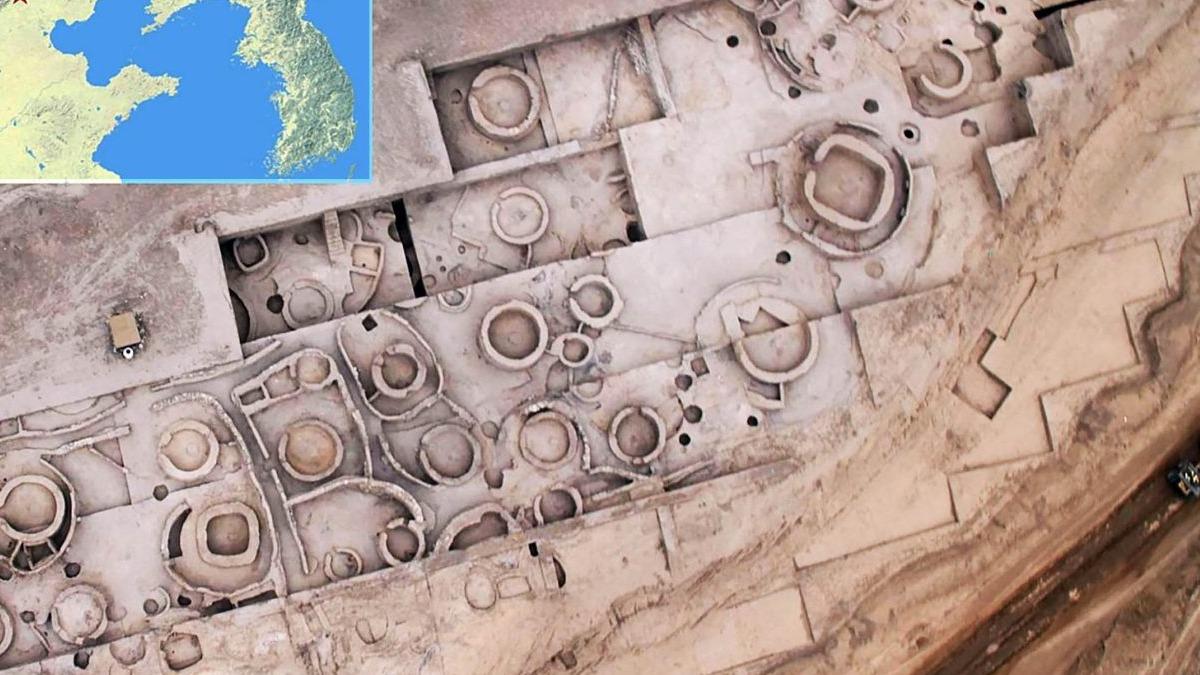
The Erdaojingzi settlement in Inner Mongolia represents a remarkable Bronze Age frontier town where people, animals, and ideas from the Yellow River heartland met the open grasslands of the West Liao River Basin. Here, in what archaeologists call an "agro-pastoral transition zone," farming communities with strong Yellow River roots established a permanent settlement, ringed with walls and ditches, and filled it with houses, storage pits, workshops, and graves dating to approximately 3700–3330 years ago.
Erdaojingzi lies on a gentle slope among low hills near Chifeng City. Because the site was buried and never built over by later cultures, its Bronze Age remains are remarkably intact. Excavations have uncovered city walls and moats, orderly courtyards, roads, and densely packed houses across some 27,000 square metres. Storage pits still held charred broomcorn and foxtail millet grains, along with woven grass containers, as if the inhabitants had just stepped away from their granaries.
More than a thousand artefacts emerged from the soil: pottery, stone tools, bone implements, and bronze pieces. There is even a large spade carved from a cow's shoulder blade, a very literal blending of animal and agriculture. This is not a camp of wandering herders, but a substantial town anchored by its fields. The exceptional preservation allows these patterns to be seen in unusual detail, and to be linked directly to specific ancient individuals whose bones still carry the isotopic and genetic traces of a Yellow River farming heritage, transplanted and transformed on the northern grasslands.
The graves at Erdaojingzi are especially telling. Painted pottery placed with the dead echoes the shapes and decoration of ritual vessels used far to the south in the Central Plains. Motifs on these pots resemble designs on bronze vessels from the eras known as Xia and Shang. These painted pieces seem to play a similar ritual role to the bronze wine cups and containers of the Central Plains, hinting at shared ceremonies and beliefs.
The settlement also yielded pottery forms with distinctly Yellow River pedigrees. Traditional local cylindrical jars gave way to tripod cooking vessels known as li, a form characteristic of Central Plains cuisine and ritual. Other ritual shapes, such as jue (wine cups) and hu (jars), mirror those of the Erlitou culture — one of the earliest bronze cultures in the Yellow River Basin.
The grave goods go beyond pottery. Turquoise-inlaid ornaments and lacquered wood objects show a taste for fine, labour-intensive luxury. Techniques of burning and drilling animal bones for divination at Erdaojingzi match, and may even predate, the practices of pre-Shang communities in the Central Plains. In other words, the people buried here were not provincial copyists. They were active participants in a larger religious and political world.
Two well-preserved male skeletons from Erdaojingzi were subjected to ancient DNA analysis. Their genomes do not look like those of earlier Neolithic people from the West Liao region. Instead, they sit squarely among farming populations from the Yellow River Basin — the communities that developed powerful millet-based agricultural societies in the Central Plains.
On genetic plots, these Erdaojingzi men cluster with middle and late Neolithic farmers from the Yellow River region. Statistical modelling shows that their ancestry can be explained almost entirely as a continuation of those Yellow River farmers, without the need to add extra contributions from northern hunter-gatherer groups or southern coastal populations. Their Y-chromosome and mitochondrial lineages are typical of northern East Asia and common among modern northern Chinese groups.
One man, labelled J30603, carries a Y-chromosome line that today is common in eastern and northern China. The other, J12213, belongs to a northern East Asian male line known as N1a3. Both men have maternal lines that are also typical of northern East Asia. In the wider tapestry of East Asian prehistory, this makes Erdaojingzi significant. It shows that people carrying Yellow River farmer ancestry had pushed deep into the West Liao steppe by around 3700–3330 years ago, bringing with them not only their genes but also their crops, animals, and ritual practices.
The study combines animal bones, charred plant remains, and chemical signatures from skeletons to reconstruct everyday life at Erdaojingzi. The plant remains are dominated by two hardy millets — foxtail and broomcorn — whose tiny grains were well suited to dry conditions. These crops turn up in almost every sampled context, from houses to storage pits, making it clear that millet farming underpinned the settlement's economy.
The animal bones tell a complementary story. Of the more than one thousand identifiable mammal bones, almost half belong to pigs. Dogs, sheep, and cattle are also common, while wild game such as deer and hare make only a modest appearance. This is a community that has turned its back on a hunting economy and thrown its lot in with domestic animals.
Stable isotope analysis — a way of reading diet from the chemistry of bone — adds color to this picture. Pigs and dogs have carbon signatures that show they were eating mainly C4 plants, which in this context means millet and millet by-products. Sheep and cattle, by contrast, show mixed diets of both C3 plants (typical wild grasses and leaves) and C4 crops, suggesting they grazed freely in the surrounding landscape but also fed on crop residues.
The two human skeletons tested sit at the top of this food chain. Their bones are enriched in nitrogen, indicating heavy consumption of animal protein. Their carbon values show that millet was the main staple. In effect, Erdaojingzi emerges as a town of millet farmers who also ate a lot of meat, especially pork, with dogs and pigs feeding on human food waste and crop leftovers.
The study dwells in some detail on pig bones, which are plentiful and finely recorded. Many skeletal elements come from young animals. Age-at-death estimates reveal that a sizeable number of pigs were slaughtered before 14 months of age, with others killed in later adolescence and adulthood. In many farming societies, pigs are kept longer to maximise meat yield, but Erdaojingzi shows a more flexible regime, regularly butchering younger animals.
Isotope values support this: some piglets have very high nitrogen values, typical of animals still benefitting from their mother's milk, while others reflect the shift to solid food. This suggests a steady flow of pork from piglets and sub-adults, not just a harvest of fully grown beasts. Such flexibility in pig management fitted well with a mixed economy of crops and grazing animals in a steppe setting.
Sheep at Erdaojingzi display a wide range of nitrogen values. Some individuals look as if they grazed on unfertilised pastures, while others seem to have eaten plants grown in nitrogen-rich soils — possibly fields manured with pig dung or corrals thick with droppings. Archaeological and textual evidence from later periods makes it clear that Chinese farmers have long used animal manure to enrich their fields. The isotope pattern at Erdaojingzi hints that such practices, or at least heavy use of dung-rich areas, were already in play.
One of the most striking aspects of the study is the use of stable carbon and nitrogen isotopes from bone collagen to follow millet as it moves through the food web. Plants like millets (known in scientific terms as C4 crops) leave a different carbon isotope signature from trees and most temperate grasses (C3 plants). By measuring this signature in bones, the study tracks who – and what – was eating what.
Wild animals from around the site, such as hares and roe deer, show isotope values typical of a landscape dominated by C3 vegetation: in other words, natural steppe and woodland plants. Cattle also cluster in this range, suggesting grazing on local grasses and forbs with only minor millet in their diet.
In strong contrast, the domestic pigs and dogs from Erdaojingzi have very high carbon isotope values, exactly what would be expected if they were being fed on C4 crops. This is clear evidence that broomcorn and foxtail millet – and their by-products like bran and chaff – were being deliberately channelled into pig and dog fodder. The pigs' nitrogen values are also relatively high, implying that scraps of meat or other protein-rich waste from human meals may have been mixed into their feed.
The research sets Erdaojingzi within a broader network of sites around 4000 years ago, from the upper Yellow River valleys of Gansu and Qinghai to the rich loess soils of Henan. Across this wide region, many communities share a common ancestral base in Yellow River farmers, yet their economies diverge according to local landscapes.
In the upper Yellow River region, at sites such as Shengedaliang and Jinchankou, sheep dominate the animal bones and cattle are important, while pigs are less central. There the economy leans more strongly towards grazing and pastoral practices, reflecting a harsher, more open environment. In the Central Plains, at sites like Wadian and Pingliangtai, pigs rule the farmyard and plant remains include not only millets but also beans, wheat, and rice, pointing to a more varied and intensive agricultural system.
Erdaojingzi sits between these worlds. Its people look genetically like Yellow River farmers and share their love of pigs and millet, but they also keep substantial numbers of sheep and cattle and live in a clearly steppe-like environment. Erdaojingzi therefore stands as a key example of how one broad population — descendants of Yellow River millet farmers — developed different local ways of making a living as they pushed into new ecological zones.
What makes this research especially compelling is the way it forces different kinds of evidence to speak to one another. Instead of relying on a single line of investigation, it braids together ancient DNA, chemical traces in bones, animal bones, and charred plant remains to reconstruct life in an agro-pastoral frontier zone.
The genetic signal reveals these were people with Yellow River farming ancestry living on the grassland margin. The isotope chemistry shows they ate millet and meat in a community where pigs fed on crop waste and sheep grazed between fields and pastures. The animal bones demonstrate intensive livestock keeping with flexible slaughter patterns. The plant remains confirm intensive millet cultivation as the economic foundation.
On the ground, this story is written in walls and moats, painted pots in graves, cattle-bone spades in workshops, piglet skeletons in rubbish pits, and two Bronze Age men whose DNA still carries the signature of the Yellow River heartland. The study shows how, by combining these traces, it is possible to watch the spread of people and practices from the Central Plains into the northern grasslands and to see how those migrants reinvented themselves as both farmers and herders on the West Liao steppe.
This is not a story of farmers simply turning into nomads, nor of steppe herders sweeping away local people. It is a more subtle picture of small communities who carried their crops, rituals and social expectations into new environments, and then bent both themselves and their surroundings into something new — an agro-pastoral frontier society, in which Central Plains and steppe lifeways were fused in everyday practice and written, quite literally, into the bones of people and animals alike.
Original source: https://www.nature.com/articles/s41598-026-42242-3


Comments