Kinship and Violence in a Rare Viking-Age Multiple Burial from Semigallia, Latvia
– 6 min read


Viking Age Semigallian Burial Customs and a Rare Multiple Grave
The article opens in the river valleys of southern Latvia, in the lands once held by the Semigallians – a Baltic people who lived along the Lielupe river system during the centuries we call the Viking Age. Here, the dead were usually laid to rest in a highly ordered way: one person, one grave. This study examines the remarkable discovery of Burial 351 at the Čunkāni–Dreņģeri cemetery, where six individuals were found laid out together in what represents one of the most extraordinary finds in Semigallian archaeology.
Semigallian cemeteries were flat burial grounds set on the higher river terraces, just above the water level. At Čunkāni–Dreņģeri, graves were arranged in rows on the second and third natural terraces above the river Mēmele. The cemetery lies on the right bank of the River Mēmele, just upstream from where it joins the Mūsa to form the Lielupe – an inland crossroads that would have been closely watched during the Viking Age. The dead were placed in extended positions on their backs, with men and women oriented in different directions according to strict local custom that had become established by the later 9th century.
This pattern of careful, individual burial runs across all Semigallian territory. Out of 167 known cemeteries in the region, only about 40% have been excavated, yielding roughly 2,500 graves. Even with that sample, the rule is clear: almost everyone was buried alone. Across all examined Semigallian sites, only eight cemeteries have any graves with more than one individual, and there are just 19 such graves in total. At Čunkāni–Dreņģeri itself, only seven out of 750 inhumation burials contain more than one person, representing less than 1% of all graves.
Čunkāni–Dreņģeri itself is a textbook Semigallian cemetery, spreading across river terraces 9 and 13 metres above the water. Over 750 inhumation burials have been excavated there, dating from the 7th to 11th centuries, and 99.1% follow the standard pattern: a single body in a single grave. The cemetery represents part of a chain of Semigallian gravefields strung along the rivers of the Lielupe basin, where a Baltic-speaking community maintained their burial traditions for centuries.
And then comes Burial 351. This grave breaks all expectations, containing six individuals laid out in a single layer, not piled carelessly, but arranged according to Semigallian custom. The grave sits among ordinary graves in the same burial rows, yet it is the largest known multiple burial at the site and one of the rarest Semigallian burials known anywhere. The very existence of this grave, in a cemetery that otherwise clings so firmly to the one-person-one-grave rule, demands explanation in terms of a single, dramatic event.
The six skeletons in Burial 351 have been labelled Individuals A to F. Archaeological analysis revealed five were male and one was female, based on grave goods and skeletal features. The adults included men mostly in their thirties and forties, along with a younger male, probably in his teens. Gender roles in life remained visible in death: the men lay with their heads towards the south-east, while the woman lay with her head towards the north-west, faithfully following Semigallian customs.
This careful arrangement shows that, despite the shock of the deaths, the living community still followed their traditional rules about how men and women should be laid out in the ground. The grave goods also followed local patterns: jewellery and costume fittings marked female gender, while weapons and tools marked male gender, all placed with the same attention normally given to single graves.
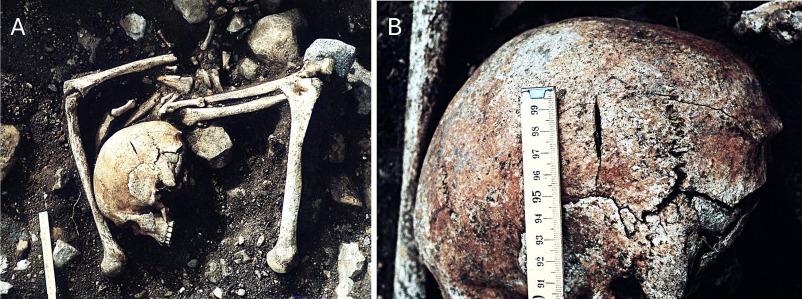
Palaeopathological analysis revealed that three of the adult males – Individuals A, B, and C – showed clear signs of sharp-force injuries at or around the time of death. These were perimortem injuries: damage that occurred very close to the moment of death, caused by edged weapons such as swords or axes. The wounds appeared as clean, V-shaped cuts or chops, sometimes with small flakes of bone peeled away where blades had bitten in.
Individual A showed cuts on the skull delivered with enough force to reach bone and leave distinct weapon marks. The direction and placement suggested face-to-face combat, with some blows coming from above, consistent with a standing opponent striking down. Individual B carried weapon injuries on both skull and possibly upper body, suggesting multiple strikes from different angles, including what may have been finishing blows and defensive injuries. Individual C also bore sharp-force trauma consistent with close-quarters fighting rather than execution from a distance.
These were not old, healed wounds but evidence of violent encounters occurring at the moment of death. The clustering of serious weapon injuries among three of the men points strongly to armed conflict, linking Burial 351 to a sudden, lethal incident in the second half of the 9th century.
Ancient DNA analysis provided some of the most gripping insights into the relationships among the dead. By extracting and studying ancient DNA from the bones, researchers reconstructed family relationships that revealed this was not just a heap of unrelated victims. The genetic data showed that Individual C was the father of Individual D, the younger male. Individual A was a more distant relative of Individual D, connected at the third-degree level – comparable to a great-uncle and great-nephew, or first cousin once removed.
In other words, at least part of the group were kin: a father, his son, and another male relative died together, alongside other men and a woman who were not their close biological family. Individuals B and F showed no close biological connection to the others, yet they were given the same careful treatment in burial. This mixture of relatives and non-relatives suggests they may have been comrades-in-arms, household followers, or allies bound by loyalty rather than blood.
For a community in which graves were normally about single lives and single deaths, Burial 351 captures a whole social web – family, comrades, perhaps dependants – cut down at once, yet kept together even in death through the community's careful burial practices.
One might be tempted to see the grave as Scandinavian – after all, this is the Viking Age, and the Baltic Sea was crisscrossed by Scandinavian warriors and merchants. Yet the genetic data tell a different story. When researchers compared the genetic fingerprints of the six individuals with other ancient populations, they found that these people matched local Baltic groups, not incoming Scandinavians.
All the men whose Y chromosomes could be studied carried versions of haplogroup N, a paternal line deeply rooted in the eastern Baltic and surrounding regions, differing from male lines more commonly associated with Scandinavia during the Viking Age. Their overall ancestry fits comfortably with earlier Baltic groups from the same region, with no sign that their ancestry was mainly Scandinavian.
All six, then, look like local Semigallians, not foreign intruders. They were part of the community that used the cemetery and followed its customs. The weapons, grave goods, and burial patterns are Semigallian, and so are their genes. This makes the scene more vivid: the grave is not a monument to outsiders who died far from home, but to local people struck down together – perhaps defending their land, perhaps caught in a wider conflict that reached deep into the river valleys of Latvia during the turbulent politics of the late 9th century.
Stepping back from this single grave, the study uses Semigallian burial customs to argue that multiple burials like Burial 351 are not routine mass graves in the modern sense, but rare, highly structured responses to moments of crisis. Unlike a modern mass grave, which might be a hurried trench where bodies are disposed without care, Burial 351 and other Semigallian multiple burials follow the same basic rules as ordinary single graves.
The bodies were formally arranged according to gender-based orientation rules, furnished with appropriate grave goods, and placed within the established cemetery layout. The careful furnishing suggests that, despite the sudden and violent cause of death, the survivors did not treat these six as disgraced or marginal figures, but gave them the same respect as other Semigallian dead.
For this reason, these should be called multiple burials rather than mass graves: several people interred at the same time, but treated as proper members of the community with usual respect and ritual. The rarity of such graves – under 1% at Čunkāni–Dreņģeri and only 19 examples across all excavated Semigallian sites – underlines how exceptional the circumstances must have been whenever the rule of one-grave-one-person was broken.
Burial 351 becomes a snapshot of a single, terrible event in the later 9th century, showing that even in a landscape where death was normally individual and orderly, the Viking Age could still bring sudden episodes of shared, violent death. The living community responded by bending their rules just enough to keep their dead together while maintaining the dignity and order that defined Semigallian burial tradition.
This interdisciplinary approach, weaving together excavation data, skeletal analysis, and ancient genetics, transforms a single large grave on a Mēmele river terrace into a richly textured scene: a small group of local Semigallians, some closely related by blood, killed with bladed weapons in the later 800s and buried with all the ritual care of their community. It offers a glimpse of how Viking Age violence and long-distance politics were experienced not from a ship's prow, but in the quiet order of a riverside cemetery, where local Baltic people stood on important river routes, within reach of the raids, conflicts, and turbulent movements that characterized this transformative period in northern European history.
Original source article: https://www.sciencedirect.com/science/article/pii/S2352409X26002257
Comments