Haplogroup O2a2b1a2a1a3

– 5 min read


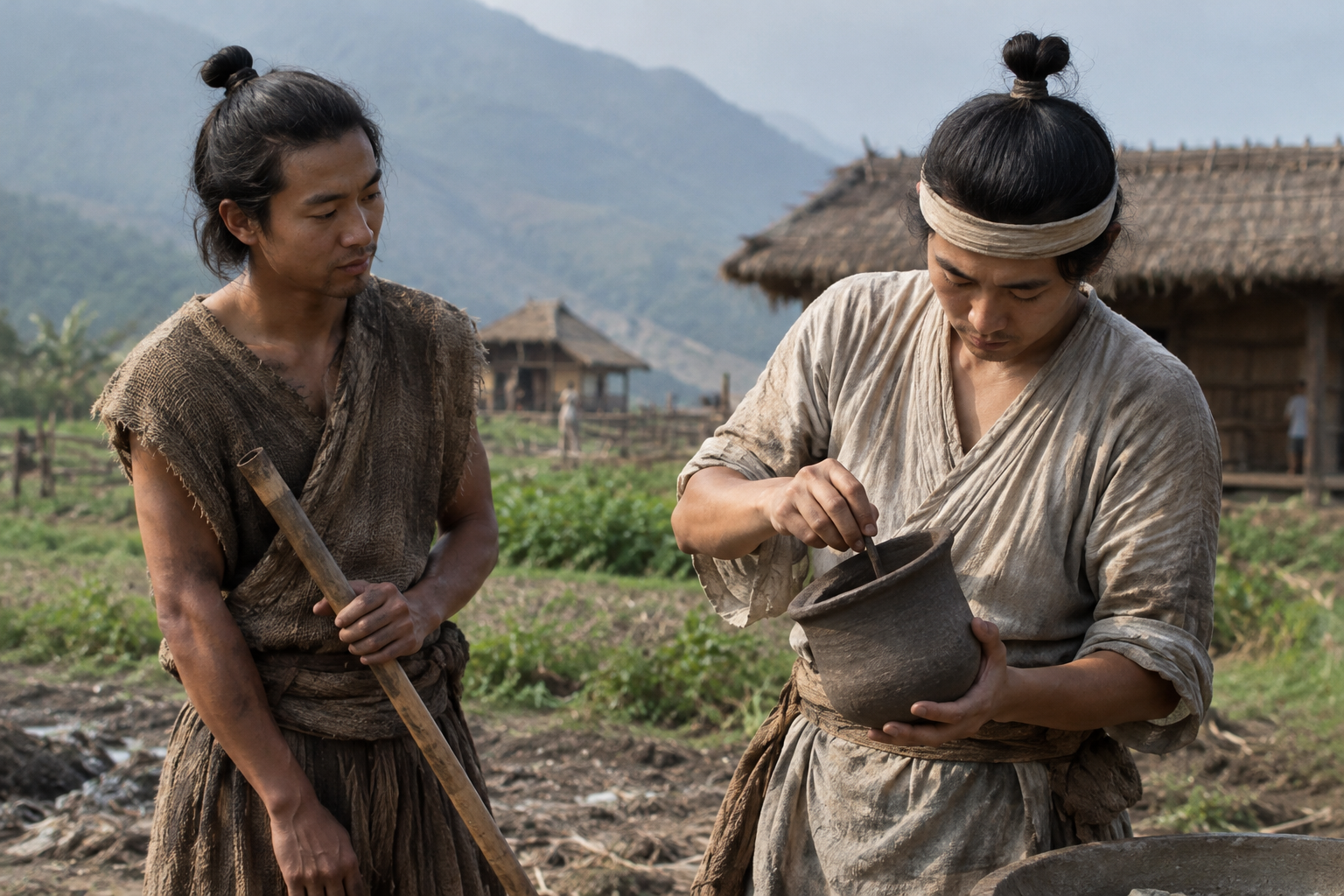
One of the clearest early signposts for Y-DNA haplogroup O2a2b1a2a1a3 comes from northern Vietnam, where an ancient male known as I1137 lived around 1750 BC at Man Bac. Man Bac matters because it sits in a region where archaeology has long shown a meeting of worlds: local forager traditions, incoming farming lifeways, and the beginnings of the social changes that would shape mainland Southeast Asia.
That makes this lineage interesting at once. A Y chromosome traces only a direct paternal line, not a person's whole ancestry, but when a branch like O2a2b1a2a1a3 appears in early agricultural and Bronze Age settings, it helps us follow one narrow male line through places where population mixture, movement, and cultural change were anything but narrow.
Man Bac has become one of the key prehistoric sites for understanding how farming spread into Southeast Asia. The site belongs to a period when communities in the Red River region were not simply isolated village farmers. They were part of a larger transformation linking southern China and mainland Southeast Asia through crops, people, and technology.
The individual I1137, dated to about 1750 BC, is important because he places this paternal line in northern Vietnam during that formative era. Research on ancient Southeast Asian populations has repeatedly shown that early farming communities in the region were often genetically mixed, combining ancestry connected to earlier inhabitants with ancestry linked to populations expanding southward from what is now southern China. In that setting, O2-related paternal lines are especially significant because they appear again and again in East and Southeast Asian population history.
A major ancient DNA study of Southeast Asia, including Man Bac, helped establish just how complex this transition was, with farming not as a single clean replacement but as a layered process of contact and admixture: https://www.ncbi.nlm.nih.gov/pmc/articles/PMC6476732/.
What is striking here is not just that a man in Bronze Age Vietnam carried a branch associated with broader East Asian paternal history. It is that he lived in a place where archaeology and genetics both point to mixture. Man Bac is less a neat origin point than a crossroads, and that is often how real paternal history looks in the ancient record.
The second sample linked here is even earlier in historical terms: WD-WT1H16 from Wadian in Yuzhou, Henan, dated to around 2135 BC and associated with the Longshan world of late Neolithic north China. If Man Bac shows this paternal line in a southern frontier zone, Wadian places it in the Central Plains, one of the great laboratories of early Chinese state formation.
The Longshan period is archaeologically famous for settlement growth, social differentiation, and regional interaction before the rise of the earliest dynastic states. Henan was not yet "China" in the later imperial sense, but it was one of the places where many building blocks of Bronze Age political life were taking shape. A lineage found here therefore matters not because it proves membership in any named dynasty or people, but because it places this paternal branch within the demographic background of the Yellow River heartland.
Research on genomes from the Middle Yellow River has emphasized long-term population structure, continuity in some regions, and changing patterns of mixture across millennia. That wider framework is essential for understanding why a haplogroup like O2a2b1a2a1a3 cannot be reduced to a single migration story or a single ethnic label. A study exploring that deep regional history is here: https://www.nature.com/articles/s41467-020-16557-2.
In other words, Wadian does not give us a heroic founder. It gives us something better: evidence that this paternal branch, or a very closely connected one, was already present in one of the major demographic centers of late prehistoric northern China.
It is tempting to take a precise-looking label such as O2a2b1a2a1a3 and turn it into a grand narrative. But ancient DNA is not kind to tidy legends. The safest reading is that this branch belongs within the broader O2 paternal world that became very important across East Asia and parts of Southeast Asia, while the two ancient samples show it in very different archaeological settings: one in the Central Plains of late Neolithic north China, the other in Bronze Age northern Vietnam.
That spread matters. It suggests that paternal lines related to this branch were part of the human movements linking the Yellow River sphere to regions farther south. Yet the two men should not be treated as members of the same tribe, language community, or political tradition. The Longshan context of Wadian and the mixed early farming context of Man Bac are connected by deep population history, but they are not identical worlds.
It is also worth being careful about resolution. Ancient Y-DNA assignments can be broader or narrower depending on coverage and analysis. So while these samples are associated here with O2a2b1a2a1a3, the larger historical point does not depend on pretending that every branching step is equally certain in every case. The bigger picture is already interesting enough.
If we stand back from the sample codes for a moment, a coherent map begins to appear. Henan represents an inland core region tied to late Neolithic complexity and the prehistory of early Chinese civilization. Northern Vietnam represents a southern interaction zone where incoming farming populations mixed with established communities and helped form new societies.
That is why this haplogroup's appearance in both places is so useful. It does not prove a straight-line trek by one family over hundreds of years. What it does show is that paternal ancestry connected to this branch belongs to the same broad historical process that carried people, crops, technologies, and marriage networks across East and Southeast Asia in the late Neolithic and Bronze Age.
This pattern sits neatly beside broader work on East Asian paternal history, where coastal and inland movements, local continuity, and repeated episodes of mixture all seem to matter. Haplogroups do not move on their own, of course; people do, and they do so in complicated social settings. A village cemetery in Vietnam and a Longshan site in Henan are reminders that the old maps of migration arrows can never quite capture the messiness on the ground.
East Asian Y-chromosome migrations
For someone who carries O2a2b1a2a1a3 today, these ancient finds offer something quite concrete. They place related paternal ancestry in two historically important settings before written history can do the talking for us: the late Neolithic societies of the Middle Yellow River and the early mixed farming communities of northern Vietnam.
That does not give a ready-made surname, dynasty, or single homeland. It gives something more archaeologically honest: a paternal line rooted in the population history of East Asia, visible in both the northern centers and the southern frontier zones that shaped the human story of the region. For this haplogroup, the most distinctive insight is not royal glamour but early presence in exactly the places where ancient East and Southeast Asian worlds were being made.


Comments