Haplogroup E1b1b1b2b2a

– 5 min read


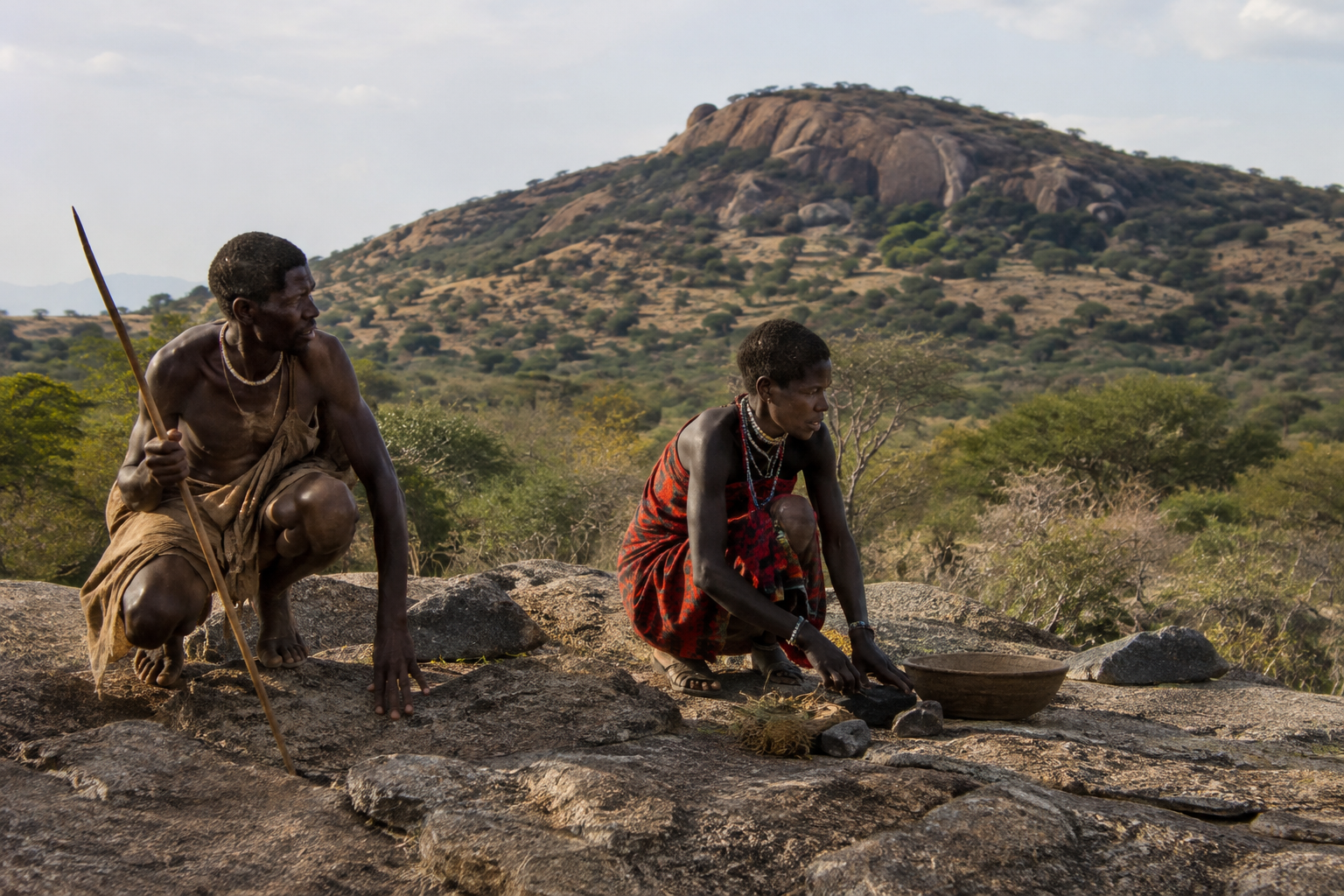
At Lukenya Hill in Kenya, one ancient male identified as LUK001 brings this paternal line into view in a particularly arresting setting: East Africa in the mid-second millennium BC, around 1550 BC. That matters because the Y-DNA haplogroup E1b1b1b2b2a sits within the wider E1b1b family, a major African-associated paternal branch whose history is deeply entangled with the long movement of herders, farmers, and foragers across eastern and northeastern Africa.
The interest here is not that one burial can explain a whole region. It cannot. But when a branch like E1b1b1b2b2a appears in ancient individuals from Kenya separated by more than two millennia, it offers something much more useful than a grand claim: a glimpse of continuity in paternal ancestry across major cultural and environmental change. Y-DNA tracks only one direct male line, not a person's total ancestry, yet that single line can still be historically revealing.
Lukenya Hill is one of those places that keeps turning up whenever archaeologists try to understand eastern Africa before written history takes over. The sample LUK001, dated here to about 1550 BC, belongs to a landscape associated with early herding communities in Kenya. In that period, domestic animals, mobility, and changing subsistence strategies were reshaping parts of the region, but they were doing so unevenly, with local variation rather than a single neat cultural package.
That is exactly the sort of world in which a lineage like E1b1b1b2b2a becomes historically interesting. The broader E1b1b family is often discussed in connection with movements linking northeast Africa and eastern Africa, but one must be careful: the ancient importance of the parent branch does not automatically tell us the exact story of this narrower subclade. What LUK001 shows, more cautiously, is that a paternal line associated here with E1b1b1b2b2a was present in prehistoric Kenya well before the medieval era.
A genetic study of ancient populations in eastern Africa, published at https://science.sciencemag.org/content/early/2019/05/29/science.aaw6275, helped transform discussion of the region by showing just how mixed and regionally specific these ancient communities could be. The larger lesson is worth stressing: pastoral expansion was not a simple replacement story. It involved interaction, adaptation, and local histories that differ from valley to valley and site to site.
The haplogroup name looks forbidding, but the logic is simple enough. E1b1b1b2b2a is a downstream branch within a much wider paternal tree. The wider tree, E1b1b, has a long and important history in Africa and around the Mediterranean, but this article's branch is narrower and should not be treated as if it carries the whole biography of its parent clade on its shoulders.
That distinction matters because popular DNA storytelling often runs ahead of the evidence. A man carrying E1b1b1b2b2a in ancient Kenya was not thereby a representative of every E1b1b movement ever proposed. Nor does the haplogroup, by itself, tell us language, social identity, or ethnicity. What it can do is anchor one direct paternal line in time and place, allowing us to compare lineages across different archaeological horizons.
In this case, the comparison is especially useful because the second sample lies in the same broad region but in a very different historical world.
The later individual, I12391, comes from Kenya Kasiole2 PIA and is dated to about AD 1000. By then, eastern Africa had been transformed many times over since the age of Lukenya Hill. Pastoral traditions had long histories behind them, farming communities were well established in many areas, and the Indian Ocean world was drawing coastal and near-coastal societies into much wider exchange networks.
Even so, a paternal lineage associated with E1b1b1b2b2a still appears in Kenya. That does not prove an unbroken local father-to-son chain from LUK001 to I12391, and no responsible archaeologist would claim it does. But it does suggest that this branch belonged to the durable genetic background of eastern Africa rather than representing a fleeting or singular intrusion.
The value of I12391 lies precisely in that longer view. Ancient DNA is most powerful when it lets us see persistence as well as change. Across the enormous social differences between a second-millennium-BC herding landscape and an AD 1000 community, this paternal branch remains part of the picture.
Settlement and disease in Africa
One of the mistakes older history-writing sometimes made was to treat inland eastern Africa as somehow separate from the great historical currents around it. Archaeology has long shown that this was false, and genetics has only sharpened the point. Communities in Kenya sat within overlapping networks of mobility that linked savanna, highland, lakes, and coast.
That does not mean every lineage came from far away, or that every genetic signal records a dramatic migration. Often the truth is subtler. A branch can persist locally for long periods while the people carrying it participate in new economies, new marriage networks, and new cultural worlds. That is the more plausible sort of story here.
Research on ancient African population structure has repeatedly shown that eastern Africa cannot be reduced to a single ancestral block. The region saw multiple streams of interaction, including deeply rooted local ancestry and connections reaching northward and across neighboring zones. Another broad ancient-DNA study relevant to African population history appeared at https://advances.sciencemag.org/content/6/24/eaaz0183, reinforcing just how dynamic and layered African genetic history really is.
So when we place E1b1b1b2b2a in Kenya, the sensible interpretation is neither isolation nor exoticism. It is regional history: a paternal line embedded in the making of eastern African societies over a very long span.
Ancient DNA and archaeogenetics
There are only two ancient sample records here, but they are well chosen for the question at hand. LUK001 shows the branch in prehistoric Kenya, in a context tied to the early development of herding lifeways. I12391 shows it again in medieval-period Kenya, after many centuries of demographic and cultural change. The significance lies not in quantity but in the chronological spread.
For readers exploring their own paternal ancestry, that is often more meaningful than a map crowded with modern frequencies. Ancient samples show that a lineage was not merely possible in a region; it was actually there, in real men living in specific historical settings. In this case, E1b1b1b2b2a is not an abstract label drifting somewhere in deep time. It is attached to ancient Kenya at two widely separated moments.
That also makes this haplogroup a useful reminder that Africa's ancient DNA record is increasingly precise. Once, broad narratives about eastern Africa had to rely almost entirely on archaeology and linguistics. Now, lineages like this one can be placed inside those debates with far greater confidence, though still with proper restraint.
How ancient DNA decodes history
The most distinctive thing about E1b1b1b2b2a in this evidence is not royal glamour or a single famous burial. It is endurance. From LUK001 at Lukenya Hill around 1550 BC to I12391 at Kasiole2 around AD 1000, the branch appears in Kenya across a vast stretch of time. For anyone carrying this haplogroup today, that does not produce a tidy personal genealogy, but it does place one paternal line within the long, complex human history of eastern Africa: mobile, locally grounded, and older than many of the identities later written onto the map.

Comments