The Noble House of Skarzynski
– 3 min read


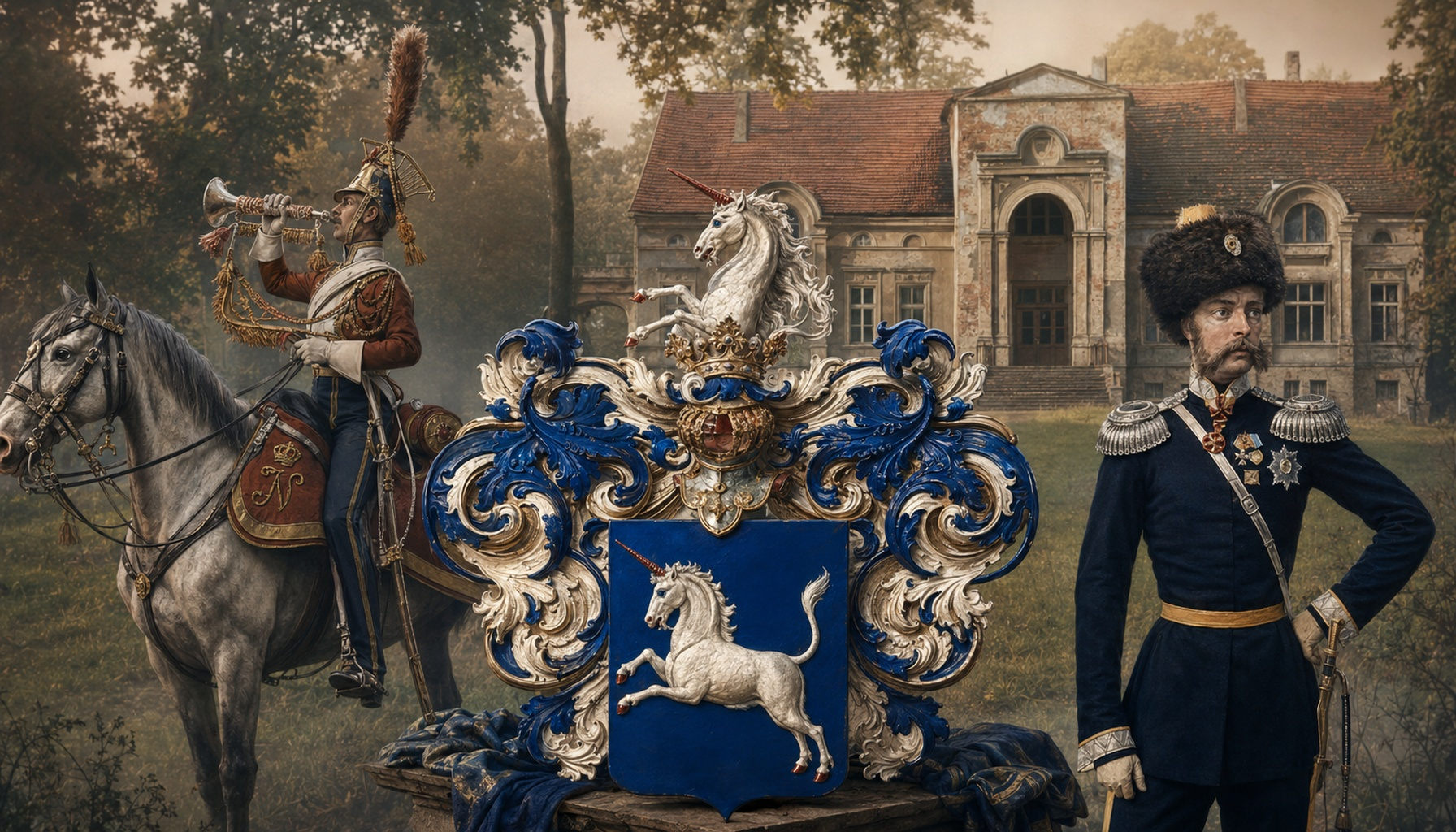
The Skarzynski family was one of the many old noble houses of Poland, part of the szlachta world that gave the Polish-Lithuanian Commonwealth so much of its character. They belonged to that distinctive noble order in which identity rested not simply on title, but on heraldic affiliation, landed standing, military duty, local influence, and service in public life. In that sense, the House of Skarzynski fits a recognisably Polish pattern: a family rooted in estate society, linked to armorial tradition, active in civic and regional affairs, and remembered across generations as part of a wider noble commonwealth. Primary family haplogroup: R1a1a1b1a1a1a2.
The name itself points to place, as so many Polish noble surnames do, and the family emerged from the historical landscape of Mazovia and the broader Commonwealth world in which local landholding families became enduring noble lineages. This was not a court aristocracy in the narrow western sense, clustered only around a monarch, but a broad corporate nobility whose members met in local assemblies, defended their privileges, maintained kin alliances, and served crown and country in war and administration. Among the figures associated with the family are Ambrozy Mikolaj Skarzynski, 1787 to 1868, remembered as a notable representative of the house, and Viktor Petrovich Skarzhunnky, whose name reflects the wider eastward historical reach of Polish noble family networks across the lands once tied to the Commonwealth.
A key location anchor for the family is the Skarzynski manor tradition, tied to the place-name history reflected in the family surname and to the landed culture that sustained noble memory in Poland over centuries. The Skarzynski name is associated with a historic manor and estate setting that speaks to the practical basis of szlachta life: land, household, patronage, and regional standing. In the old Commonwealth, a manor was more than a residence. It was the centre of estate management, family continuity, local authority, and often the archive of memory itself, where documents, heraldic identity, and kinship ties were preserved. The Skarzynski manor connection, as reflected in the historical record, gives the family a concrete geographical footing rather than leaving them as an abstract armorial name. Where the surviving site or associated locality remains identifiable, it can still be visited in the reasonable sense that many historic Polish noble seats survive either as preserved buildings, altered estates, or traceable heritage locations within the modern landscape.
For readers interested in genetic deep history, the primary family haplogroup linked here is R1a1a1b1a1a1a2, a branch strongly at home in the historical genetic landscape of Central and Eastern Europe. That does not mean any one ancient sample was an ancestor of the Skarzynski family, and it is important not to claim direct descent without evidence. But related or linked ancient DNA finds help sketch the wider world from which such paternal lines emerged and persisted. Examples include Medieval Poland and Piast-era samples such as PCA0166 from the Early Kingdom of Poland, PCA0328 from Plonsk in Masovia, PCA0386 and PCA0387 from Santok on the Lubusz-Greater Poland border, PCA0502, PCA0510, PCA0513, and PCA0517 from Santok in Lubusz Province, PCA0203 from Greater Poland, PCA0309 from Konskie in Sub-Carpathia, PCA0380 from Santok, PCA0533 and PCA0557 from Milicz in Silesia, PCA0572 from Zielonka near Poznan, PCA0573 and PCA0574 linked to Piast princely lines, PCA0222 from Obalczkowo in Wielkopolska, and PCA0205 and PCA0197 from medieval Piast-period Poland. Beyond medieval Poland, related R1a-linked context appears in older and wider finds such as poz554 from Bronze Age Lublin Brodzica Trzciniec, I25524 from Iron Age Hungary, VK212 from an elite Viking grave at Cedynia, VK408 from Staraya Ladoga, VK438 and VK452 from Viking Age Gotland, VEM054 from early medieval Croatia, I26748 from the Visigoth or Ostrogoth era at Sisak Pogorelec in Croatia, and even MX265 from Iron Age Boii territory at Singen am Hohentwiel. Taken together, these samples do not prove a family tree, but they do place the Skarzynski haplogroup within a rich and mobile historical landscape stretching across Piast Poland, the Baltic world, and the frontier zones of early medieval Europe.
If the story of the House of Skarzynski has you wondering how your own family fits into the long human past, you can take the next step by uploading your DNA to MyTrueAncestry. It is a lively way to compare your results with ancient samples, explore haplogroup connections such as R1a1a1b1a1a1a2, and place family history into a much deeper historical setting.
Comments