Clan OMahony
– 3 min read


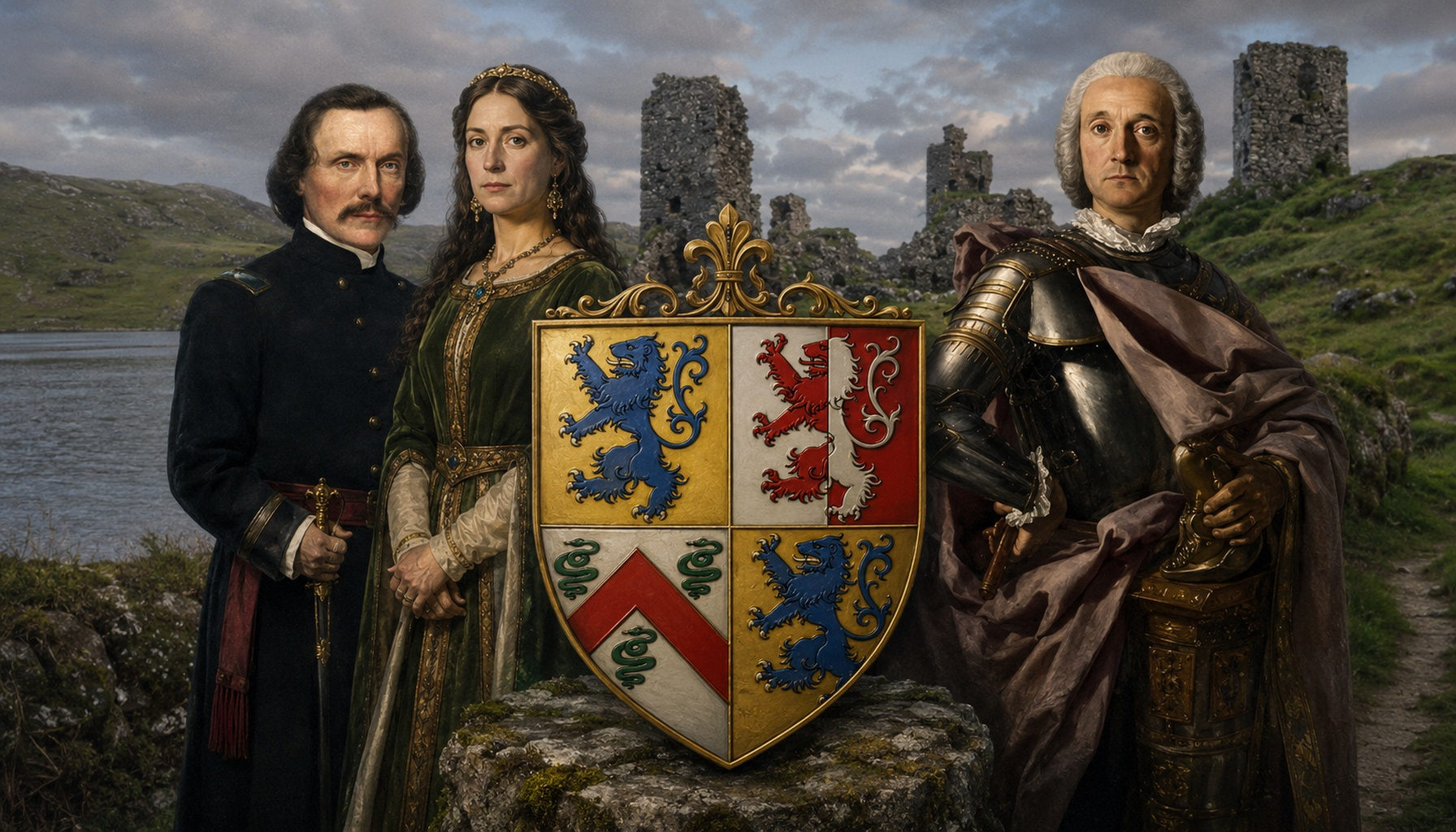
Clan OMahony was one of the notable Gaelic Irish lineages of southwest Ireland, rooted in Munster and especially associated with the old kingdom-world of Desmond along the coasts of Cork and Kerry. Their heritage belongs to that distinctly southern Irish pattern in which authority came not only from bloodline and landholding, but from command of harbours, sea routes, headlands, fighting men, and fortified places. The clan is often linked in genetic genealogy with the Y-DNA haplogroup R1b1a1b1a1a2c1a3a2, which is also treated here as the primary family haplogroup tag. Haplogroups linked with Clan OMahony: R1b1a1b1a1a2c1a3a2.
The OMahonys emerged from an older Gaelic dynastic landscape shaped by kingship, rivalry, and re-founded power after political upheaval in Munster. This was not a family that sat politely inland; they belonged to a rough Atlantic-facing zone where cliffs, coves, islands, cattle, tribute, and ships all mattered. Their story includes clan chiefs, castles, heraldic identity, warfare, alliances, and the long defense of local sovereignty against stronger neighbors and changing political orders. Among the named early figures connected with this lineage are Cian mac Maolmuadh, Prince of Raithlin, around 1000; Mathghamhain, remembered as an ancestor of the OMahonys, around 1014; and Brodceann OMahony, an early bearer of the surname, around 1050. Together they stand at the point where genealogy, memory, and politics begin to harden into the family tradition later generations recognized as OMahony.
Dunlough Castle is one of the great location anchors for OMahony history, and it could hardly be more dramatic if a novelist had invented it. Set on the Mizen Peninsula in west Cork, near the Atlantic edge of Ireland, it is a three-tower fortified complex connected by a wall and positioned beside a lake, with steep slopes and the sea close at hand. It is generally dated to the 15th century and is associated with the OMahony lords of this coastal territory. What makes Dunlough so striking is that it is not just a ruin but a statement of lordship in stone: a place built to watch approaches, secure a defensible landscape, and project power in a maritime frontier zone. In other words, it tells us exactly what OMahony authority looked like on the ground. The site remains standing as an impressive ruin and, yes, it can still be visited, with the surrounding peninsula being a well-known historic and scenic area for travelers willing to make the walk and take in one of the most atmospheric castle settings in Ireland.
Explore the Royal House of ODonoghue
From an ancient DNA point of view, the OMahony-linked haplogroup R1b1a1b1a1a2c1a3a2 sits within a wider Atlantic and Celtic-looking pattern rather than something confined to one medieval surname. Related or linked ancient samples associated with this branch include a remarkable spread of individuals from Iron Age and later Europe: Celtic Durotriges burials from Duropolis at Winterborne Kingston in England such as WBK12, WBK20, WBK29, WBK41, WBK05, WBK30, WBK43, WBK06, WBK08, WBK18 and WBK191; Celtic Parisi and Brittonic-era individuals from East Yorkshire and Pocklington including I28743, I28771, I28772, I21644, I30911, I28927, I30903, I5509, I36995, I14102, I14104, I13753, I13760 and I14100; and deeper prehistoric or later linked finds such as Bronze Age Orkney KD061, Iron Age Worlebury I11991, Battlesbury Bowl I21309, Bronze Age Trumpington Meadows I3256, Amesbury Down I2417, Bell Beaker Upavon I4950, Bedfordshire I7576 and I7577, South Lanarkshire I5473, Hinxton HI2, Thames I5377, Scotland Late Bronze Age I2859, and Ireland Copper Age Rathlin2B. Beyond Britain and Ireland, related branch matches also appear in contexts as varied as Imperial Roman Zadar I26776, Late Roman Conimbriga R10488, Klosterneuburg R10656, Sint-Truiden ST2025 and ST1308, Parancot CGG023699, Worth Matravers I11580, Alt-Inden IND013, and Bronze Age Calabria GMO015. None of this proves direct descent from any one of these individuals to the OMahonys; what it does show is that the clan's tagged paternal signature belongs to a very old western European story with strong representation in Celtic Britain, Atlantic-facing populations, and later medieval continuities.
If OMahony is part of your family story, you are looking at a lineage shaped by sea-cliffs, fortresses, shifting lordships, and the stubborn continuity of Gaelic identity in southwest Ireland. Uploading your DNA to MyTrueAncestry can help you see whether you match the OMahony family profile or show connections to the related ancient DNA samples from Ireland, Britain, and the wider Celtic and Atlantic world.
Comments