The Noble House of Vernon
– 3 min read


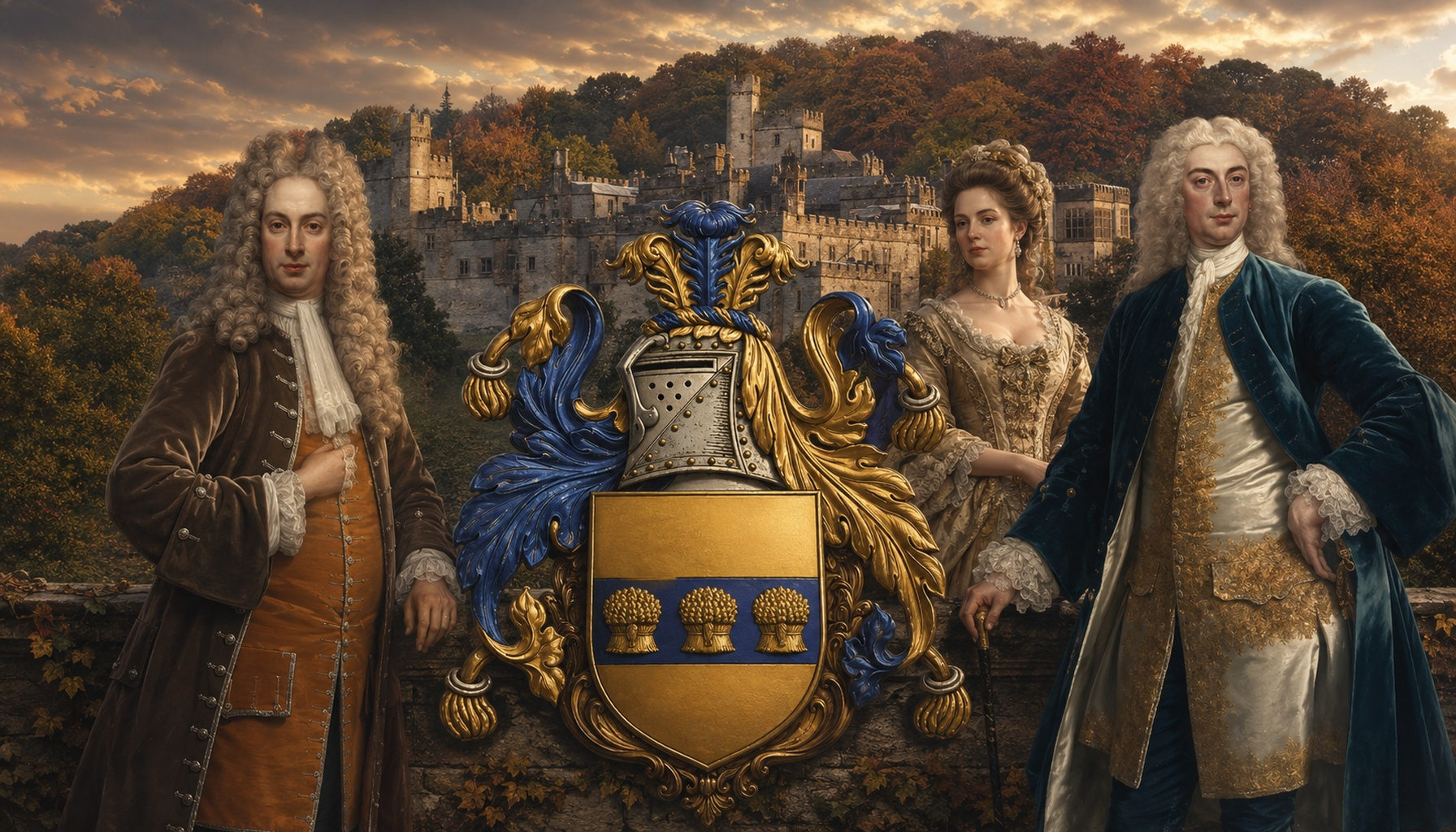
The House of Vernon was one of those long-lived English noble families whose story begins in the age of the Norman Conquest and runs forward through centuries of estate management, service, marriage strategy, heraldry, and local authority. The family is traditionally linked to Vernon in Normandy, and like many conquest-era lineages they came into England as part of that great reshaping of land and power after 1066. Their primary family haplogroup is linked here as J2b2a1a1a1a1a1a1, a paternal marker that sits rather intriguingly beside a family memory rooted in Norman expansion, medieval lordship, and aristocratic continuity in England.
What makes the Vernons interesting is not simply that they were old, but that they fit a very recognisable English pattern: a Norman-origin house that translated conquest into landholding, landholding into regional influence, and regional influence into durable identity. Across the Middle Ages and into the early modern period, the family built itself through feudal obligation, advantageous marriages, military duty, and public service. Figures such as Sir Richard de Vernon, Lord of Haddon, recorded in 1150, show the family already established in the great business of lordship. Later came Sir Henry Vernon of Haddon, associated with 1515, and Sir George Vernon of Haddon, associated with 1567, each helping carry the house through changing political climates while preserving the family name, arms, and social position.
Explore the House of de Warenne
If the Vernons have a great location anchor, it is Haddon Hall in Derbyshire, one of the most atmospheric survivals of medieval and Tudor aristocratic England. Set above the River Wye near Bakewell, Haddon Hall grew over several centuries, with important building phases from the 12th to the 17th centuries, and it still preserves the layered feel of a house that was lived in, adapted, and cherished rather than swept away and rebuilt into something fashionable and unrecognisable. Its hall, chapel, courtyard spaces, long gallery, towers, and gardens together give an unusually vivid sense of noble domestic life. This was not merely a pretty residence: it was a working seat of family authority, hospitality, estate oversight, and social display. Because Haddon Hall survives and operates as a historic house, it can still be visited, which makes the Vernon story wonderfully tangible. One can quite literally walk through the architectural memory of the house.
Read more about the Manners Family
From a DNA perspective, the Vernon haplogroup tag J2b2a1a1a1a1a1a1 also opens a much deeper and broader historical window. Related or linked ancient samples carrying this same paternal branch or close placement within it appear across a striking range of times and places, including Migration Period and Avar-associated individuals from Rakoczifalva in Hungary such as RKF031, RKF029, RKF198, RKF142, RKF213, RKF015, RKF160, RKF046, RKF157, RKF170, RKF141, RKF127, RKF032, RKF218, RKF010, RKF012, RKF016, RKF041, and RKF231, alongside elite Avar-linked samples such as RKC026, RKF047, RKC046, RKC047, RKC050, RKC011, RKC038, RKC035, RKC002, RKC028, RKC039, RKC012, RKC043, RKC042, RKC020, RKC031, RKC005, RKC030, and RKC045. The wider linked landscape also includes Early Medieval Croatia Nustar Dvorac I34800, Pannonian and post-Roman samples such as SZL082, SZL087, GHD012, GHD019, the Rakoczifalva Szolnok samples RKF210 and RKF219, Late Imperial Roman and early medieval Croatian examples like I34294, BBC017, VEM033, and VEM025, as well as deeper connections ranging from Poland PC1001 and Sicily I24671 to SP-2 from the Hungarian Conqueror elite, Albania I15707, Illyrian Montenegro samples I13778, I14498, and I13169, Bronze Age Croatia I26726, Viking Age Oland VK346, and the Celtoiberian outlier R116. None of this proves direct descent from any one ancient individual, of course. What it does show is that this paternal line has a long and remarkably mobile history across the Balkans, the Carpathian Basin, the Mediterranean, and parts of Europe long before it appears in a documented English noble house.
Read about Norman Conquest DNA
The Vernon story is a fine reminder that noble history is never just about titles. It is about places, memory, inherited symbols, and the stubborn continuity of families who navigated conquest, monarchy, Reformation, civil change, and modernity without losing their sense of who they were. If you have Vernon connections in your family tree, or simply want to see whether your DNA matches the House of Vernon or related ancient DNA samples linked to haplogroup J2b2a1a1a1a1a1a1, you can upload your DNA to MyTrueAncestry and explore those connections for yourself.
Comments