The Noble House of Schwerin
– 3 min read


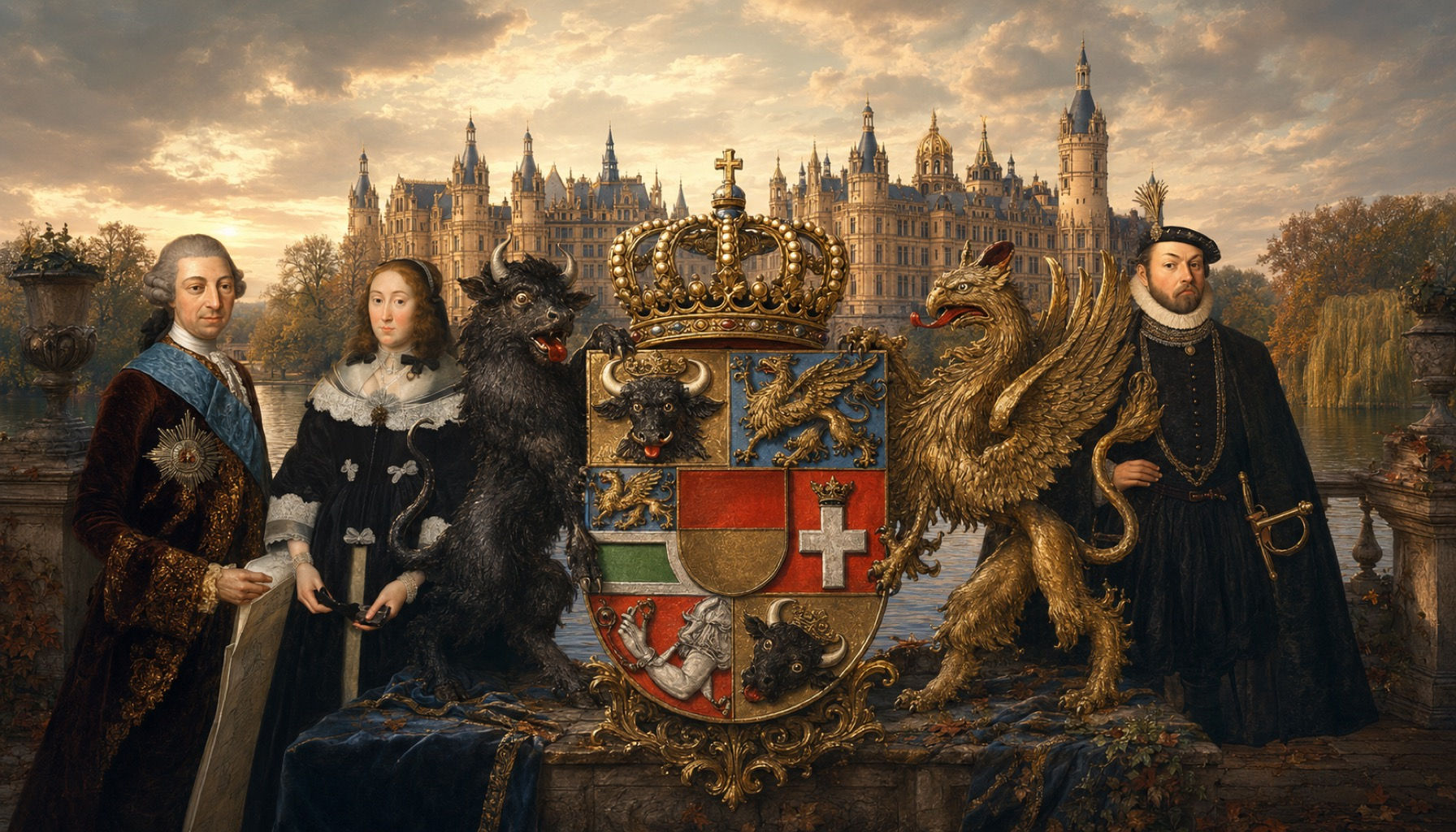
The House of Schwerin was one of the old noble families of northern Germany, rooted above all in Mecklenburg and connected more broadly with Pomerania and the aristocratic world of the Baltic north. Its story is the classic one of a durable German noble house: landholding, lordship, military service, office under princes and states, advantageous marriages, heraldry, and the careful preservation of family standing over generations. In haplogroup terms, the primary family line is tagged here with I1a2a1a1a1, a branch strongly associated with the wider northern European and Germanic world.
The family background belongs to a region where Slavic, Saxon, Danish, and later German princely interests collided and fused. That matters, because Mecklenburg was never a sleepy backwater; it was a frontier of power, conquest, adaptation, and noble reinvention. The Schwerin name emerged in this wider landscape of castles, bishoprics, estates, and regional courts. In historical memory, figures linked to the early Mecklenburg world such as Niklot, Prince of the Obotrites, Pribislav of Mecklenburg, and Henry Brown I, Lord of Mecklenburg, help evoke the turbulent setting out of which later northern noble identities were formed. The Schwerins, like many enduring houses, did not survive by accident. They endured because property, service, reputation, and political usefulness all worked together.
No location anchors the family imagination more powerfully than Schwerin itself, above all Schwerin Castle. Set dramatically on an island in Lake Schwerin, the castle is one of the most striking historic residences in Germany and embodies the long political prestige of the region. The site has much older roots, going back to an early medieval stronghold in a contested Slavic and German frontier zone, but the building seen today is largely the result of 19th-century reconstruction in a richly romantic historicist style. It became a grand ducal residence and a visual statement of Mecklenburg sovereignty, with towers, gilded details, formal interiors, and a setting that looks almost theatrical rising from the water. In other words, it is not just a pretty building; it is a monument to the aristocratic and princely culture of northern Germany that houses such as Schwerin inhabited and helped sustain. Yes, it can still be visited today, and it remains one of the major heritage landmarks of the region.
The haplogroup I1a2a1a1a1 places the family within a lineage with deep links across the ancient and early medieval north European world. That does not prove direct descent from any excavated individual, and it should not be presented that way, but it does place the Schwerin line in a wider network of related or linked ancient DNA finds. Examples include Imperial Roman Serbia at Svilos Krusevlje, sample R6693; Gothic period Serbia at Timacum Kuline Ravna Village, I15549; Gothic era Serbia at Timacum Slog Necropolis, I15545; Longobard period Pannonia at Savaria Szeleste Barbaricum in Hungary, SZL028; the Thuringii-associated sample from Obermoellern in Germany, OBM005; Nordic and Danii-linked samples from Denmark including Southern Sjaelland Praesto Endegaarde, CGG107416, Kalundborg Simonsborg, CGG106721, Vester Egesborg Vordingborg, CGG107507, and Espe, CGG107515; Nordic Bronze Age Denmark at Strandlunden II Gerlev, CGG106515; Iron Age Denmark at Trundholm Mose, CGG106734; Viking Age Denmark at Bogovej, CGG106777; Bronze Age southwest Ukraine at Bereminay Komarow, poz643; Viking Age Sweden at Stockholm Gorla, gor164, and Oland, VK337 and VK357; Anglo-Saxon Norfolk at Sedgeford, SED014; Migration Period Scitarjevo in Croatia, R3660; Gothic Kecskemet-Mindszenti Transtisza in Hungary, A181015 and A181016; and medieval Tarquinia in Lazio, TAQ009. Taken together, these linked samples show how a lineage associated with the Schwerin house belongs to a broad northern and Germanic ancient DNA horizon stretching from the Bronze Age to the Viking and medieval worlds.
If the House of Schwerin is part of your family story, or if you are curious whether your DNA links you to this wider northern German noble and Germanic world, upload your results to MyTrueAncestry and explore the ancient connections for yourself.



Comments