The Noble House of Darcy
– 3 min read


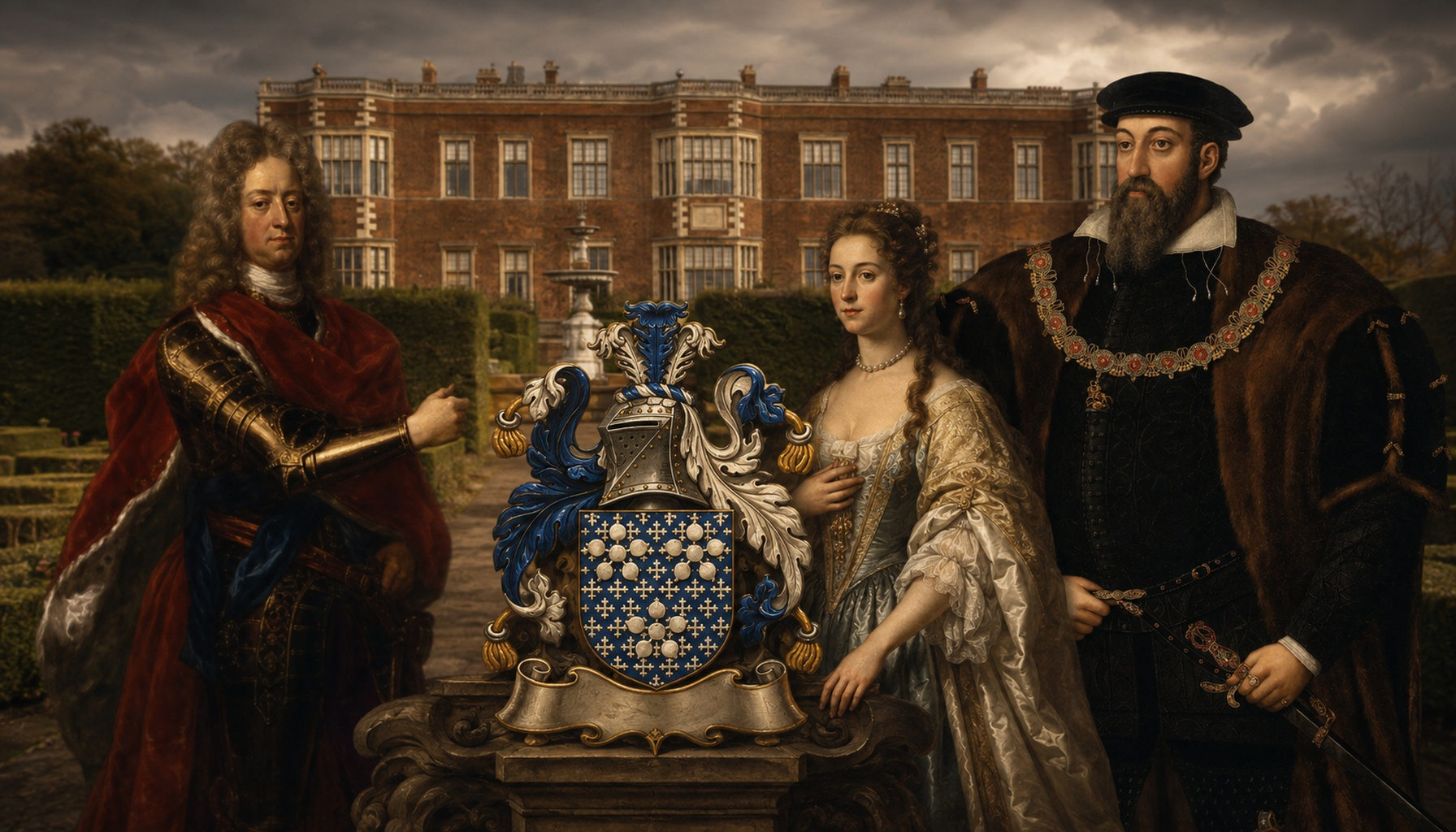
The House of Darcy was one of those solid English noble houses whose story is really a story about land, office, loyalty, and the long business of serving the crown. Rooted above all in Yorkshire and closely associated with Temple Newsam, the Darcys belonged to the baronial world of medieval and early modern England, where power was measured not simply in titles but in estates, tenants, military obligations, marriages, and influence at court. In haplogroup tagging, the primary family haplogroup linked here is R1b1a1b1a1a2c1a1a1a1a1a1a1a1a1b, a lineage placed within the broader tapestry of western European paternal ancestry.
The family name itself reflects the old Norman pattern so familiar in English aristocratic history: a lineage tied to place, status, and the reshaping of England after the Norman and Angevin centuries. Over time the Darcys became part of the regional ruling fabric of the north, developing through feudal authority, estate ownership, marriage alliances, military duty, and public office. Figures such as John Darcy, 1st Baron Darcy de Knayth (1280-1347), a major royal servant under Edward II and Edward III, show the family at its medieval height in crown service. Thomas Darcy, 1st Baron Darcy de Darcy (1467-1537), belongs to that more dangerous Tudor world in which noble loyalty could become a fatal matter. And later, Frances dArcy, Lady Dawes (1673-1705), reminds us that family memory did not end with the battlefield or the barony, but carried on through inheritance, social position, and the quieter transmission of aristocratic identity.
Read more about the Noble House of Vernon
Temple Newsam is the great location anchor for Darcy heritage, and it does a wonderful job of making noble history feel real rather than merely heraldic. Situated to the east of Leeds in West Yorkshire, the estate takes its name from the Knights Templar, who once held land there before later medieval transfer and redevelopment. The house known today was substantially rebuilt in the Tudor period and became one of the most important country houses in Yorkshire. Its history is bound up with the Darcys through possession, status, and the social prestige that radiated from a major estate seat. Temple Newsam was not simply a handsome residence: it was a statement of rank, authority, hospitality, and regional command, the sort of place from which a noble family managed land, displayed wealth, negotiated alliances, and projected influence. The site survives and can still be visited today, which is rather splendid, because it allows modern visitors to stand in a landscape where the memory of baronial England still lingers in brick, parkland, and setting.
From a DNA perspective, the Darcy tag here is linked with the paternal haplogroup R1b1a1b1a1a2c1a1a1a1a1a1a1a1a1b. As always, that does not by itself prove direct descent from any named noble house, but it does place the family within a wider network of related or linked paternal lines seen in ancient and medieval populations. Samples connected to this haplogroup include a notable cluster from Medieval Ireland at Ballyhanna, County Donegal, such as Sk197an, Sk197y, Sk197q, Sk197am, Sk197s, Sk197ab, Sk197u, Sk197t, Sk197r, Sk197ad, Sk197x, Sk197n, Sk197aa, Sk197z, Sk197ak, Sk197w, Sk197ai, Sk197m, Sk197ah, Sk197ag, Sk197v, Sk197ac, Sk197al, Sk197af, Sk197ae, Sk197o, Sk197aj, HAN197x, Sk197a, Sk197b, Sk197c, Sk197d, Sk197e, Sk197f, Sk197g, Sk197h, Sk197i, Sk197j, Sk197k, Sk197l, Sk197p, and HAN197, alongside Medieval Ireland Kilteasheen Roscommon Bishops Seat samples KIL041 and KIL044, and Medieval Ireland Kilteasheen sample KIL014. These are best understood as related comparative markers within a broader Atlantic and Insular world of medieval paternal ancestry, not as documentary evidence for the Darcy pedigree itself.
Read more about the Noble House of Harrington
If the House of Darcy speaks to your own family story, whether through Yorkshire roots, noble service, heraldry, or simply that enduring English baronial pattern of land and loyalty, you can take the next step through DNA. Upload your results to MyTrueAncestry to see whether you match the House of Darcy, this haplogroup branch, or related ancient DNA samples from the medieval world.
Comments