Clan Mackenzie
– 3 min read


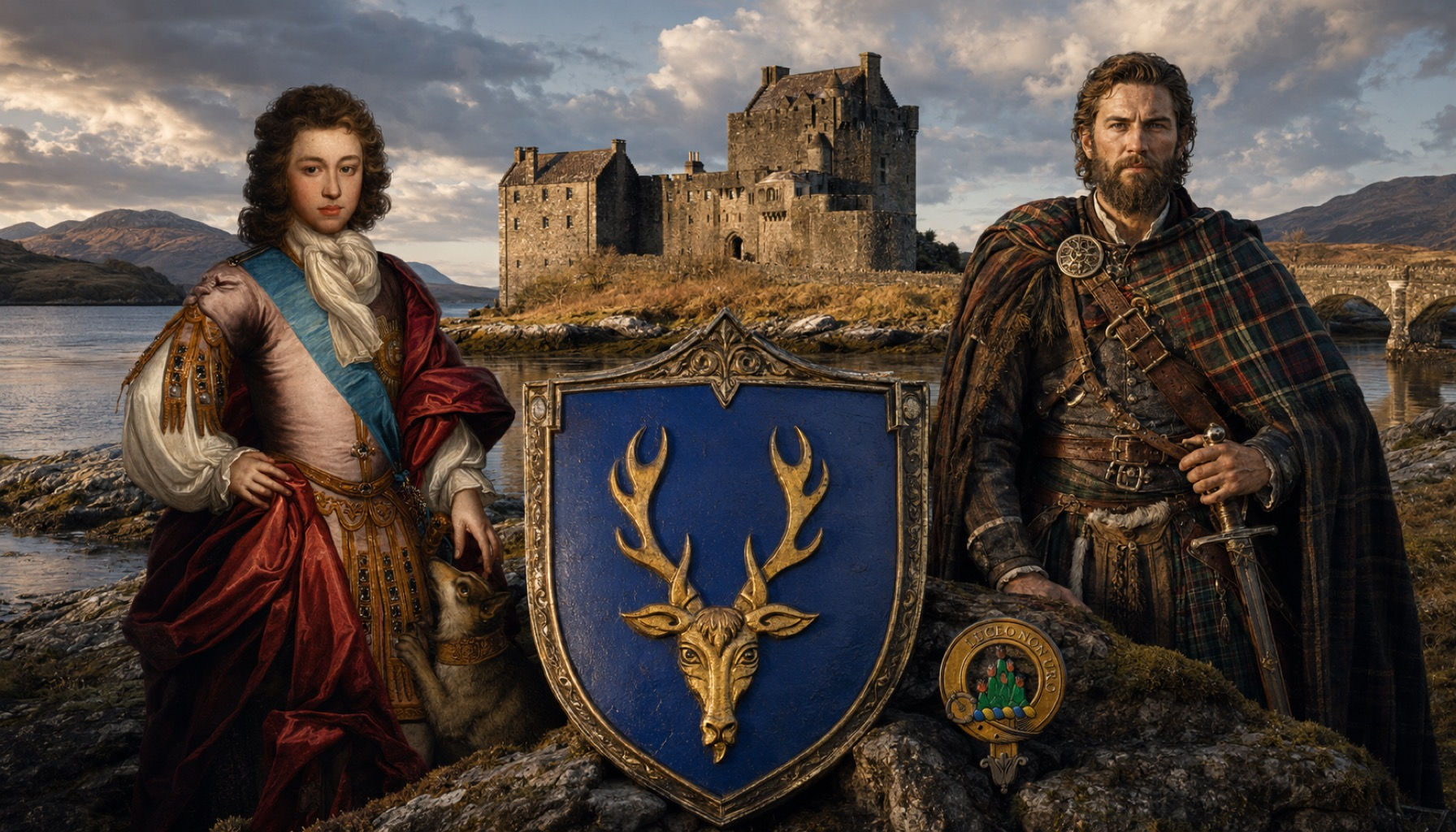
Clan Mackenzie was one of the great power-clans of the northern Highlands, rooted above all in Kintail in Ross-shire and long associated with the western seaways, Highland lordship, and the formidable world of Gaelic Scotland. In family DNA terms, the primary haplogroup linked here is R1b1a1b1a1a2c1a2a2d, a branch within the wider R1b line that is common in the Atlantic-facing parts of Europe. As ever with clan history, that does not mean every Mackenzie man carried exactly the same paternal line, but it gives a useful marker for the main lineage tradition attached to the family.
The Mackenzies emerged in the medieval Highlands through the classic mixture of chiefship, kinship, land control, military usefulness, and clever marriage politics. This is the world in which a clan was not merely a surname but a territorial machine: chiefs, cadet branches, tenants, fighting men, church links, office holders, and castle strongpoints all bound together. By the early 14th century we already find Kenneth Mackenzie, 1st of Kintail, recorded in 1304, and from that base the family expanded steadily. Later figures and branches, including Alexander Mackenzie of Kintail, the Earls of Seaforth from 1623 to 1781, and the Earls of Cromartie from 1703 to 1746, show just how far the clan moved from regional lordship into the titled aristocracy and public life of Scotland. In that sense the Mackenzies are a textbook Highland magnate clan: deeply Gaelic in identity, but equally comfortable in heraldry, noble rank, royal service, and state power.
Read more about Clan Mackenzie
No place captures Mackenzie prestige better than Eilean Donan Castle, one of the most famous castles in Scotland, dramatically set on a small tidal island where three great sea lochs meet: Loch Duich, Loch Long, and Loch Alsh. The site was fortified in the 13th century, probably as part of the western defensive network of the Scottish crown against Norse power in the Isles. Over time it became strongly associated with the Mackenzies of Kintail, who held it through constables and clan authority, while their close allies the MacRaes later became especially linked with its defense. The castle was involved in Jacobite-era conflict and was destroyed in 1719, then famously rebuilt in the 20th century. What matters historically is not just the postcard view, lovely though it is, but the fact that Eilean Donan sat at a strategic hinge of sea, mountain, and lordship. It was a gateway castle, a statement in stone that whoever controlled this point mattered in Highland politics. Yes, it can still be visited today, and for anyone interested in Mackenzie history it is one of those rare places where landscape, archaeology, and clan memory all still work together.
For the haplogroup R1b1a1b1a1a2c1a2a2d, the ancient DNA picture is broad and rather evocative. Related or linked samples appear across Britain and beyond, including Celtic Durotriges burials from Duropolis at Winterborne Kingston in England such as WBK12, WBK20, WBK29, WBK41, WBK05, WBK30, WBK43, WBK06, WBK08, WBK18, and WBK191; Celtic Briton East Kent England I13730; Iron Age Worlebury Somerset I11991; Iron Age Roundhouse Bu Orkney Scotland I2982; Iron Age Hillfort Battlesbury Bowl I21309; and older British examples such as Bronze Age Trumpington Meadows I3256, Bronze Age Amesbury Down I2417, Bell Beaker Wiltshire Upavon I4950, Bronze Age Bedfordshire I7576 and I7577, Bronze Age Boatbridge Quarry South Lanarkshire I5473, Celt Hinxton Iron Age HI2, Early Bronze Age England Thames I5377, and Ireland Copper Age Rathlin2B. Linked samples also turn up farther afield, including Imperial Roman Era Zadar Croatia I26776, Late Roman Conimbriga Portugal R10488, Late Roman Klosterneuburg Lower Austria R10656, Early Medieval Belgium Sint-Truiden Groenmarkt ST2025, Medieval Belgium outsider ST1308, Merovingian Alt-Inden IND013, Gallic France Parancot CGG023699, Post Roman Worth Matravers Dorset I11580, Medieval Faroe Islands VK27, Bronze Age Orkney KD061, and Bronze Age Calabria GMO015. None of this proves direct descent from any named ancient individual, of course. What it does show is that the Mackenzie-linked paternal branch belongs to a very old and widely distributed Atlantic and western European story, one that runs through Bronze Age, Iron Age, Roman, and medieval populations long before the clan itself emerged in Highland history.
If you carry Mackenzie ancestry, or simply want to see whether your DNA shows links to Clan Mackenzie or to ancient samples connected with haplogroup R1b1a1b1a1a2c1a2a2d, this is exactly the sort of story genetic genealogy can help illuminate. Upload your DNA to MyTrueAncestry and compare your results against ancient remains, historic populations, and family-linked heritage profiles to see where your own line may fit in the longer human past.
Comments