The House of Turenne
– 3 min read


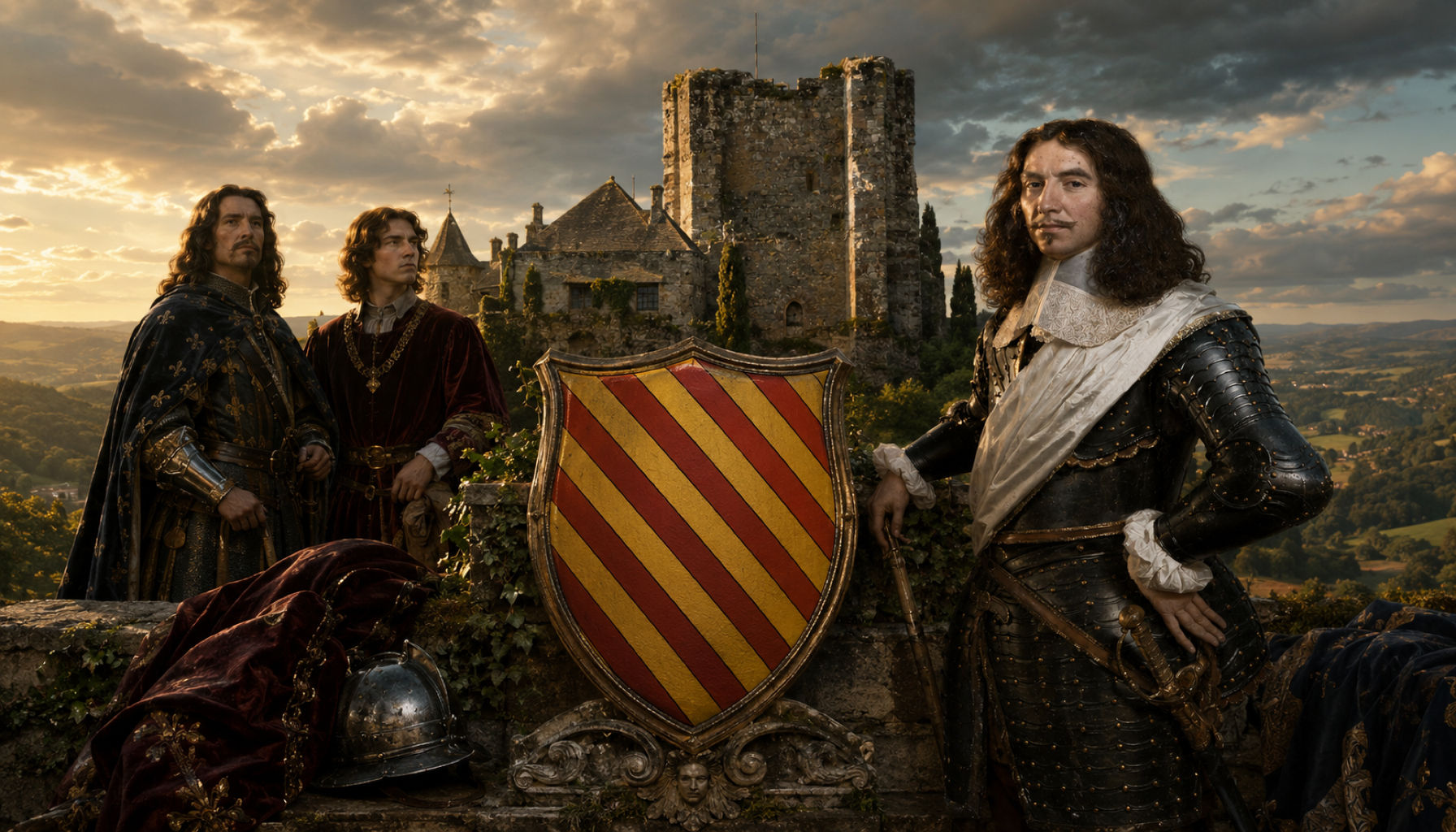
The House of Turenne was one of the notable noble lineages of medieval and early modern France, rooted in the viscounty of Turenne in what is now Correze, on the edge of the Limousin and Quercy worlds. This was not merely a family with a title tacked on for decoration. The viscounts of Turenne held a territory with a famously semi-independent character, the sort of lordship that reminds us medieval France was never a neat map of obedient provinces, but a patchwork of powers, privileges, and local strongholds. The family name carries the weight of feudal authority, military service, aristocratic marriages, and a long afterlife in French historical memory. Primary family haplogroup: R1b1a1b1a1a2a1a1. Other linked haplogroups and branches may appear in related populations, but this is the main lineage tag associated here.
In historical terms, the Turenne story is almost a textbook example of high French nobility, except that it is more interesting than any textbook summary. Their standing came from land, castle, military obligation, and the careful management of prestige. The viscounty sat in a region where local lordship mattered enormously, and where a family could act with a degree of autonomy that would have made the kings in Paris periodically uneasy. Among the named figures associated with the house is Raymond IV of Turenne, 1187-1243, a reminder that the family was already established in the high medieval period when lordship still meant fortifications, mounted retinues, and political bargaining conducted as much through kinship as through war. Later, the name Turenne would become inseparable from the great marshal of France, whose military reputation carried the old territorial name into the grander theatre of early modern Europe.
Read more about the House of Montfort
The great location anchor for this family is the Chateau de Turenne, rising above the town of Turenne itself. Perched on a rocky height, the castle was the commanding heart of the viscounty and perfectly expresses what this family was about: visibility, defensibility, and authority written into the landscape. Over centuries the site developed as a fortified residence of the viscounts, with towers, walls, and a strategic position overlooking the surrounding countryside. Like so many French strongholds, it was both a military installation and a public statement. A castle like this was not simply where one lived; it was how one ruled. Though damaged and altered over time, especially in the great reworkings of the French state and the long decline of feudal independence, the remains still preserve the outline of that old power. The site is known today for its surviving towers and panoramic views, and yes, it can still be visited, which is one of the pleasures of French historical geography: the stone still does some of the explaining for you.
From a DNA perspective, the Turenne-associated paternal line is tagged here as R1b1a1b1a1a2a1a1, a branch with a wide and rather fascinating ancient footprint across western Europe and beyond. That does not prove direct descent from the House of Turenne to any excavated individual, and it is important not to pretend otherwise. What it does show is that related or linked paternal lines appear in a broad historical arc: Bronze Age Iberia at Almoloya Pliego in Murcia through samples such as ALM036, ALM039, ALM050, ALM052, ALM058, ALM063, ALM064, ALM070, and ALM081; Valencian Bronze Age Villena sample PUC002; Iron Age and Celtiberian contexts in Spain including esp005 and I19991; Belgic and Gallic France in samples like ISL6950, CGG023685, and CGG022434; Merovingian Frankish Germany in EV8; Anglo-Saxon and medieval Britain in SED018, SED020, SED021, ATP_PSN_950, I12771, I11143, I14327, I12413, I20630, and I7629; medieval France in I15027; and even later historic contexts such as the Napoleon Grande Armee sample YYY095A and colonial Maryland sample I35260. In other words, the haplogroup linked with Turenne belongs to a deeply layered western European story, one that runs from Bronze Age warrior societies to medieval lordship and into the documented world of nobles, soldiers, and settlers.
Read more about the House of Sully
If the House of Turenne catches your imagination, that is because it sits at the meeting point of genealogy, fortification, politics, and memory. It is a family that helps us see how medieval France actually worked on the ground: not as a tidy kingdom, but as a negotiated world of castles, privileges, military reputations, and stubborn local power. If you have tested your DNA, you can upload it to MyTrueAncestry and explore whether you match the House of Turenne profile or any of the related ancient DNA samples linked to this wider R1b1a1b1a1a2a1a1 story.

Comments