The Noble House de Saddington
– 3 min read


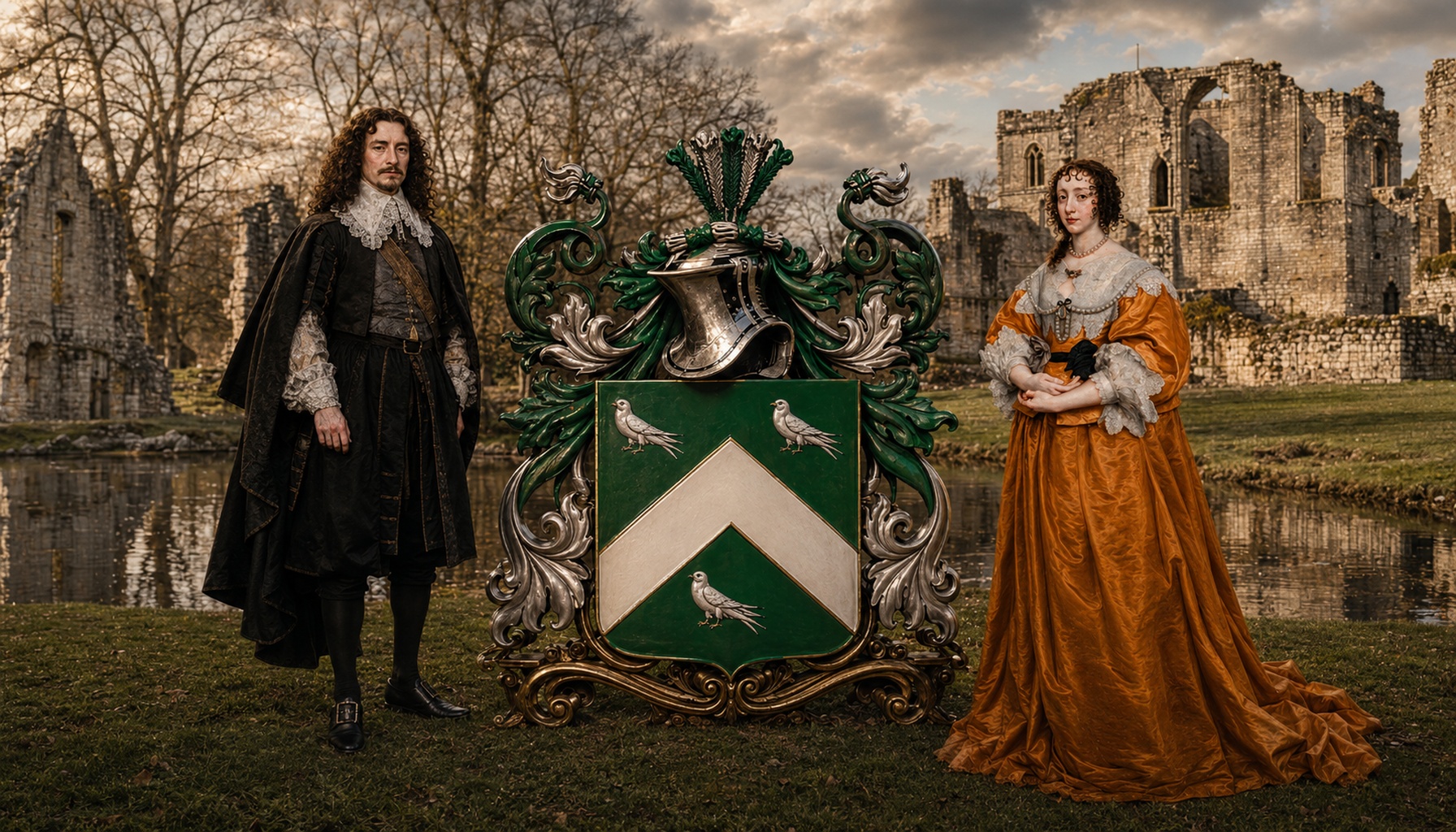
The de Saddington family was an English noble and landed house rooted in Leicestershire, its name taken from the village of Saddington itself, in the old heartland of the Midlands. Like many medieval English gentry families, they grew out of place, property, and service: a family became a house because it held land, married well, served in office, and left its name in records, seals, and local memory. The primary haplogroup linked with the family is R1b1a1b1a1a2a1a1, a paternal line widely represented across western Europe and often turning up in ancient and medieval contexts tied to movement, settlement, and elite formation.
What makes the House de Saddington interesting is that it fits a very recognisable English pattern without being dull for a second. This was not simply a surname floating through parish registers. It was a territorial identity with teeth: estate-based, heraldic, legally active, and tied to county society. Figures such as John de Sadington, recorded around 1300, Sir Robert de Sadington (1307-1361), and Isabel de Saddington (1325-1379) show us a family operating in the world of medieval landholding, alliances, and administration. Sir Robert in particular stands out as a man of law and royal service, a reminder that the gentry were not only country landowners but often the working machinery of the realm, sitting where crown, county, and local influence met.
A useful location anchor for thinking about the wider world around families like the de Saddingtons is Deddington Castle in Oxfordshire. Although not a de Saddington seat, it helps place them in the social landscape of medieval England: castles were not just fairy-tale fortresses but practical centers of lordship, justice, storage, and local control. Deddington Castle began as a Norman motte and bailey and later developed into a more substantial stone fortification. Across the Middle Ages it was associated with important aristocratic interests and with the contested politics of baronial and royal power. Today, what survives is mostly earthwork rather than soaring masonry, but that is rather the point: medieval power often survives in the shape of the ground itself. The site is still accessible and can reasonably be visited, giving a very immediate sense of how territorial authority was planted into the landscape. For a family such as de Saddington, whose identity rested on land, duty, and reputation, places like this are the proper backdrop.
Read more about the House of Mortimer
On the DNA side, the de Saddington family is tagged with haplogroup R1b1a1b1a1a2a1a1, and there are many related or linked ancient samples carrying the same broader paternal signature across time and space. These do not prove direct descent from the family, of course, but they do show the long historical reach of this lineage. Linked examples include Medieval Northern Spain Las Gobas (ldo049), Medieval England Cherry Hinton (ATP_PSN_950), Merovingian Frankish Eltville in Germany (EV8), Anglo-Saxon Sedgeford in Norfolk (SED018, SED020, SED021), and Bronze Age Britain samples from Melton Quarry in East Riding of Yorkshire (I7629) and Constantine Island in Cornwall (I16454). The same line also appears further afield in Iberian Bronze Age and Iron Age contexts such as Almoloya Pliego, Villena, Cogotas, and Celtiberian La Rioja, as well as later settings from Viking Age Ribe and Bogovej to post-Viking Hedeby, Roman-era Sardinia, Sicily, and even historic St. Mary City Chapel Field Cemetery in Maryland (I35260). In other words, this is a lineage with a deep and mobile western Eurasian story, one that sits very comfortably beside an English landed-gentry house whose identity emerged from medieval local power but belongs to a much longer human past.
Explore Roman and Early Medieval Britain DNA
If you are curious about the House de Saddington, the real fun is in combining paper history with deep ancestry. Uploading your DNA can help you see whether you match the de Saddington family profile or any of the related ancient DNA samples linked to haplogroup R1b1a1b1a1a2a1a1, placing your own story against the backdrop of medieval England, county society, and the far older population history of Europe.



Comments