The House of Mortimer

– 3 min read


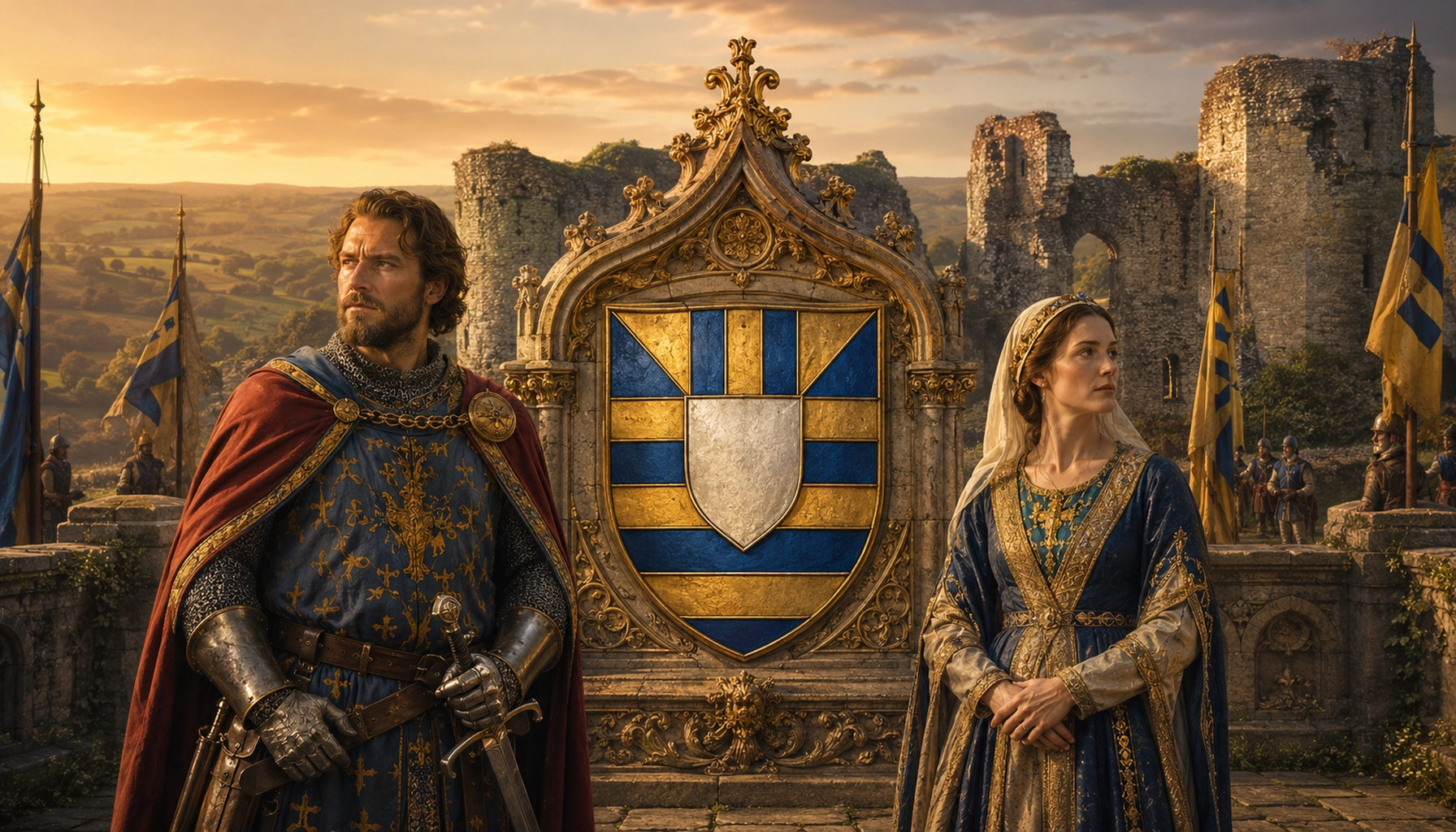
The House of Mortimer was one of the great noble families of medieval Britain: a Norman and then Anglo-Norman dynasty whose power was built on land, castles, armed service, marriage, and a sharp instinct for politics. Their name is usually traced to Mortemer in Normandy, and like many families who crossed into England after the Norman Conquest, they turned frontier opportunity into lasting authority. In the Mortimers' case, that frontier was the Welsh Marches, where royal power, local lordship, warfare, and ambition all met in a rather combustible mix. The primary haplogroup linked here is I2a1b2a2d1b1b.
What makes the Mortimers so interesting is that they were never just local castle-holders. They became marcher lords of real consequence, balancing service to the English crown with a level of regional independence that could make kings uneasy. Their story runs through the familiar machinery of medieval aristocratic success: estates carefully accumulated, titles defended, heraldry displayed, daughters and sons married strategically, and claims remembered across generations. Figures such as Edmund de Mortimer (1252-1304) stand at the heart of that rise, helping consolidate the family's strength in the Marches. In time the Mortimers became entangled not only in border warfare and rebellion, but in the dynastic politics of the realm itself, with connections that would matter for royal succession.
Read more about the House of de Clare
If one place anchors Mortimer identity, it is Wigmore Castle in Herefordshire. This was not just a residence but the great symbolic and practical center of Mortimer power, planted close to the Welsh border in exactly the sort of landscape where marcher lordship mattered most. The site began as an early Norman motte and bailey stronghold, later rebuilt and enlarged in stone, and over time it developed into a substantial fortress with curtain walls, towers, a gatehouse, domestic ranges, and all the architectural language of aristocratic authority. From here the Mortimers managed estates, projected military strength, and staged themselves as one of the defining families of the borderlands. Its position was strategic, but also theatrical in the medieval sense: a castle was meant to dominate the countryside and make hierarchy visible. Today Wigmore Castle survives as an atmospheric ruin, and yes, it can still be visited, which is rather marvellous because it lets you stand in the landscape that made the Mortimers possible.
From a DNA perspective, the Mortimer-linked haplogroup I2a1b2a2d1b1b sits within a much deeper European story, and related or linked ancient samples show just how long and varied that story is. Among them are MBG008 from the elite Celtic burial at Magdalenenberg in Villingen-Schweningen, ATP_PSN_522 from the medieval Augustinian Friars in England, I7959 from Early Bronze Age Praha-Stodlky-Mal-Ohrada in Czechia associated with the Unetice world, BRC039x from Migration Period Saxony-Anhalt, poz498 from Bronze Age Karczyn in Lower Silesia, poz720 from Bronze Age Pielgrzymowice Grave 669 in Silesia, I11590 and I20641 from the early Anglo-Saxon cemetery at West Heslerton in Yorkshire, I17327 from Iron Age Prague in Central Bohemia, ELW030 from a post-medieval plague victim at Ellwangen in Germany, SRA62 from Mesolithic Sramore in Leitrim, and even the famous Cheddar Man from Somerset. These are not claims of direct descent from the Mortimers, of course. Rather, they show the broad time depth and geographic spread of lineages related to or linked with this haplogroup across prehistoric and historic Europe.
If the Mortimers' world of Norman settlement, marcher castles, frontier warfare, and dynastic ambition feels close to your own family story, you can explore that link through DNA. Upload your results to MyTrueAncestry and see whether you match the House of Mortimer profile or any of the related ancient DNA samples connected with haplogroup I2a1b2a2d1b1b.
Comments