Clan Cockburn
– 2 min read


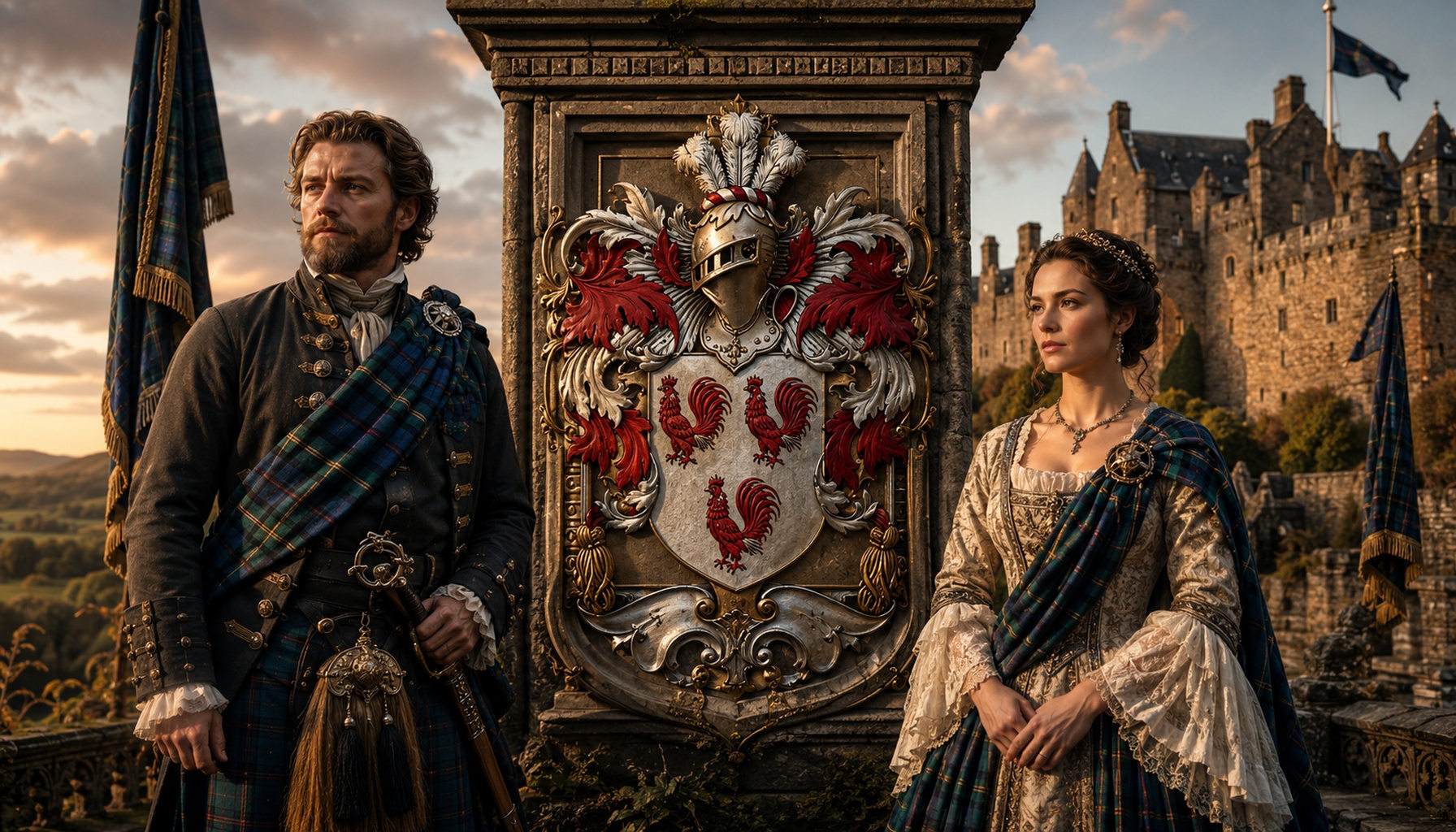
Clan Cockburn was a historic Scottish Border family rooted above all in Berwickshire, in the eastern marches of Lowland Scotland, where land, loyalty, and local reputation mattered enormously. Their name is commonly linked to the district around Cockburn and especially to Cockburn Law, and their long story fits the classic Border pattern: a family built through estate holding, crown service, heraldic identity, and steady participation in the political life of the region. The primary haplogroup associated here is R1b1a1b1a1a1b1a1a, a lineage widely represented across parts of Atlantic and northwestern Europe and useful as a broad paternal tag rather than a proof of descent.
The Cockburns emerge in record not as some misty legendary warrior house, but as a recognisable landed family of the medieval Borders, shaped by a frontier world where Scotland met England in uneasy proximity. This was a country of fortified places, legal duties, feuds, raids, and also administration, charters, and office holding. One early named figure is Sir Roberto de Cokeburn, recorded in 1261, already showing the family in documentary history. From there the surname persists with remarkable continuity, tied to public service and local standing, and reflecting how Border families often survived not simply by force, but by adaptability, alliances, and usefulness to crown and community alike.
Cockburn Law is the great landscape anchor of the family story, and it is exactly the sort of place that makes history feel physical rather than abstract. Rising prominently in Berwickshire, this hillfort site occupies a commanding position in the eastern Borders, with extensive views over the surrounding countryside and toward routes that would have mattered deeply in prehistoric and medieval movement alike. The archaeological record noted at Canmore identifies it as a substantial defended site, with visible earthworks and ramparts that speak to repeated importance long before the surname Cockburn entered written history. In other words, the family inherited not an empty map point but a place already loaded with memory, defence, and authority. That matters, because Border lordship so often rested on knowing the land intimately and being visibly rooted in it. Cockburn Law can still be visited, and for anyone interested in the clan it offers the rare pleasure of standing in the very terrain that helped shape the name.
From a DNA perspective, the haplogroup tag R1b1a1b1a1a1b1a1a connects Clan Cockburn to a wider web of ancient paternal lineages found across early medieval and Iron Age northern Europe. Related or linked samples include Merovingian Period Frankish Moemlingen, Germany (Mln27), Medieval Vasterhus, Sweden (mbv200), Viking Age Uppsala Gammelbyn Brstil, Sweden (gam872), Iron Age eastern Sjaelland samples from Denmark such as Varpelev (CGG107411) and Hastrup (CGG107419), Mosede Mose (CGG107489), Mosede Fort (CGG107495), Kalundborg Simonsborg (CGG106728), Sanddal (CGG019442), Engbjerg (CGG019091), Allerslev (CGG107387), and further linked individuals from western and northern Norway, Scania, Anglo-Saxon England, Orkney, the Isle of Man, Iceland, and Viking Age battle burials in England. These do not demonstrate direct descent from any one ancient individual to the Cockburn family. What they do show is that the broader paternal lineage belonged to the same deep northern European world from which the peoples of the North Sea, the Danelaw, the Scandinavian sphere, and the medieval British Isles were historically formed.
Explore Ancient DNA in Post-Roman Britain
If you carry the Cockburn surname, have Border ancestry, or simply want to see how your own DNA may connect with families like this and with related ancient samples, MyTrueAncestry lets you upload your DNA and explore those deeper links for yourself.
Comments