Clan Coyne
– 3 min read


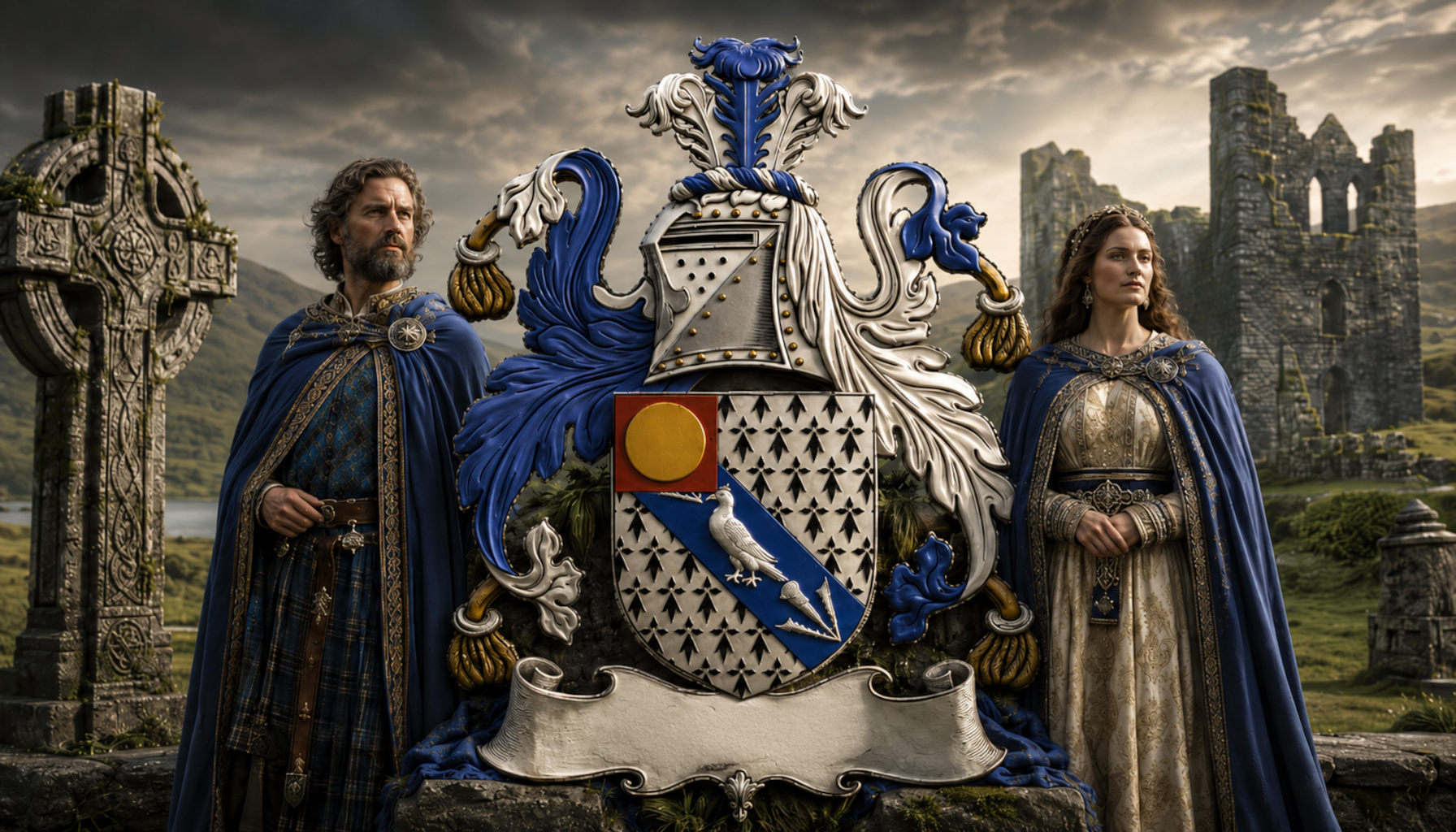
Clan Coyne belongs to the old Gaelic Irish world of kin, place, and remembered descent. The surname is generally linked with the O Cadhain tradition, a name carried through generations in Ireland as families held on to identity despite conquest, anglicization, and migration. In that older Irish pattern, a clan was not simply a badge or a tartan-style emblem, but a living network of relatives, clients, local loyalties, and shared memory. For the Coynes, that meant belonging to a landscape as much as to a name, and in genetic terms this family profile is here tagged with the primary haplogroup R1b1a1b1a1a2c1a1a1a1a1b1.
The story is richer than a bare surname note. Families like the Coynes survived because they adapted. Some served locally, some moved, some preserved naming traditions, and some were remembered in connection with learned or poetic roles, a reminder that Gaelic lineages were not only fighting families but could also be custodians of language, story, and reputation. One later notable bearer of the name was Joseph Sterling Coyne (1803-1868), the Irish writer and dramatist, whose career shows how a Gaelic surname could travel from local roots into the wider literary and public world without losing the echo of its origin.
A useful location anchor for the Coyne story is Ballykine Castle in County Galway, a region where Gaelic family memory still sits thick in the place-names and in the stones themselves. Ballykine Castle is a tower house, one of those late medieval Irish strongholds that were at once residence, status symbol, and practical defense in a countryside shaped by competing lordships. Its history, as outlined in local accounts, reflects the layered world of Gaelic and later landed Ireland: a castle embedded in local territory, altered by changing power, and preserved as part of Galway's historical fabric. It is the sort of place that makes the clan system feel real rather than abstract, because you can see how families were rooted in particular districts, fields, and routes. Based on its heritage presentation and local coverage, Ballykine Castle can still be visited in the sense that it remains a visible historic site in the landscape, though visitors should always check current access arrangements locally before planning a trip.
The Coyne haplogroup tag R1b1a1b1a1a2c1a1a1a1a1b1 also sits within a wider ancient DNA picture stretching across medieval and earlier Europe. Related or linked samples assigned within this broader paternal line include Medieval Jutland Denmark Vor Frue Kirkegard Aalborg (CGG100512), Thuringii Tribe Germany Deersheim Saxony-Anhalt (DRH026), Carolingian Era Groningen Netherlands (GRO005), Medieval Ireland Kilteasheen Roscommon Bishops Seat (KIL043), Merovingian Grave North Rhine-Westphalia Germany Alt-Inden (IND007), Anglo-Saxon Sedgeford England Norfolk (SED005), Iron Age Briton Thornholme East Riding of Yorkshire (I22060), Aquitani Pech-Maho France (PECH8), and the colonial Maryland burials associated with Philip Calvert and his son (I2097 and 2099). These do not prove direct descent from any one individual. What they do show is that this paternal branch appears across a remarkably wide historical geography, from Iron Age Britain and medieval Ireland to northwestern Europe and the Atlantic world, which is exactly the sort of long, tangled, mobile background from which many later surnamed families emerged.
If you carry the Coyne name, or have O Cadhain, Coyne, Coyne-related, or broader Irish kinship in your family story, this is where DNA can become wonderfully concrete. Upload your DNA to MyTrueAncestry to see whether you match Clan Coyne, this haplogroup branch, or any of the related ancient DNA samples connected with the wider R1b1a1b1a1a2c1a1a1a1a1b1 story.
Comments