Clan Coffey
– 3 min read


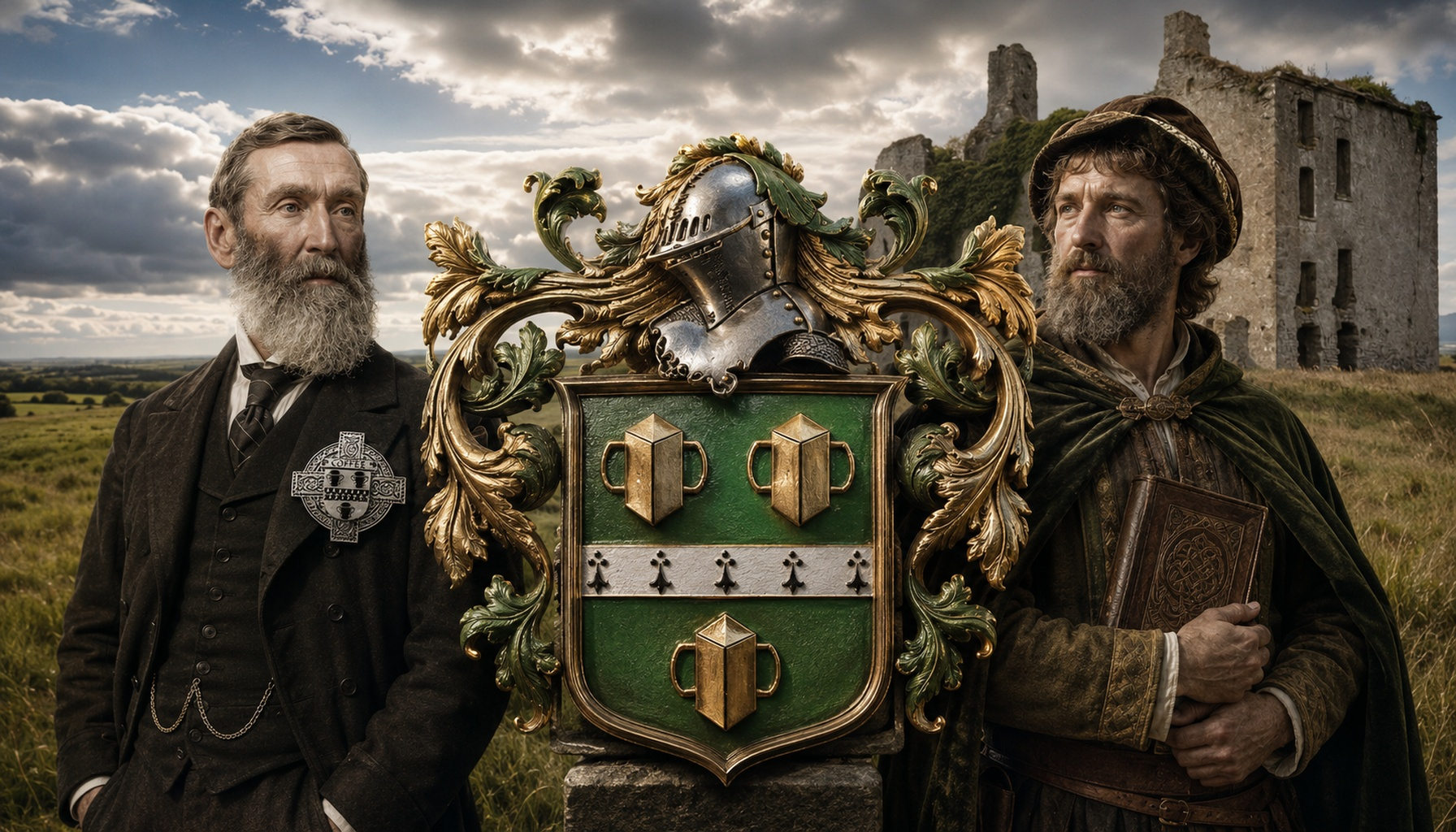
Clan Coffey, from the Gaelic O Cobhthaigh, was an Irish learned family of Munster, rooted in the old Gaelic world of kinship, local service, poetry, history, and inherited memory. In that world, a surname was not merely a label but a declaration of belonging: to people, to place, and to a line of descent remembered across generations. The Coffeys are best understood as part of that wider Gaelic Irish pattern, a family shaped by regional identity and continuity, and in genetic tagging here linked above all with the primary family haplogroup R1b1a1b1a1a2c1a3a2a1b1b.
Their story is, in many ways, the story of Ireland itself. Families like the Coffeys endured conquest, the tightening grip of anglicization, shifting political orders, migration, and later the pull of diaspora, yet the surname survived. That matters. Names endure because memory endures: in genealogies, in local tradition, in parish and legal records, and in the stubborn fact that descendants continued to call themselves Coffey. A named figure such as Dermot OCoffey, recorded in 1580, gives us one historical glimpse of that continuity, but behind him stands a much longer tradition of Gaelic family life in which learning and lineage were deeply prized.
The family name O Cobhthaigh is especially associated with Munster, and more specifically with a landscape of old Irish lordships where hereditary learned families attached themselves to powerful regional dynasties. Historically, the O Cobhthaigh were noted as a bardic and literary family, one of those indispensable Gaelic kindreds who preserved praise poetry, genealogy, and local memory for their patrons. The surname is strongly tied to counties in the south, especially Cork and nearby Munster districts, where Gaelic culture remained deeply rooted even under pressure from Tudor expansion and later English administration. This is not the sort of history that always leaves a dramatic ruined castle with a ticket desk and a gift shop; often it survives instead in place-names, manuscripts, ecclesiastical landscapes, and the old territories themselves, which can still be visited across Munster today. To walk that country is to see the true anchor of the family story: not one single monument, but a lived historical landscape of townlands, churches, roads, fields, and remembered names.
From the ancient DNA side, the primary family haplogroup tag here is R1b1a1b1a1a2c1a3a2a1b1b, a branch linked with a broad Atlantic and Celtic-facing story rather than any provable one-to-one descent from a single excavated individual. Related or linked samples carrying this branch or close associations appear across a striking range of times and places: Celtic Durotriges burials from Duropolis at Winterborne Kingston in England such as WBK12, WBK20, WBK29, WBK41, WBK05, WBK30, WBK43, WBK06, WBK08, WBK18, and WBK191; Iron Age and post-Roman Britain including Worlebury I11991, Battlesbury Bowl I21309, and Worth Matravers I11580; Bronze Age Britain and Ireland including Trumpington Meadows I3256, Amesbury Down I2417, Upavon I4950, Bedfordshire I7576 and I7577, Boatbridge Quarry I5473, Thames I5377, Scotland I2859, and Rathlin2B from Copper Age Ireland; and further linked finds from Roman and medieval Europe, from Zadar in Croatia and Conimbriga in Portugal to Sint-Truiden in Belgium and Alt-Inden in Germany. None of these should be presented as direct ancestors of the Coffeys without documentary proof. But together they sketch the deep paternal backdrop of the wider northwestern European and Celtic world in which an Irish Gaelic surname like Coffey later took historical shape.
If the Coffey name is part of your family story, the real pleasure lies in joining the strands together: surname, region, records, oral history, and DNA. Upload your DNA to MyTrueAncestry and see whether you match Clan Coffey, its broader Gaelic Irish context, or related ancient DNA samples from Britain, Ireland, and Europe that illuminate the deeper past behind the name.

Comments