Clan OSullivan
– 3 min read


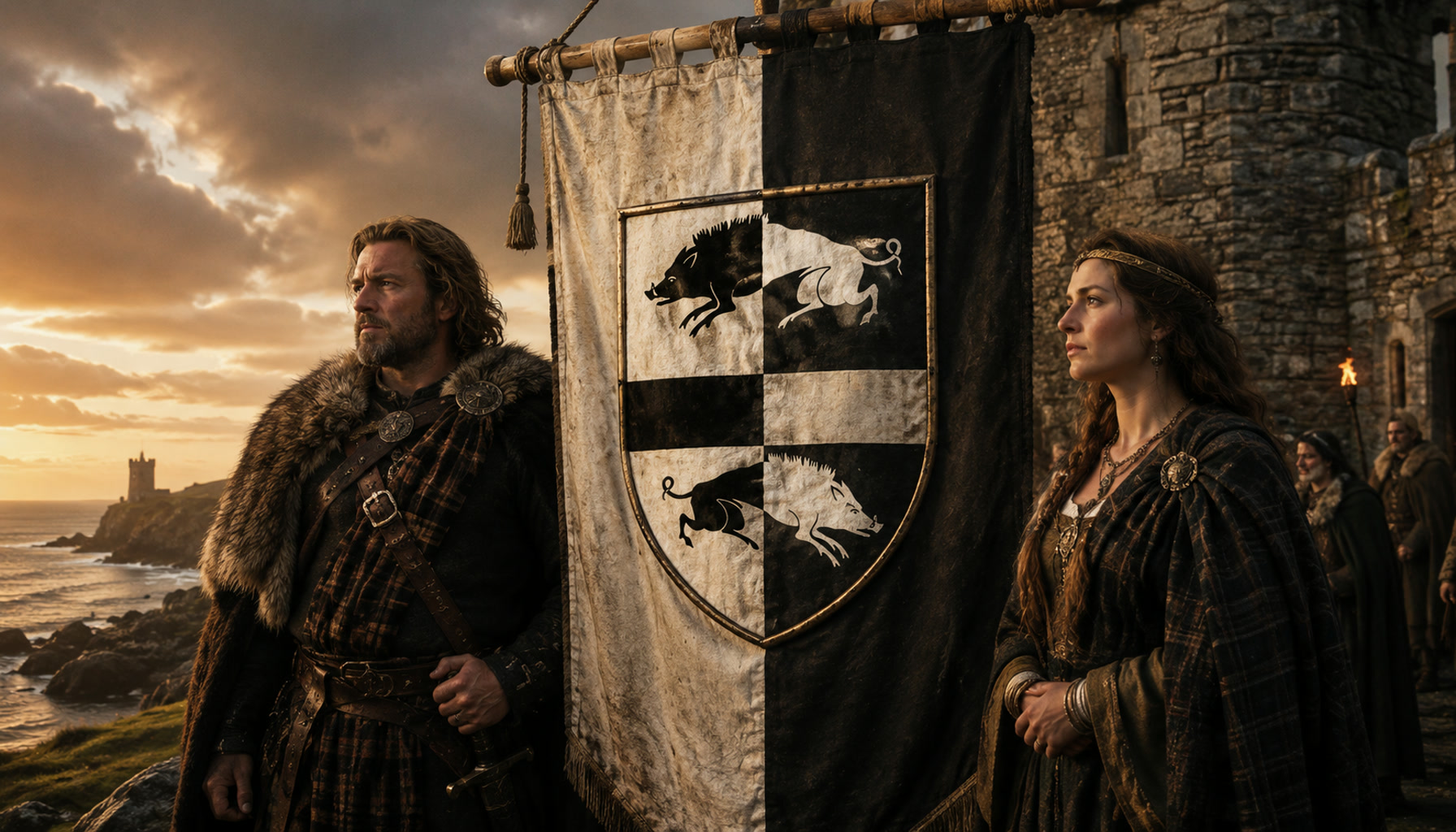
Clan OSullivan was one of the great Gaelic dynasties of Munster, rooted above all in the south-west of Ireland, with deep associations in what are now Counties Kerry and Cork. The surname O Sullivan, from the Irish O Suileabhain, belongs to the old world of hereditary kingship, kin-groups, contested land, and regional power. In genealogical tradition the family emerged from an influential Gaelic lineage connected to the wider Eoganacht sphere, and over time the OSullivans divided into powerful branches such as O Sullivan Mor and O Sullivan Beare. Their historical story is very much the story of Gaelic Ireland itself: descent from named ancestors, control of territory, warfare, lordship, and survival under enormous pressure. Primary family haplogroup: R1b1a1b1a1a2c1a3a2. Haplogroups linked here: R1b1a1b1a1a2c1a3a2.
The family first comes into view in the early medieval record, and one of the earliest named figures associated with the line is Suilebhan mac Maolura, recorded in 862. That matters because Gaelic dynasties were not simply collections of surnames; they were political organisms, remembering founders and preserving rank through genealogy. The OSullivans rose in the shifting landscape of medieval Munster, where rival Irish kindreds, Norse coastal influence, Norman intervention, and later Tudor conquest all reshaped power. They were landholders, fighting lords, and patrons of a distinctly Gaelic order. Even after dispossession and migration in the early modern period, the name endured with unusual strength, carrying with it the memory of resistance, exile, and continuity.
Read more about Clan MacCarthy
No place anchors the OSullivan story more dramatically than Dunboy Castle on the Beara Peninsula in County Cork. This was the principal stronghold of the O Sullivan Beare line, standing near Castletownbere on a commanding coastal site that looked out over Bantry Bay and the maritime approaches of south-west Ireland. The castle became famous for the siege of 1602 during the Nine Years War, when English forces under George Carew attacked it after the Battle of Kinsale had begun to turn the tide against Gaelic and allied resistance. Dunboy was not just a residence; it was a military and political symbol of lordship on the edge of the Atlantic, tied to sea routes, local power, and the stubborn independence of Gaelic Munster. The stronghold was shattered in that campaign, and its fall became one of the defining episodes in the destruction of the old order in the south-west. The ruins of Dunboy Castle still survive and can be visited today, making it one of those rare places where the landscape, the stones, and the history still speak plainly enough without much help from us.
From a DNA perspective, the OSullivan story sits comfortably within a broader Atlantic and Celtic pattern often associated with haplogroup R1b1a1b1a1a2c1a3a2. That does not mean any ancient individual can be claimed as a direct OSullivan ancestor, and we should resist that temptation. What we can say is that a number of ancient samples are linked or related to this broader paternal cluster across western and central Europe, showing how deep and widespread such lineages became over time. Relevant linked examples include the Celtic Durotriges burials from Duropolis, Winterborne Kingston in England such as WBK12, WBK20, WBK29, WBK41, WBK05, WBK30, WBK43, WBK06, WBK08, WBK18 and WBK191; Iron Age and later British and Irish connected material such as Iron Age Worlebury Somerset England (I11991), Iron Age Hillfort Battlesbury Bowl England (I21309), Celt Hinxton Iron Age (HI2), Post Roman Era Worth Matravers Dorset England (I11580), Early Bronze Age England Thames (I5377), Scotland Late Bronze Age (I2859), Bronze Age Boatbridge Quarry South Lanarkshire Scotland (I5473), and Ireland Copper Age (Rathlin2B). The same linked branch also appears more widely in samples such as Imperial Roman Era Zadar Croatia (I26776), Late Roman Conimbriga Portugal (R10488), Late Roman Era Klosterneuburg Lower Austria (R10656), Early Medieval Belgium Sint-Truiden Groenmarkt (ST2025), Medieval Belgium Outsider Sint-Truiden Onze-Lieve-Vrouwekerk (ST1308), Merovingian Grave North Rhine-Westphalia Germany Alt-Inden (IND013), Gallic France Parancot (CGG023699), Bronze Age Orkney Westray Links of Noltland (KD061), Bronze Age Calabria Cosenza Grotta della Monaca Sant Agata di Esaro (GMO015), Bronze Age Trumpington Meadows Cambridge England (I3256), Bronze Age Amesbury Down Wiltshire England (I2417), Bell Beaker Wiltshire Upavon England (I4950), and Bronze Age Bedfordshire England (I7576, I7577). In other words, the OSullivan haplogroup tag belongs to a very old and mobile family of lineages with strong representation in Atlantic Europe, especially in regions tied to Bronze Age and later Celtic populations.
Read more about Clan ODomhnaill
If you carry the OSullivan name, have roots in Munster, or simply want to know whether your DNA shows links to this Gaelic world, this is exactly the sort of family history that becomes more vivid when combined with genetics. Uploading your DNA to MyTrueAncestry can help you explore whether you match Clan OSullivan, its broader haplogroup R1b1a1b1a1a2c1a3a2, or related ancient samples from Ireland, Britain, and the wider Celtic and Atlantic zone.
Comments