Clan Mac Murchada
– 3 min read


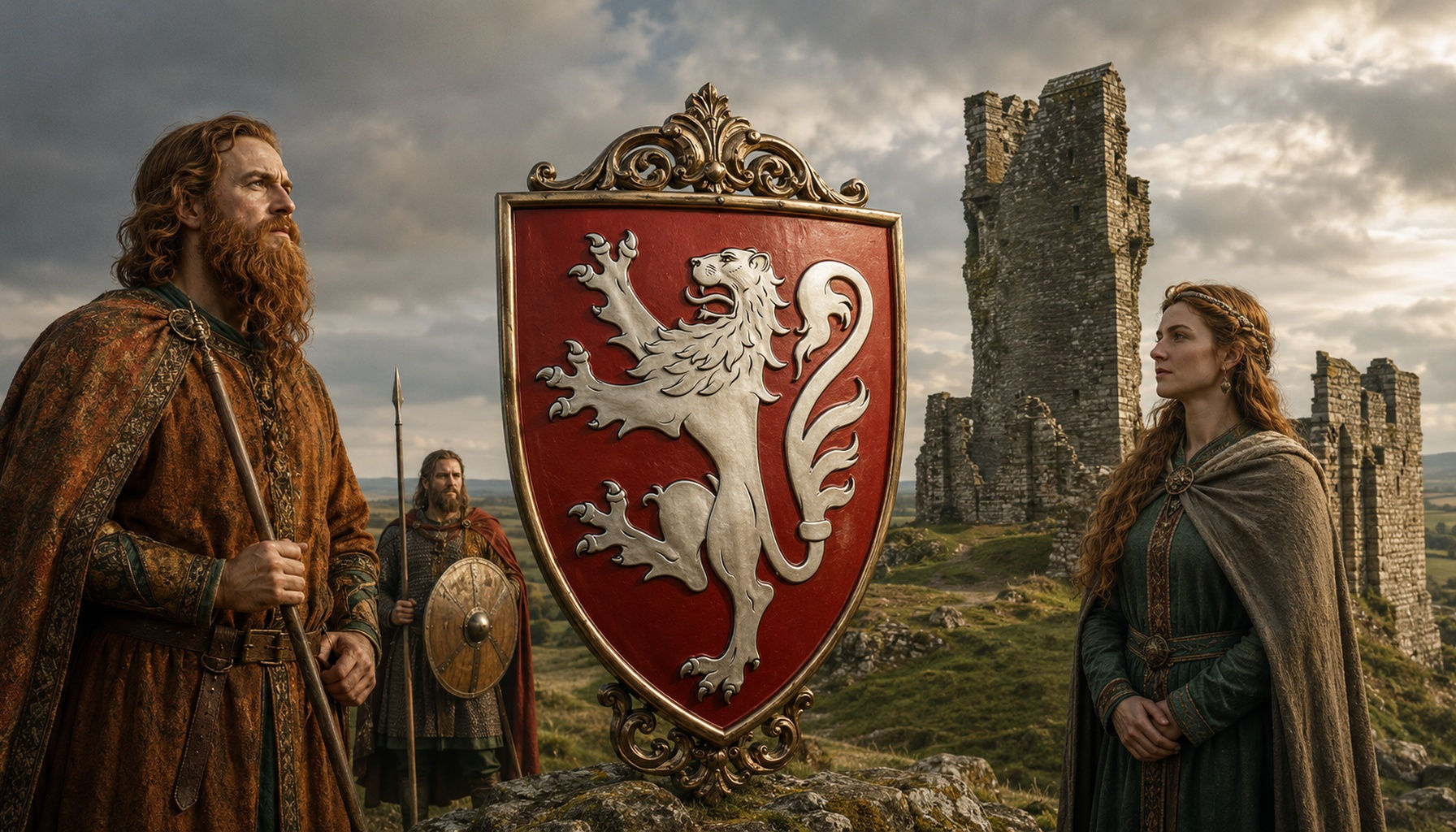
Clan Mac Murchada was a Gaelic Irish dynastic family of Leinster, rooted in the old kingship traditions of eastern Ireland and strongly associated with the political world of medieval Gaelic lordship. Their remembered lineage belongs to that recognisable Irish pattern in which power was carried not just by swords and landholding, but by genealogy, inauguration, bardic praise, rivalry, and the stubborn importance of descent. The haplogroup most closely linked here is R1b1a1b1a1a2c1a4a1, a branch within the great R1b family so often found in the long population history of Atlantic and western Europe.
The Mac Murchada story is not a neat tale of a single family quietly sitting on an estate for centuries. It is far more Irish than that: shifting alliances, territorial competition, conflicts with neighbouring dynasties, and eventually entanglement with the Anglo-Norman world. The most famous figure is Diarmait Mac Murchada, King of Leinster (1110-1171), whose career became one of the great turning points in Irish history. Through him, Clann Mac Murchada stands at the crossroads between Gaelic regional kingship and the profound changes that followed the arrival of Norman power in Ireland.
The family's location anchor is Leinster, especially the south-east of Ireland, where Diarmait Mac Murchada ruled in the 12th century. He was king of Leinster, a province that mattered enormously in the politics of the island, connected to major ecclesiastical centres, coastal routes, and rival kingdoms. Diarmait is particularly associated with Ferns in County Wexford, which served as an important royal and ecclesiastical centre, and with a wider Leinster landscape that included modern Wexford, Carlow, Wicklow, Kildare, and parts of Dublin's political orbit. His expulsion in 1166 and his return with Norman military backing helped trigger the Anglo-Norman intervention in Ireland, so the Mac Murchada name is tied not just to a local dynasty but to one of the most consequential episodes in medieval Irish history. Ferns, long linked with Diarmait, can still be visited today, and the area remains one of the best places to feel the overlap of royal memory, church foundations, and the changing world of 12th-century Ireland.
From a DNA perspective, the primary family haplogroup tag here is R1b1a1b1a1a2c1a4a1. That does not mean every historical Mac Murchada line can be directly proven from ancient remains, and it certainly does not allow us to claim descent from named medieval rulers without specific evidence. What it does do is place the family within a wider network of related or linked ancient paternal lines seen across Europe. Samples associated with this branch include a notable cluster from Celtic Durotriges burials at Duropolis, Winterborne Kingston in England, such as WBK12, WBK20, WBK29, WBK41, WBK05, WBK30, WBK43, WBK06, WBK08, WBK18, and WBK191. Other linked examples appear in Imperial Roman Zadar in Croatia (I26776), Bronze Age Orkney at Links of Noltland (KD061), Bronze Age Calabria at Grotta della Monaca Sant Agata di Esaro (GMO015), Early Medieval and Medieval Sint-Truiden in Belgium (ST2025 and ST1308), Gallic France at Parancot (CGG023699), Post-Roman Dorset (I11580), Merovingian Germany at Alt-Inden (IND013), Late Roman Austria (R10656), Late Roman Conimbriga in Portugal (R10488), Iron Age Somerset (I11991), Battlesbury Bowl (I21309), Bronze Age Trumpington Meadows (I3256), Amesbury Down (I2417), Bell Beaker Upavon (I4950), Bedfordshire samples I7576 and I7577, Boatbridge Quarry in South Lanarkshire (I5473), Hinxton Iron Age HI2, Early Bronze Age Thames I5377, and Ireland's Copper Age Rathlin2B. These are best understood as genetic fellow travellers across time, showing the deep prehistoric and historic background of the wider paternal world in which a Gaelic Leinster dynasty like the Mac Murchada emerged.
Read more about Clan MacDiarmada
If you carry the Mac Murchada name, have roots in Leinster, or simply want to see how your DNA connects to the old dynastic landscape of Ireland, this is exactly the kind of family story worth exploring. Upload your DNA to MyTrueAncestry and see whether you match Clan Mac Murchada, its haplogroup R1b1a1b1a1a2c1a4a1, or related ancient DNA samples from Ireland, Britain, and the wider Celtic and post-Roman world.

Comments