Clan Laigin
– 2 min read


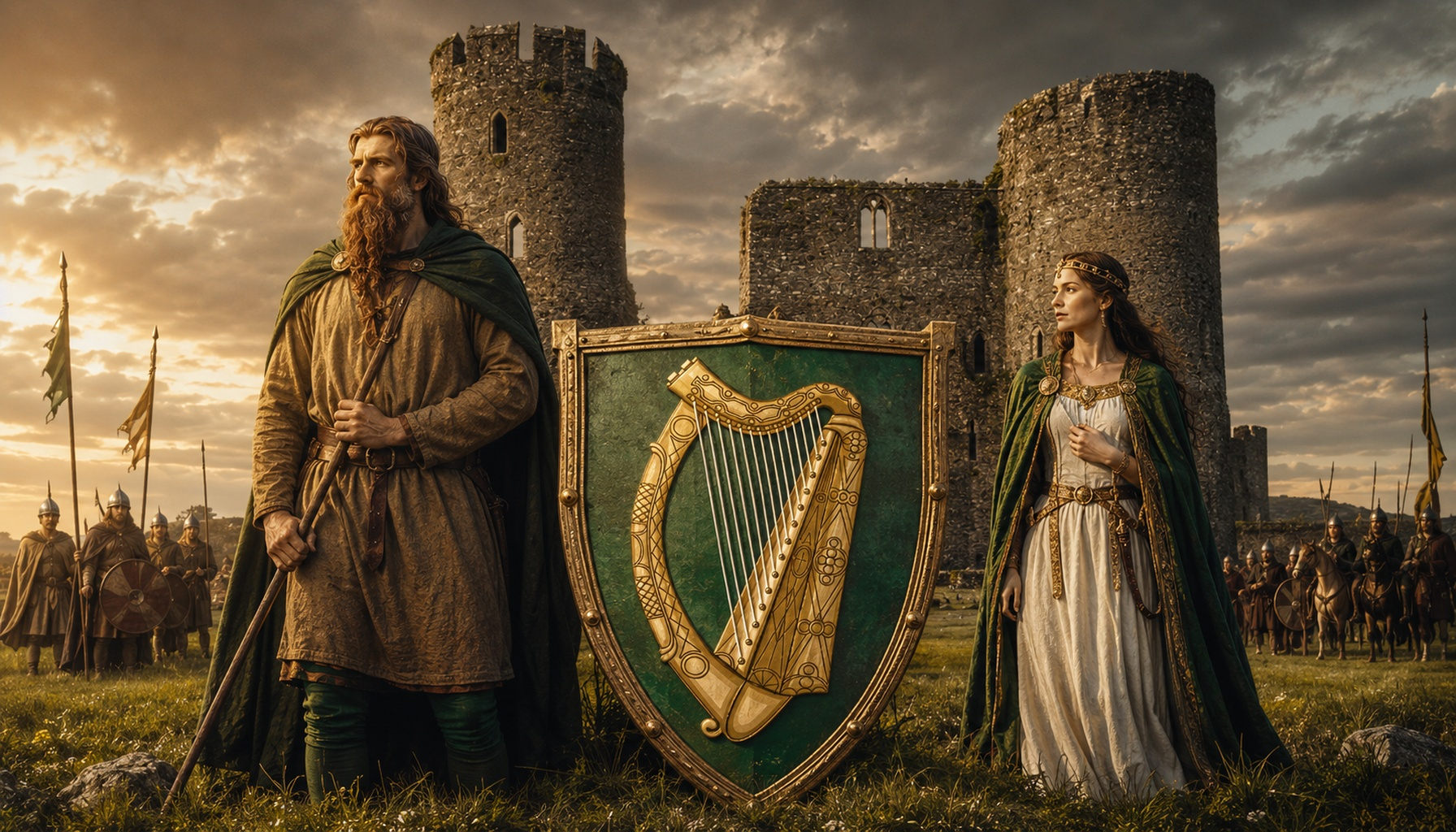
Clan Laigin was not a later medieval surname-clan in the familiar sense, but a much older Gaelic Irish lineage identity tied to the people of Leinster in eastern Ireland. Their name survives in the province itself: Laigin gave us Leinster, which is one of those splendid reminders that in early Ireland, ancestry, territory, and political identity were deeply entangled. Linked here with the haplogroup R1b1a1b1a1a2c1a1a1a1a1, Clan Laigin belongs to that older world of regional peoples, remembered less through a single modern surname than through a whole landscape of kinship, origin legends, and ancestral continuity.
Historically, the Laigin represent a very ancient layer of Irish identity: not simply a family, but a peoplehood. In early Gaelic tradition, belonging was rooted in descent, land, and collective memory, and the Laigin were one of the great provincial populations whose presence shaped the political and cultural map of Ireland. Their heritage evokes the old tribal traditions of Leinster, where local dynasties, warrior elites, and sacred kingship all sat within a larger regional identity. Among the memorable figures associated with this tradition is Labraid Loingsech, remembered in Irish legend as a High King of Ireland and placed in some traditional reckonings around 369. Whatever the exact chronology, he stands as a striking emblem of how the Laigin were woven into Ireland's deep historical imagination.
A useful anchor for understanding this world is Rathcroghan, one of the great royal landscapes of ancient Ireland, in County Roscommon. Although better known as a Connacht ceremonial center than a Leinster one, it helps us grasp the sort of political and ritual environment in which identities like the Laigin were formed and remembered. Rathcroghan is not just a single monument, but a whole archaeological complex of earthworks, burial mounds, enclosures, and ceremonial sites spread across the landscape. It is bound up with early Irish kingship, assembly, myth, and the Otherworld, and it appears prominently in the medieval tales, especially those linked with Queen Medb and the Tain. In other words, this is exactly the kind of place that lets us see how ancient Irish lineage identities were embedded in land and story as much as in bloodline. The site and its wider complex can still be visited today, and it remains one of the most atmospheric places in Ireland for anyone wanting to stand inside the older tribal and royal past.
From a DNA perspective, the haplogroup R1b1a1b1a1a2c1a1a1a1a1 links Clan Laigin to a wider network of ancient and medieval samples across Ireland and beyond, though of course these are related or linked comparisons rather than proof of direct descent from any one individual. Among relevant examples are Medieval Ireland Kilteasheen Roscommon Bishops Seat samples KIL033, KIL037, and KIL009, which help place this lineage within the genetic landscape of Gaelic Ireland. Further linked samples include Bronze Age Austria Drasenhofen DSH008, the Gallic Cenomani Tribe horse co-burial from Verona Seminario Vescovile 3232s, Late Iron Age West Yorkshire Wattle Syke I14347, Iron Age Long Bredy Dorset England I27382, Iron Age Briton Thornholme East Riding of Yorkshire I22060, Iron Age Chemin de Coupetz Marne France I19359, Viking Age Hofstadir Iceland VK95, Viking Age Faroe Islands Panum VK24, Medieval Age Faroe Islands Sandoy Church VK44, and Viking Iceland FOV-A1. Taken together, these linked results show how lineages associated with Atlantic and northwestern European populations could persist and travel across centuries, while still finding a particularly resonant home in the enduring Gaelic heritage of Ireland.
If you want to see how your own DNA may connect with ancient Ireland, Leinster heritage, and linked haplogroups like R1b1a1b1a1a2c1a1a1a1a1, upload your results to MyTrueAncestry and explore the deeper story behind your family history.
Comments