Clan Napier
– 2 min read


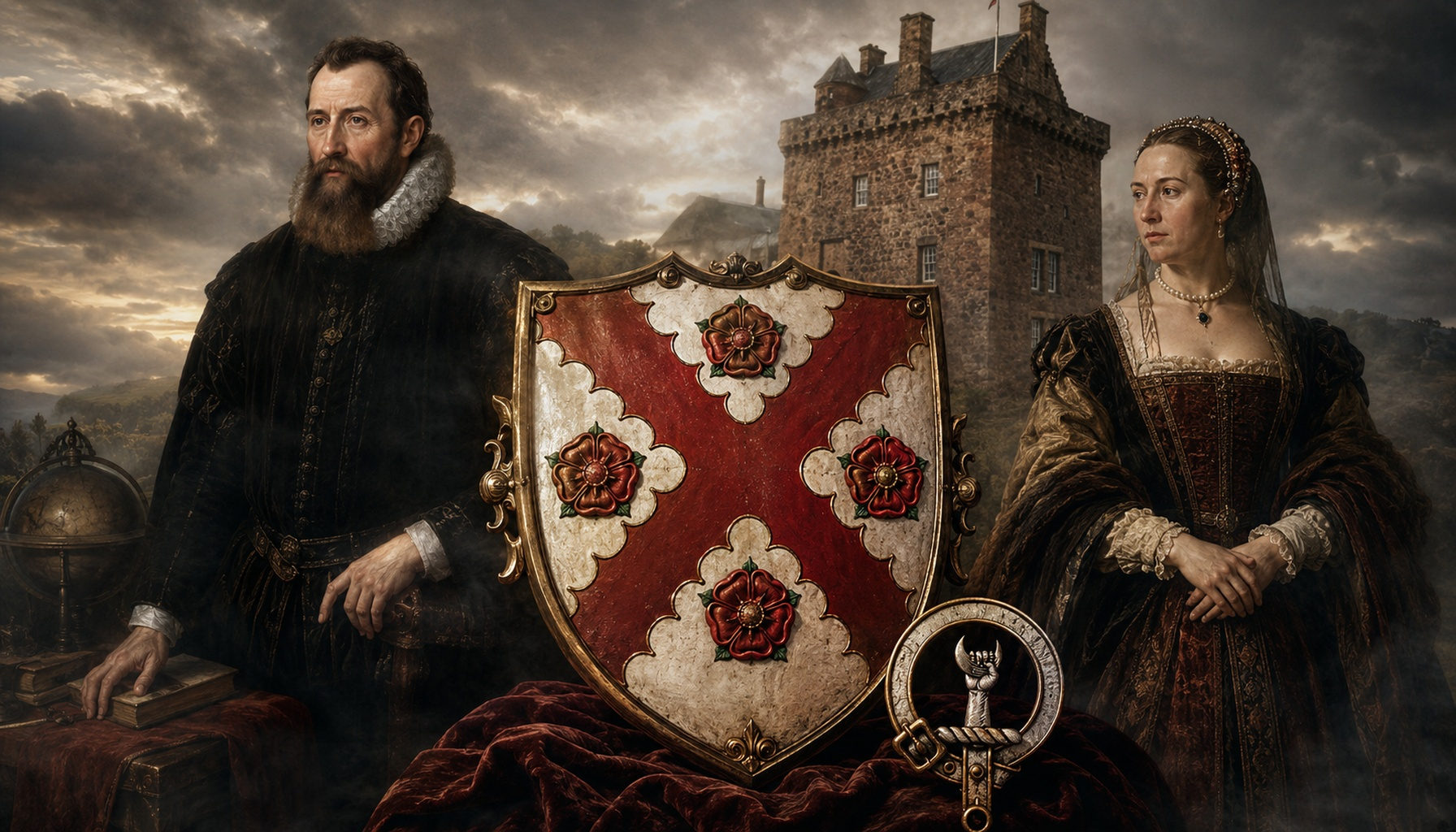
Clan Napier was one of Scotland's notable Lowland families, rooted above all in the Lennox and in Merchiston near Edinburgh, and remembered not just for land and arms but for brains. Their heritage sits firmly in that very Scottish overlap of estate identity, public duty, heraldry, military service, and learned ambition. If some clans are remembered for border raids or Highland battle-cries, the Napiers are remembered just as much for books, offices, and ideas. Their primary family haplogroup is linked here as R1b1a1b1a1a2c1a1e1, a branch associated in wider ancient DNA comparisons with many individuals from later prehistoric and historic western Europe.
The surname itself is old in Scottish record, and the family rose within the world of medieval and early modern Lowland society, where landholding families often moved easily between the court, the law, the kirk, and the battlefield. The Napiers became especially associated with Merchiston, and through that base developed a reputation as a family of consequence in Scottish civic life. Their most famous son, of course, was John Napier of Merchiston, the mathematician who introduced logarithms, which is not a bad family calling card to leave to history. Even later figures such as Sir Archibald Napier of Merchiston, noted in 1625, show the continuity of the house as a landed and publicly engaged family rather than a brief flash in the record.
Merchiston Tower is the great location anchor for Napier history, and it tells the story beautifully. Originally a fortified tower house, probably founded in the 15th century and later enlarged, it stood to the southwest of old Edinburgh and served as the seat of the Napiers of Merchiston. This was not simply a defensive lump of stone, though it certainly had the stern practicality of a Scottish tower house; it was also the family setting for scholarship, estate management, and status. John Napier was born there in 1550, which gives the place the rather enviable distinction of being associated with one of the most important mathematical minds in European history. Today the tower survives within the campus of Edinburgh Napier University, restored and incorporated into later buildings, so yes, it can still be visited in a reasonable sense as a surviving historic site with strong Napier associations.
On the ancient DNA side, the haplogroup link R1b1a1b1a1a2c1a1e1 connects Clan Napier's profile to a broad and interesting scatter of related ancient samples rather than to any proved single ancestor. These include Roman Era England Knobbs Farm Somersham (KNF006), numerous Celtic Durotriges individuals from Duropolis at Winterborne Kingston such as WBK12, WBK20, WBK29, WBK41, WBK05, WBK30, WBK43, WBK06, WBK08, WBK18, and WBK191, as well as samples from Bronze Age Orkney at Links of Noltland (KD061), Bronze Age South Lanarkshire at Boatbridge Quarry (I5473), Celtic Briton Oxfordshire Yarnton (I21182), Iron Age Somerset Worlebury (I11991), Iron Age Battlesbury Bowl (I21309), Bell Beaker and Bronze Age southern England, Copper Age Ireland Rathlin2B, and even later historic individuals from Croatia, Hungary, Belgium, Germany, Austria, Portugal, and Viking Age Iceland. The point is not direct descent from any named skeleton, which would be far too neat for real history, but that this paternal line sits within a very old western European story stretching from Bronze Age and Iron Age Britain into the Roman and medieval worlds.
Explore Ancient DNA in Post-Roman Britain
If you carry Napier heritage, or simply suspect a connection to this learned and landed Scottish family, uploading your DNA can help place your story in a much deeper landscape of clan history and ancient population links. You may find matches to the Napier family profile or to related ancient DNA samples that illuminate the older background behind your paternal line.



Comments